Good writing isn’t just about choosing the right words. It’s also about connecting ideas in a way that helps readers follow your thoughts without getting lost. That’s where on the other hand transition words come in handy. They help you introduce a contrasting opinion, present another perspective, or show that a situation has a different side worth considering.
Whether you’re writing a school essay, preparing a business report, or creating content for a website, knowing how to use contrast transitions can make your writing clearer and more engaging. Although “on the other hand” is a familiar expression, repeating it too often can make your sentences feel predictable.
In this guide, you’ll discover useful alternatives to “on the other hand,” learn when to use each expression, and see practical examples that show how these transition words work in different contexts.
What Are On the Other Hand Transition Words?
On the other hand transition words are expressions that connect ideas by highlighting a contrast, difference, or alternative perspective. They help readers understand that the next statement differs from, qualifies, or provides another angle on the previous point.
For example:
“Working from home saves commuting time. On the other hand, some employees miss the social interaction of an office.”
The transition signals that the second sentence introduces a contrasting consideration rather than continuing the same argument.
These expressions are particularly useful in:
- Academic essays and research papers
- Compare-and-contrast assignments
- Business reports and professional emails
- Opinion articles and persuasive writing
- Everyday conversations and discussions
- Blog posts and informational content
The best transition depends on the relationship between your ideas. Some expressions emphasize a direct contradiction, while others simply introduce a different possibility.
Best On the Other Hand Transition Words and Alternatives
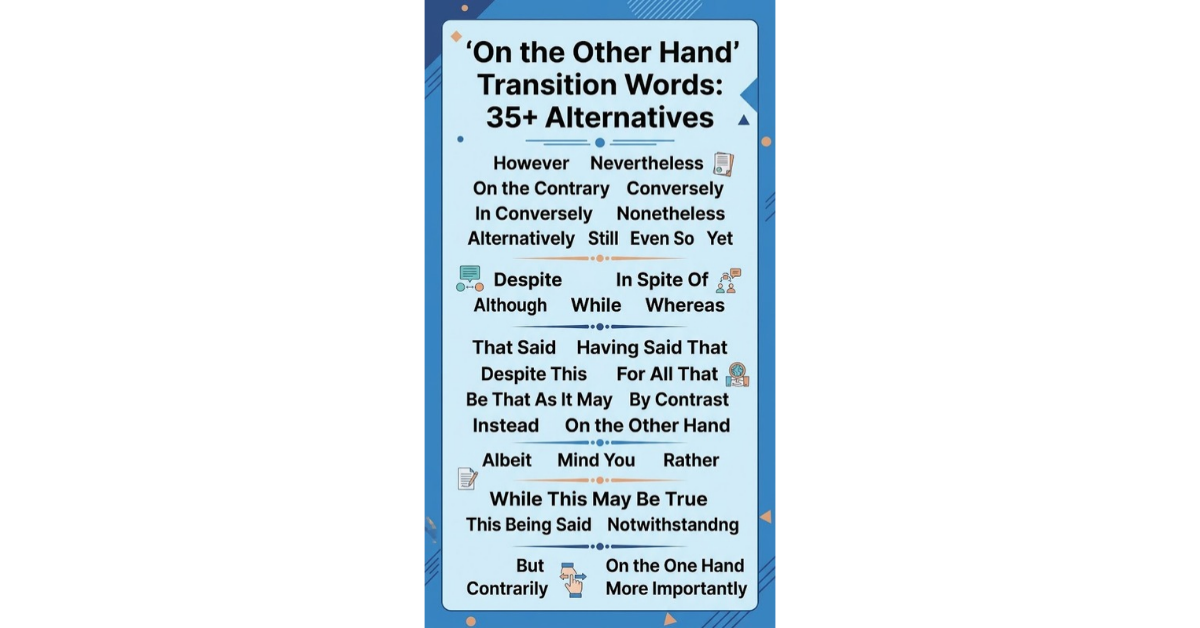
If you’re looking for another way to say “on the other hand,” the following expressions can help you vary your writing without losing your intended meaning.
| Transition Word or Phrase | Best Use | Example |
| However | General contrast | The plan is affordable. However, it requires more time. |
| In contrast | Highlighting differences | City life is busy. In contrast, rural life is often quieter. |
| Conversely | Showing an opposite relationship | Demand increased last year. Conversely, supply declined. |
| Nevertheless | Introducing a contrasting point despite a difficulty | The task was challenging. Nevertheless, she completed it. |
| Nonetheless | Similar to nevertheless | The evidence was limited. Nonetheless, the results were useful. |
| By contrast | Comparing two different situations | The first model is expensive. By contrast, the second is affordable. |
| Alternatively | Presenting another option | We could drive. Alternatively, we could take the train. |
| That said | Adding a qualification | The apartment is small. That said, its location is excellent. |
| Even so | Showing contrast despite a fact | It was raining. Even so, the event continued. |
| Still | Introducing a contrasting consideration | The job is demanding. Still, the experience is valuable. |
| Yet | Introducing an unexpected contrast | He was tired, yet he kept working. |
| Whereas | Comparing contrasting facts | Maya prefers tea, whereas Alex prefers coffee. |
| While | Showing contrast between two facts | While the first option is cheaper, the second lasts longer. |
| On the contrary | Correcting or directly opposing an earlier statement | The change did not weaken the system. On the contrary, it improved security. |
| Instead | Replacing one action or choice with another | We didn’t cancel the meeting. Instead, we moved it online. |
| In comparison | Comparing two things | In comparison, the newer model uses less energy. |
| Unlike | Highlighting a difference | Unlike its predecessor, the new device is lightweight. |
| At the same time | Acknowledging another consideration | The proposal is ambitious. At the same time, it carries risks. |
| Having said that | Qualifying a previous statement | The software is easy to use. Having said that, it lacks advanced features. |
| Despite this | Contrasting with a preceding fact | Sales declined. Despite this, profits remained stable. |
Quick tip: These phrases aren’t always interchangeable. For example, “on the contrary” generally challenges or corrects a previous statement, while “alternatively” introduces another choice. Select the expression that matches the relationship between your ideas.
On the Other Hand Transition Words for Essays
Academic writing often requires you to examine different perspectives before reaching a conclusion. Contrast transitions help you build balanced arguments and show that you’ve considered more than one side of an issue.
Here are some useful expressions for essays and research papers.
1. However
“However” is one of the most versatile contrast transitions. It works well when the next sentence presents a limitation, disagreement, or unexpected detail.
Example:
“Online education provides flexibility for students. However, some learners struggle without direct classroom interaction.”
Use it when you want a clear, straightforward transition without making your writing sound overly formal.
2. Nevertheless
“Nevertheless” emphasizes that something remains true despite an obstacle or opposing fact.
Example:
“The study included a relatively small sample. Nevertheless, its findings offer useful insights for future research.”
This transition is particularly helpful when acknowledging a limitation without dismissing the main point.
3. Conversely
“Conversely” works when the next statement presents an opposite or reverse relationship.
Example:
“Consumers tend to spend more when confidence is high. Conversely, spending may decline when economic uncertainty increases.”
It’s useful in analytical essays, reports, and discussions involving trends or relationships.
4. In Contrast
“In contrast” draws attention to a clear difference between two people, situations, objects, or ideas.
Example:
“Traditional classrooms provide face-to-face interaction. In contrast, online courses allow students to learn from different locations.”
Use this expression when comparing two distinct features or outcomes.
5. That Said
“That said” is a natural transition that acknowledges a previous point before introducing a qualification or different perspective.
Example:
“The restaurant is more expensive than its competitors. That said, the food quality and service may justify the price.”
It works especially well in conversational essays, reviews, blog posts, and opinion writing. In highly formal academic writing, “however” or “nevertheless” may be a better fit.
Formal Alternatives to On the Other Hand
When writing a dissertation, research paper, professional report, or formal letter, you may prefer transitions that sound precise and objective.
Consider these options:
- Conversely: When presenting a reverse relationship.
- In contrast: When highlighting a difference.
- Nevertheless: When acknowledging an obstacle but maintaining the main point.
- Nonetheless: When introducing a contrasting idea that remains valid.
- Notwithstanding this: When indicating that a point remains true despite a preceding consideration.
- By comparison: When drawing attention to differences between two subjects.
- In comparison: When evaluating one subject in relation to another.
- Whereas: When contrasting two facts within a sentence.
- Despite this: When introducing an outcome that differs from what might be expected.
- Alternatively: When presenting a different approach or option.
Formal Transition Examples
Example 1: Research writing
“The intervention improved short-term performance. Nevertheless, its long-term effects remain uncertain.”
Example 2: Business reporting
“Operating costs increased during the quarter. By comparison, revenue growth remained relatively modest.”
Example 3: Academic comparison
“Method A requires less preparation, whereas Method B provides more detailed results.”
Example 4: Presenting another option
“The company could expand its existing facility. Alternatively, it could outsource part of its production.”
The important thing is to use transitions that express the exact relationship between your claims rather than choosing formal-sounding words simply to make your writing appear sophisticated.
Informal and Conversational Alternatives to On the Other Hand
Not every piece of writing needs to sound academic. In blogs, personal essays, social media posts, and everyday conversations, a more relaxed transition often feels natural.
Here are some conversational alternatives:
| Transition | Example |
| That said | The phone is expensive. That said, the camera is excellent. |
| Still | I understand your concerns. Still, I think we should try. |
| Even so | The journey was long. Even so, we enjoyed it. |
| Then again | The house is beautiful. Then again, the rent is high. |
| At the same time | The job pays well. At the same time, it demands long hours. |
| Mind you | The restaurant is small. Mind you, the food is outstanding. |
| On the flip side | The city offers great opportunities. On the flip side, living costs are high. |
| Having said that | The course is challenging. Having said that, it’s worth the effort. |
“On the flip side” and “then again” are especially common in casual conversation. However, they may be less suitable for formal academic assignments or highly structured business documents.
Writing tip: Match your transition to your audience. A friendly blog post can benefit from conversational language, while a scientific paper usually calls for more precise and formal expressions.
On the Other Hand vs. However vs. Conversely
These three expressions are related, but each serves a slightly different purpose.
| Expression | Main Purpose | Example |
| On the other hand | Presents another side or perspective | The job pays well. On the other hand, the hours are long. |
| However | Introduces a contrast or qualification | The job pays well. However, the hours are long. |
| Conversely | Shows an opposite or reverse relationship | Costs increased. Conversely, demand declined. |
When Should You Use “On the Other Hand”?
Use “on the other hand” when you want to explore another side of a situation, especially when discussing advantages and disadvantages.
For example:
“Buying a car gives you greater independence. On the other hand, owning one involves maintenance and insurance costs.”
When Should You Use “However”?
Use “however” when you need a concise, flexible transition that introduces a limitation, contrast, or qualification.
For example:
“The car is affordable. However, it has limited cargo space.”
When Should You Use “Conversely”?
Use “conversely” when the second statement reflects an opposite pattern or relationship.
For example:
“When prices fall, demand may increase. Conversely, rising prices may reduce demand, depending on the market.”
The distinction matters because using the wrong transition can make a sentence sound awkward or suggest a relationship that isn’t actually present.
How to Use On the Other Hand in a Sentence
The expression “on the other hand” can appear at the beginning of a sentence or clause to introduce a contrasting point.
1. At the Beginning of a Sentence
This is the most familiar construction.
Example:
“Living in a large city provides access to more career opportunities. On the other hand, housing can be expensive.”
The transition makes the contrast between the two statements clear.
2. When Comparing Advantages and Disadvantages
Use the phrase when discussing both the positive and negative aspects of a decision.
Example:
“Working remotely saves commuting time. On the other hand, it may reduce opportunities for in-person collaboration.”
This structure works particularly well in persuasive essays, product reviews, and decision-making articles.
3. When Presenting an Alternative Perspective
The expression can also introduce a viewpoint that differs from the first one.
Example:
“Some people believe standardized tests provide a fair way to evaluate students. On the other hand, others argue that these tests fail to measure creativity and practical skills.”
This approach allows you to acknowledge competing opinions before explaining your own position.
4. When Writing About Complex Issues
For complicated topics, a contrast transition can help you move from one consideration to another without suggesting that the first point is completely wrong.
Example:
“Artificial intelligence can automate repetitive tasks. On the other hand, organizations must consider privacy, accuracy, and the impact on workers.”
This is useful when a subject has benefits and drawbacks that deserve equal attention.
Punctuation Rules for On the Other Hand
Correct punctuation helps your transitions fit naturally into a sentence. The phrase “on the other hand” is commonly followed by a comma when it introduces a sentence.
Correct:
“The proposal could save money. On the other hand, it might take longer to implement.”
You can also use the expression within a sentence:
“The proposal, on the other hand, might take longer to implement.”
When connecting two independent clauses with a semicolon, you can write:
“The proposal could save money; on the other hand, it might take longer to implement.”
Remember these basic rules:
- Use a comma after “on the other hand” when it begins a sentence or independent clause.
- Use commas around the phrase when it interrupts a sentence and functions as a parenthetical transition.
- Avoid joining two complete sentences with only a comma. Use a period or semicolon where appropriate.
These punctuation guidelines make your writing easier to read and help readers recognize where one idea ends and another begins.
Common Mistakes When Using Contrast Transition Words
Even experienced writers sometimes choose transitions that don’t accurately describe the relationship between their ideas.
Here are a few mistakes to watch for.
Confusing “On the Other Hand” With “On the Contrary”
These phrases serve different purposes.
“On the other hand” presents another perspective, while “on the contrary” directly challenges or corrects an earlier statement.
For example:
- On the other hand: “The apartment is affordable. On the other hand, it’s far from work.”
- On the contrary: “I don’t dislike the apartment. On the contrary, I think it’s excellent.”
Using “on the contrary” simply to introduce any disadvantage can make your meaning confusing.
Using Too Many Transitions
Transitions improve flow, but inserting one into every sentence can make writing repetitive.
Instead of writing, “The plan is affordable. However, it takes time. Moreover, it requires extra staff. On the other hand, it offers benefits,” consider combining related points and using only the transitions that genuinely help the reader.
Choosing a Transition That Doesn’t Fit
“Alternatively” introduces another option, while “nevertheless” indicates that a statement remains true despite a difficulty. They aren’t interchangeable.
Before selecting a transition, ask yourself whether you are showing a contrast, correcting a claim, acknowledging a limitation, or presenting a new choice.
Repeating the Same Phrase
Using “on the other hand” repeatedly can make an essay feel monotonous. Vary your wording with alternatives such as “however,” “in contrast,” “that said,” or “conversely,” whenever their meanings fit.
Practical Tips for Choosing the Right Transition Word
If you’re unsure which expression to use, follow this simple process:
- Identify the relationship between your ideas. Are you showing a difference, an opposing view, an exception, or another option?
- Consider your audience. Formal reports generally benefit from precise language, while personal writing can use more conversational phrases.
- Check the meaning. Make sure the transition communicates the relationship you intend.
- Read the sentence aloud. If the wording sounds unnatural, a simpler transition may work better.
- Remove unnecessary transitions. If the connection between two sentences is already obvious, you may not need one at all.
Good transitions should guide readers through your reasoning rather than distract them from the message.
Frequently Asked Questions
1. What are the best alternatives to “on the other hand”?
Common alternatives include “however,” “in contrast,” “conversely,” “nevertheless,” “nonetheless,” “that said,” and “by contrast.” The best choice depends on whether you want to present a different perspective, highlight a difference, or acknowledge a limitation.
2. Is “on the other hand” a transition word?
Yes. More precisely, it is a transitional phrase because it contains multiple words. It connects ideas by introducing another perspective, contrast, or consideration.
3. Can I use “however” instead of “on the other hand”?
Often, yes. Both expressions can introduce contrasting ideas, but “on the other hand” more explicitly signals another side of an issue, while “however” is a broader transition that can introduce a qualification or unexpected result.
4. What is a formal way to say “on the other hand”?
“In contrast,” “conversely,” “nevertheless,” “nonetheless,” and “by comparison” are useful formal alternatives. Choose the one that most accurately reflects the relationship between your statements.
5. What is an informal way to say “on the other hand”?
Conversational alternatives include “that said,” “then again,” “still,” “even so,” and “on the flip side.” These work well in casual discussions, personal writing, and many blog posts.
6. Is “on the contrary” the same as “on the other hand”?
No. “On the contrary” usually corrects or directly opposes a previous statement, while “on the other hand” introduces a different perspective. For instance, use “on the contrary” when you want to reject an assumption, not merely present a disadvantage.
7. Should “on the other hand” be followed by a comma?
Usually, yes, when the phrase begins a sentence or independent clause: “On the other hand, the alternative is less expensive.” When the phrase appears in the middle of a sentence, commas can set it apart from the surrounding text.
8. Can I start an essay paragraph with “on the other hand”?
Yes. Starting a paragraph with “on the other hand” is appropriate when the paragraph introduces a contrasting perspective that connects clearly to the previous discussion. Make sure the contrast is meaningful and that the paragraph develops the new point rather than merely repeating earlier information.
Conclusion
Using on the other hand transition words effectively can make your writing clearer, more balanced, and easier to follow. Expressions such as “however,” “in contrast,” “conversely,” “nevertheless,” and “that said” provide useful alternatives, but each has a slightly different purpose.
The key is to choose a transition that accurately reflects the connection between your ideas. Use formal expressions in academic and professional writing when appropriate, choose conversational alternatives for a relaxed tone, and avoid repeating the same phrase unnecessarily.
With a little practice, you’ll be able to move between contrasting ideas smoothly and communicate your arguments with greater confidence. Explore other guides to transition words, linking phrases, and commonly confused expressions to keep strengthening your writing skills.