Have you ever wondered whether to write bale or bawl? These two English words sound exactly alike in most accents, but their meanings are completely different. Choosing the wrong one can change the meaning of your sentence, especially when you’re writing about farming, crying, or making a loud noise.
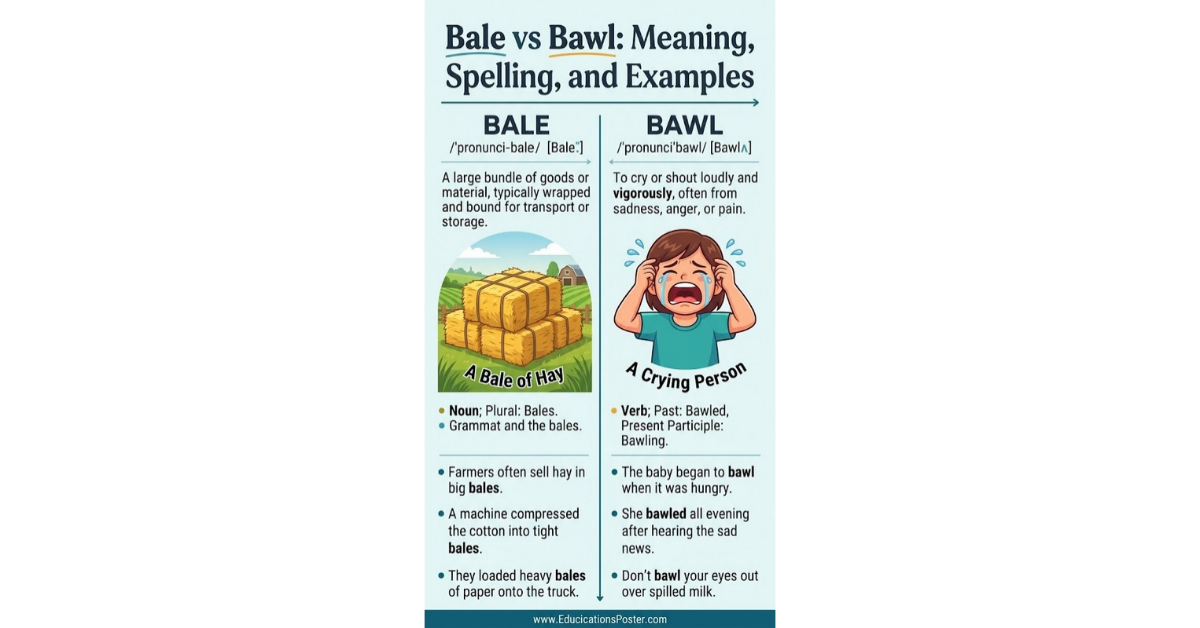
The difference between bale vs bawl comes down to how each word is used. A bale is a tightly packed bundle of material, such as hay, straw, or cotton, while bawl means to cry loudly or shout in a forceful voice.
Both words are pronounced the same way, making them examples of homophones. In this guide, you’ll learn their definitions, grammatical uses, example sentences, and simple tricks to remember the correct spelling.
Bale vs Bawl: What Is the Difference?
The main difference between bale and bawl is their meaning and function in a sentence. Although they share the same pronunciation, they refer to entirely different things.
| Word | Meaning | Part of Speech | Example |
| Bale | A tightly compressed bundle of material | Noun; sometimes verb | The farmer loaded a bale of hay onto the truck. |
| Bawl | To cry loudly or shout | Verb; sometimes noun | The toddler began to bawl after falling down. |
Quick rule to remember:
- Bale is associated with bundles, farming, and compressed materials.
- Bawl is associated with loud crying, shouting, and strong emotions.
If you’re describing something stacked in a barn, bale is probably the word you need. If you’re describing someone crying loudly, use bawl.
What Does Bale Mean?
The word bale usually refers to a large bundle of material that has been compressed and tied or wrapped together for easier storage, handling, or transportation.
Bales are commonly found in agriculture, textile production, recycling, and other industries that handle bulky materials.
Examples of Bale in a Sentence
Here are several examples showing how to use bale correctly:
- The farmer stored a bale of hay in the barn.
- We needed a tractor to move the heavy bale of straw.
- The cotton was compressed into a bale before shipment.
- The recycling facility prepared a bale of cardboard.
- She purchased a bale of fabric for her sewing business.
In each example, bale refers to a bundle of material rather than a sound or an emotional reaction.
What Is a Bale of Hay?
A bale of hay is a bundle of dried grass or other forage plants that has been compressed for storage and feeding livestock. Farmers use hay bales to provide food for animals such as horses, cattle, and sheep.
Bales come in different shapes and sizes. Small rectangular bales are often handled manually, while large round or rectangular bales generally require machinery.
The word bale can also be used as a verb, meaning to form material into bales. For example, “The workers bale the straw after harvesting the field.”
What Does Bawl Mean?
The word bawl means to cry loudly, often with tears, or to shout in a loud, forceful voice. It commonly describes an intense emotional reaction, such as sadness, frustration, anger, or disappointment.
Unlike bale, which usually names a physical object, bawl most often describes an action.
Examples of Bawl in a Sentence
Consider these examples:
- The baby began to bawl when she woke up hungry.
- He started to bawl after hearing the heartbreaking news.
- The coach had to bawl instructions across the noisy field.
- My little brother will bawl if he loses his favorite toy.
- She bawled at the television when her team lost the championship.
These sentences show how bawl can describe either loud crying or loud shouting.
Is Bawl the Same as Cry?
Not exactly. Cry is a broader word that can describe shedding tears, expressing sadness, or making certain sounds. Bawl usually emphasizes the loudness or intensity of the crying.
For example:
- “The child cried quietly in bed.”
- “The child bawled loudly in the supermarket.”
Both sentences describe crying, but bawled suggests a much louder and more forceful reaction.
Similarly, bawl someone out is an informal expression meaning to scold someone angrily or severely. For example, “The manager bawled him out for arriving late.”
Why Are Bale and Bawl Confused?
The main reason people confuse bale and bawl is that they are homophones. Homophones are words that sound alike but have different meanings and spellings.
In most English accents, bale and bawl have the same pronunciation, even though their vowel spellings differ.
English contains many similar word pairs, including:
- Sail and sale: To travel by sail versus an act of selling.
- Flour and flower: A baking ingredient versus a plant’s bloom.
- Knight and night: A historical title versus the period of darkness.
- Right and write: Correctness or direction versus putting words on paper.
- Bale and bawl: A bundle of material versus loud crying or shouting.
Because pronunciation alone cannot tell you which spelling is correct, you need to consider the meaning of the sentence.
Bale vs Bawl: Pronunciation Guide
Both bale and bawl are pronounced alike in most varieties of English.
A simple pronunciation guide is:
- Bale: /beɪl/
- Bawl: /bɔːl/ in accents that distinguish the vowel; in many other accents, it is pronounced like bale.
Pronunciation varies by region. In accents with the cot-caught distinction, bawl may have a different vowel sound from bale. In many accents without that distinction, the two words sound identical.
This regional variation explains why some speakers can hear a difference while others cannot. Regardless of pronunciation, the spelling depends on the intended meaning.
Easy Tricks to Remember Bale vs Bawl
If you often mix up these words, a few simple memory tricks can help.
1. Connect Bale With Bundle
Think of the word bale as part of the phrase “bale of hay.” Both words are associated with farms, fields, and stored crops.
Whenever you picture a tightly packed bundle of straw, cotton, or cardboard, remember the spelling b-a-l-e.
2. Connect Bawl With Loud Crying
Think of bawl as a word for a big, loud cry. The double-purpose association with shouting and crying can help you remember that b-a-w-l describes a sound or action.
For example, if someone is sobbing loudly or yelling across a room, bawl is the appropriate word.
3. Check the Meaning Before the Spelling
When you’re unsure, ask yourself what the sentence describes:
- Is it talking about a bundle of material? Use bale.
- Is it describing loud crying or shouting? Use bawl.
- Does neither meaning fit? Consider whether a different word is needed.
This quick check is especially helpful when proofreading emails, essays, social media posts, and other everyday writing.
Bale vs Bawl: Common Grammar Mistakes
Although both words are easy to pronounce, their grammatical uses differ.
Using Bale Correctly
Bale is commonly used as a noun:
- “The bale of cotton was ready for transport.”
- “Three bales of hay were stored in the shed.”
It can also function as a verb:
- “The machine will bale the straw.”
- “Workers bale recyclable paper into compact bundles.”
Using Bawl Correctly
Bawl is most often used as a verb:
- “The baby bawls whenever she’s hungry.”
- “He bawled when he learned the disappointing news.”
- “The supervisor bawled at the workers to get their attention.”
It can also be used as a noun, although this usage is less common. For example, “The child let out a loud bawl.”
What Are the Past Tense Forms?
Both words can be used as verbs, but their past-tense forms retain their different spellings:
| Base Word | Past Tense | Example |
| Bale | Baled | The workers baled the straw yesterday. |
| Bawl | Bawled | The child bawled for several minutes. |
A useful distinction is that baled refers to forming or packaging material into bales, while bawled refers to crying loudly or shouting.
Frequently Asked Questions About Bale vs Bawl
1. Is it bale or bawl when someone cries loudly?
The correct word is bawl. For example, “The child began to bawl when his parents left the room.” Bale refers to a compressed bundle of material, not crying.
2. Is bale or bawl used for hay?
Use bale when referring to hay. A bale of hay is a compressed bundle of dried grass used mainly as animal feed.
3. Are bale and bawl homophones?
Yes, they are homophones in many English accents because they are pronounced the same way despite having different spellings and meanings. Some regional accents pronounce their vowels differently.
4. What does bawling mean?
Bawling means crying loudly or shouting forcefully. For example, “The baby was bawling because she was tired.”
5. What is the plural of bale?
The plural of bale is bales. For example, “The farmer stacked several bales of straw beside the barn.”
6. Can bawl mean shouting?
Yes. Bawl can mean shouting loudly, especially when someone is angry or trying to be heard over a distance. The phrase “bawl someone out” means to scold that person severely.
7. How do you remember the difference between bale and bawl?
Remember bale = bundle and bawl = loud cry. Connecting each word with a familiar image makes it easier to choose the correct spelling.
Conclusion
Understanding bale vs bawl is simple once you connect each word to its meaning. Bale refers to a tightly packed bundle of material, such as hay, cotton, or paper, while bawl means to cry loudly or shout forcefully.
Although these words sound alike in many English accents, they cannot be used interchangeably. Remember the simple trick—bale for bundles, bawl for loud crying—and you’ll be much less likely to make this common spelling mistake.
If you want to strengthen your vocabulary further, explore other commonly confused English words and homophones to make your everyday writing clearer and more accurate.