Have you ever typed the word cancellation and wondered whether it should have one L or two? You’re not alone. The spelling difference in cancellation vs cancelation can be confusing, especially because English uses different rules for words such as canceled and cancelled.
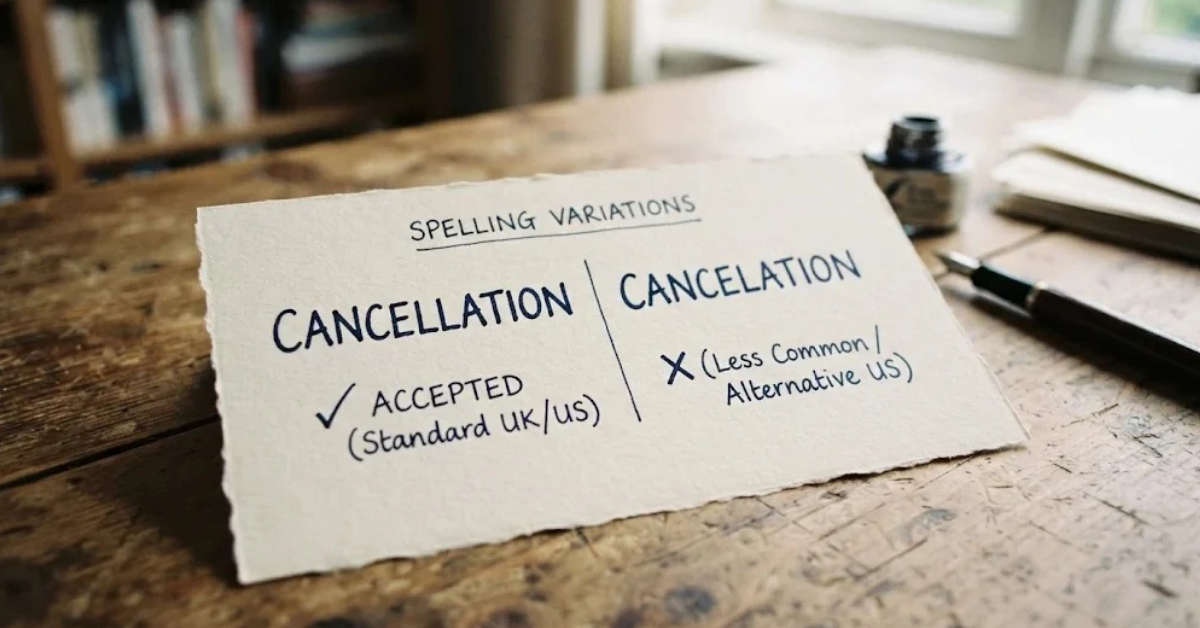
The good news is that both cancellation and cancelation are accepted spellings. However, they aren’t equally common. Cancellation, with two Ls, is the standard and widely preferred spelling in both American and British English. Cancelation, with one L, is a less common variant used mainly in American English.
Let’s look at the difference, understand why both spellings exist, and find out which version you should use in professional and everyday writing.
Cancellation vs Cancelation: The Main Difference
The main difference between cancellation and cancelation is the number of Ls.
- Cancellation: The standard and much more common spelling, with two Ls.
- Cancelation: A less common alternative spelling, with one L.
Both words have exactly the same meaning. They refer to the act of canceling something, such as an appointment, reservation, event, subscription, order, or agreement.
For example:
- The airline announced the cancellation of several flights.
- The airline announced the cancelation of several flights.
Both sentences are understandable and grammatically acceptable, but the first uses the spelling most readers expect.
| Feature | Cancellation | Cancelation |
| Number of Ls | Two | One |
| Meaning | The act of canceling | The act of canceling |
| Pronunciation | Same | Same |
| Usage | Standard and widely preferred | Less common variant |
| American English | Common | Accepted but uncommon |
| British English | Standard spelling | Not the usual form |
The easiest rule to remember: When writing for a general audience, choose cancellation.
Is Cancellation or Cancelation Correct?
Both spellings are correct, but cancellation is the better choice in almost every situation.
Major English dictionaries recognize cancellation as the standard spelling. Some dictionaries also record cancelation as a variant, particularly in American English.
The important point is that the one-L spelling isn’t necessarily a spelling mistake. It is simply much less common.
If you’re writing any of the following, cancellation is the safer option:
- Business emails and formal letters
- Academic assignments
- News articles and blog posts
- Customer service messages
- Travel and booking policies
- Legal or administrative documents
Consistency is also important. If a publication or organization has a house style, follow its preferred spelling throughout the document.
Why Does Cancellation Have Two Ls?
The spelling becomes easier to understand when you look at the word cancel and how English forms nouns.
The word cancellation is formed from cancel and the noun-forming suffix -ation. The standard spelling retains the double L before the ending:
Cancel + -ation = Cancellation
The less common form, cancelation, uses a simplified single-L spelling.
English spelling isn’t always perfectly consistent, which is why the noun cancellation has two Ls even though American English commonly uses the single-L spelling canceling for the verb form.
This difference can seem strange at first, but it is an established feature of modern English usage.
Cancellation vs Cancelation in American English
American English is known for using single-L spellings in certain words when a suffix is added.
For example:
- Canceling
- Canceled
- Traveling
- Traveled
- Modeling
- Modeled
However, the noun cancellation is commonly spelled with two Ls in the United States.
This is where many writers become confused. They see canceled with one L and assume that its related noun should also be cancelation.
That assumption doesn’t reflect standard usage. American dictionaries and publications commonly use cancellation.
American English Examples
- The customer requested the cancellation of the order.
- We received a notification about the cancellation of the meeting.
- The airline confirmed the cancellation of the flight.
- The company introduced a new subscription cancellation policy.
Although cancelation may appear in American writing, the double-L version is the more familiar choice.
Cancellation vs Cancelation in British English
In British English, cancellation is the established spelling.
British English generally doubles the final L in words such as cancelled, cancelling, travelling, and modelling when adding certain suffixes.
Examples include:
- The concert’s cancellation surprised everyone.
- The hotel confirmed the cancellation of our reservation.
- The customer received an email about the cancellation of the service.
While spelling preferences can vary between publishers, cancellation is the conventional form in British English.
Cancellation vs Cancelation: Pronunciation
Another useful thing to know is that the two spellings are pronounced exactly the same way.
Both are generally pronounced:
kan-suh-LAY-shuhn
The emphasis falls on the third syllable, “LAY.”
The number of Ls in the written word doesn’t change its pronunciation. Whether someone writes cancellation or cancelation, the spoken meaning remains identical.
This is why the difference is a spelling issue rather than a pronunciation or grammar issue.
Cancellation vs Canceling: What’s the Difference?
One common source of confusion is the difference between cancellation and canceling.
Although both words come from the verb cancel, they serve different grammatical purposes.
- Cancellation is a noun. It names the act or result of canceling something.
- Canceling is a verb form. It describes the action of calling something off.
Consider these examples:
| Word | Part of speech | Example |
| Cancel | Verb | I need to cancel my appointment. |
| Canceling | Present participle or gerund | She is canceling the reservation. |
| Canceled | Past tense or past participle | They canceled the event. |
| Cancellation | Noun | The cancellation was unexpected. |
Notice that American English commonly uses canceling and canceled with one L, while British English generally uses cancelling and cancelled with two.
However, cancellation is commonly written with two Ls in both varieties.
Cancellation vs Cancelation Example Sentences
The following examples show how the standard spelling works in everyday situations.
1. Travel and Flight Bookings
- The airline announced the cancellation of the morning flight.
- Passengers received compensation after the flight cancellation.
- We were informed about the cancellation of our hotel booking.
2. Events and Appointments
- The unexpected weather caused the cancellation of the outdoor concert.
- I received a message confirming the cancellation of my appointment.
- The school announced the cancellation of classes for the day.
3. Business and Subscriptions
- The company updated its subscription cancellation policy.
- Customers can request the cancellation of their orders.
- The service provider confirmed the cancellation in writing.
4. Everyday Conversations
- I didn’t expect the cancellation of the weekend plans.
- The event organizer explained the reason for the cancellation.
- We received a full refund after the cancellation.
In all these examples, cancelation could be substituted without changing the basic meaning. However, cancellation remains the more conventional spelling.
Common Spelling Mistakes Related to Cancellation
Writers sometimes make mistakes because English uses different L patterns when forming words from cancel.
Here are a few examples worth remembering:
| Common form | Standard American spelling | Standard British spelling |
| Present tense | Cancel | Cancel |
| Present participle | Canceling | Cancelling |
| Past tense | Canceled | Cancelled |
| Noun | Cancellation | Cancellation |
The key lesson is that you shouldn’t automatically apply the spelling pattern of canceled or cancelled to the noun.
A Simple Memory Trick
If you’re unsure, remember this sentence:
“The cancellation of the event was unexpected.”
The word cancellation has two Ls. Learning it as a complete word is easier than trying to apply the verb’s spelling rules every time you write it.
Which Spelling Should You Use?
If you want your writing to look natural and professional, use cancellation.
It is the most widely recognized spelling and works well in both American and British English. It is also the better choice for SEO articles, formal communication, customer service messages, and general business writing.
Choose cancelation only if you’re following a specific publication’s spelling preference or reproducing a source that uses that variant.
For most writers, there is no practical advantage to choosing the less common spelling.
Frequently Asked Questions About Cancellation vs Cancelation
1. Is cancellation spelled with one L or two?
The standard spelling is cancellation, with two Ls. Cancelation, with one L, is also an accepted but less common variant.
2. Is cancelation a real word?
Yes. Cancelation is a recognized spelling variant, particularly in American English. However, cancellation is much more common and is generally the preferred form.
3. Is cancellation American or British English?
Cancellation is standard in both American and British English. It is the usual spelling in formal writing across both varieties.
4. Why does canceled have one L but cancellation has two?
American English commonly uses canceled with one L, but the conventional noun spelling is cancellation with two. English spelling conventions don’t always apply identically across related word forms.
5. Is cancelation wrong in American English?
Not necessarily. It is an accepted variant, but it is considerably less common than cancellation. Most writers should use the double-L version.
6. Do cancellation and cancelation mean the same thing?
Yes. Both refer to the act or result of canceling something. There is no difference in meaning or pronunciation.
7. Which spelling is better for formal writing?
Cancellation is the better choice. It is widely accepted, familiar to readers, and suitable for academic, professional, and business communication.
8. Is it cancellation policy or cancelation policy?
Cancellation policy is the standard and preferred expression. It refers to the rules and conditions governing how an appointment, booking, order, or service can be canceled.
9. Is it flight cancellation or flight cancelation?
Flight cancellation is the more common and recommended spelling. Airlines, travel publications, and booking communications commonly use this form.
10. How do you remember the correct spelling of cancellation?
Remember that cancellation has two Ls. You can also memorize the phrase “cancellation of plans” to reinforce the standard spelling.
Conclusion
When comparing cancellation vs cancelation, both spellings are acceptable, but they aren’t equally common. Cancellation, with two Ls, is the standard form in American and British English, while cancelation is a less frequently used variant.
The difference doesn’t affect meaning, pronunciation, or grammar. It simply comes down to spelling preference and established usage.
If you want to avoid confusion in emails, articles, academic assignments, or professional documents, stick with cancellation. It’s the most familiar and widely accepted choice. You can also explore related spelling comparisons, such as canceled vs cancelled and traveling vs travelling, to become more confident with English spelling.