Choosing between Ally and Allie might seem like a small decision, but when it comes to names, even a single letter can matter. Both spellings are popular, and both are commonly used as nicknames for longer names such as Alison, Allison, and Alexandra.
So, when comparing Ally vs Allie, which spelling is correct? The answer depends on whether you’re using the word as a name, a nickname, or a common English word. Although the two forms sound identical, they have slightly different associations and uses.
This guide explains the differences between Ally and Allie, their meanings, origins, pronunciation, and how to choose the right spelling for your situation.
Ally vs Allie: Which Spelling Is Correct?
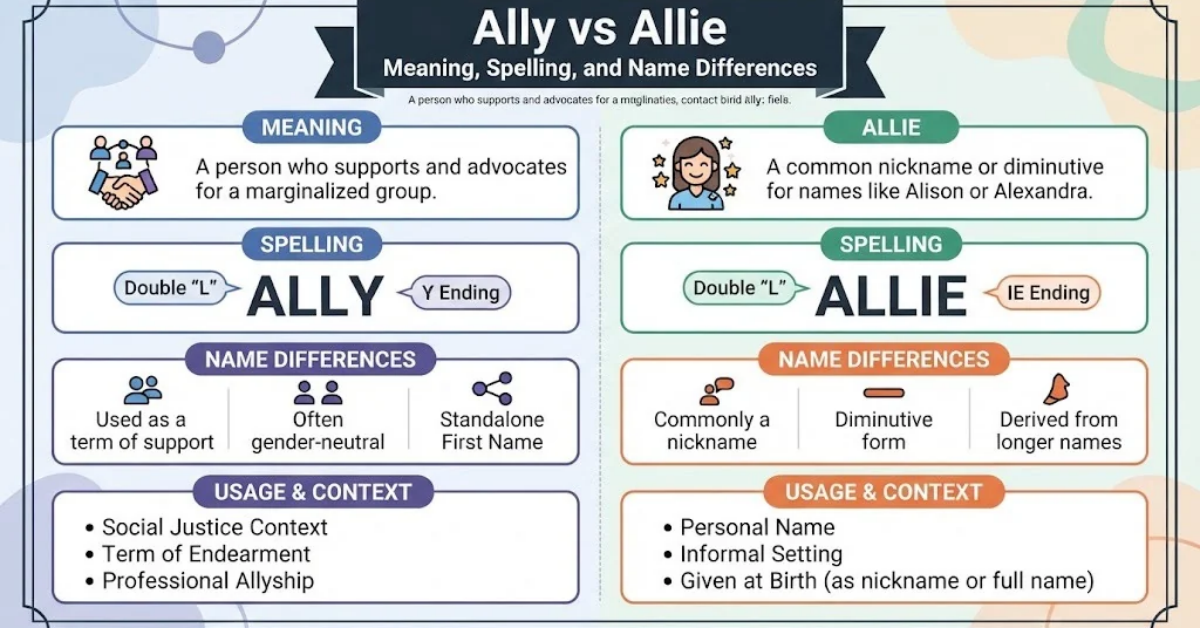
Both Ally and Allie are correct spellings when used as personal names or nicknames. Neither spelling is universally more correct than the other.
The main difference is personal preference and naming tradition.
| Spelling | Correct? | Common Usage |
| Ally | Yes | A nickname, given name, or the English word meaning a supporter |
| Allie | Yes | A nickname or given name, often associated with Alison or Allison |
If you’re referring to a specific person, the correct spelling is whichever version that person uses.
For example, if someone’s name is Allie, writing Ally may be considered incorrect even though both spellings are valid names.
What Does Ally Mean?
The word ally has two common uses: as a personal name and as an ordinary English word.
As a word, an ally is someone who supports, helps, or cooperates with another person, group, or country.
For example:
- “She has always been a loyal ally.”
- “The two countries became allies during the conflict.”
- “A good friend can be an important ally during difficult times.”
The word can also be used as a nickname or given name. In this context, Ally is often a shortened form of Alison, Allison, or Alexandra.
Ally as a Name
Ally is a popular informal name because it is short, friendly, and easy to pronounce.
It is often associated with names such as:
- Alison
- Allison
- Alexandra
- Alexandria
However, Ally can also be a standalone given name rather than a nickname.
What Does Allie Mean?
Allie is primarily used as a personal name or nickname. It is often associated with Alison, Allison, Alexandra, and other names beginning with the “Al” sound.
Unlike the ordinary English word ally, Allie is not the standard spelling of the word meaning a supporter or partner.
For example:
- “Allie is coming to dinner tonight.”
- “I met Allie at school.”
- “Allie has always been a wonderful friend.”
In these sentences, Allie is a person’s name rather than a description of a relationship.
Allie as a Name
Allie has a warm, informal, and affectionate feel. The additional “e” gives it a slightly different visual appearance, although the pronunciation generally remains the same as Ally.
It can be used as:
- A nickname for Alison or Allison
- A nickname for Alexandra or Alexandria
- A standalone first name
- An affectionate name used by friends and family
The spelling Allie is especially familiar in English-speaking countries, although naming preferences vary by family and region.
Ally vs Allie: Meaning and Origin
The two spellings are closely related because both are commonly used as nicknames for longer personal names.
The name Alison is generally understood as a medieval form of Alice. Alice ultimately comes from the Old French name Aalis, which developed from the Germanic name Adalheidis.
The Germanic elements are commonly interpreted as meaning “noble” and “kind” or “type,” giving Alice and related names the traditional meaning “noble” or “of noble kind.”
Allison is another spelling associated with Alison, and Ally and Allie are frequently used as informal versions of both names.
However, when ally is used as an English vocabulary word, its meaning is different. The word comes through French from Latin alligare, meaning “to bind to” or “to join.”
This distinction is important because the same pronunciation can represent a personal name or an ordinary word with a separate history.
How Do You Pronounce Ally and Allie?
Ally and Allie are generally pronounced the same way.
The common pronunciation is:
AL-ee
The first syllable sounds like “al,” while the second sounds like the letter “E.”
Both names usually have two syllables:
- Ally: AL-ee
- Allie: AL-ee
The spelling does not normally change the pronunciation. However, individual preferences can vary, so it’s always best to follow the pronunciation used by the person whose name you’re saying.
Ally vs Allie: Examples in Sentences
Understanding how these spellings work in real sentences can make the difference clearer.
When to Use Ally
Use Ally when referring to someone whose name is spelled Ally or when using the ordinary English word.
Examples:
- “Ally is my best friend.”
- “She became an important ally in our project.”
- “The organization needs a strong ally.”
- “Ally enjoys reading and traveling.”
When to Use Allie
Use Allie when referring to someone whose name is spelled Allie.
Examples:
- “Allie invited us to her birthday party.”
- “I spoke with Allie yesterday.”
- “Allie is studying at university.”
- “Everyone calls her Allie because it’s shorter than Allison.”
The key is to distinguish between a person’s chosen name and the ordinary word ally.
Ally vs Allie vs Ali: What’s the Difference?
Ally, Allie, and Ali are three different spellings that can sound similar, depending on pronunciation.
| Name | Common Pronunciation | Typical Usage |
| Ally | AL-ee | Nickname or standalone name |
| Allie | AL-ee | Nickname or standalone name |
| Ali | AH-lee or AL-ee | Standalone name or nickname |
Ali is often used as a nickname for names such as Alexander, Alexandra, or Alison. It is also a standalone name with origins in Arabic, where it is commonly associated with meanings such as “high,” “exalted,” or “elevated.”
Unlike Ally and Allie, Ali can have a different pronunciation and cultural background.
The best spelling depends on the name’s origin and the person’s preference.
Which Name Is More Popular: Ally or Allie?
Both Ally and Allie are familiar names in English-speaking countries. Their popularity can vary depending on the country, generation, and naming trends.
Allie is often viewed as a traditional nickname spelling, while Ally can feel more modern or minimalist to some people.
However, there is no universal rule that makes one spelling more fashionable or appropriate than the other.
If you’re choosing a name for a baby, character, or personal nickname, consider:
- How the name looks alongside the full name
- Whether you prefer a shorter or more traditional spelling
- How easily people will recognize and pronounce it
- Whether the name has a personal or family connection
Ultimately, both spellings are valid, and the best choice is the one that feels right for the individual.
Is Ally or Allie Better for a Baby Name?
If you’re considering Ally or Allie as a baby name, both are attractive options.
Ally is short and straightforward, making it easy to write and remember. Allie has a softer, more traditional nickname appearance because of the extra “e.”
Here is a quick comparison:
| Feature | Ally | Allie |
| Appearance | Short and simple | Slightly more traditional |
| Pronunciation | AL-ee | AL-ee |
| Common use | Nickname or first name | Nickname or first name |
| Associated names | Alison, Allison, Alexandra | Alison, Allison, Alexandra |
| Overall feel | Modern and minimal | Friendly and classic |
Neither spelling has an inherently better meaning. The choice is largely a matter of personal taste.
Frequently Asked Questions
1. Is Ally or Allie the correct spelling?
Both Ally and Allie are correct spellings when used as personal names. The correct version depends on the individual person’s preferred spelling.
2. Are Ally and Allie pronounced the same?
Yes. Both are generally pronounced AL-ee, with two syllables. The additional “e” in Allie does not normally change the pronunciation.
3. Is Allie short for Allison?
Yes. Allie is a common nickname for Allison, Alison, and sometimes Alexandra or Alexandria. It can also be used as a standalone given name.
4. What does the name Ally mean?
Ally is often used as a nickname for Alison, Allison, or Alexandra. The name is associated with the traditional meaning of Alison and Alice, commonly interpreted as “noble” or “of noble kind.”
As an ordinary English word, ally means a supporter, friend, or partner.
5. Is Ally a real name?
Yes. Ally is a recognized given name as well as a nickname. It is commonly used independently of longer names such as Alison or Allison.
6. Which spelling is more common, Ally or Allie?
Both spellings are familiar, but their popularity varies by location and generation. There is no universal rule that makes one spelling correct or more appropriate than the other.
7. Can Ally and Allie be used interchangeably?
They can be used interchangeably when choosing a nickname in a general sense, but not when referring to a specific person. Always use the spelling that person prefers.
8. Is Ally the same as the word ally?
The spelling is identical, but the meaning depends on context. As a name, Ally is usually a nickname or given name. As an ordinary English word, ally means someone who supports or cooperates with another person or group.
Conclusion
When comparing Ally vs Allie, both spellings are correct as personal names and nicknames. They are generally pronounced the same way, and both are commonly associated with longer names such as Alison, Allison, and Alexandra.
The main difference is spelling preference rather than meaning or pronunciation. Ally is often seen as a shorter, simpler version, while Allie has a more traditional nickname appearance.
If you’re writing about a specific person, use their preferred spelling. If you’re choosing a name for yourself, a baby, or a fictional character, either option can work beautifully.
For more helpful guides on commonly confused words, name meanings, and spelling differences, explore related language articles to strengthen your vocabulary and make your writing more confident.