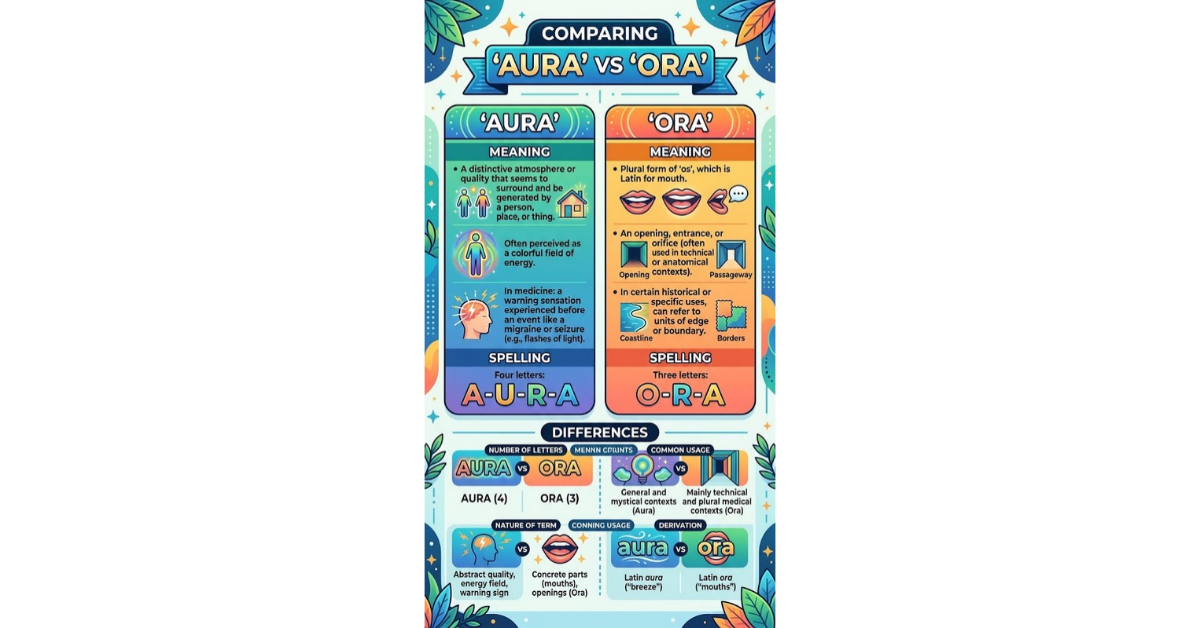
Have you ever wondered whether the correct word is aura or ora? Although these words look and sound similar, they have different meanings and uses. Understanding Aura vs Ora can help you choose the right spelling in everyday conversations, academic writing, social media posts, and other forms of communication.
The key difference is that aura is an English word referring to a distinctive atmosphere, impression, or energy associated with a person or place. Ora, on the other hand, has several meanings depending on the language and context. It can mean “now” or “hour” in Italian, refer to a type of currency in certain historical contexts, or appear as a word or name in other languages.
Let’s explore the meanings, pronunciation, examples, and common situations in which you might encounter these words.
Aura vs Ora: Which Word Is Correct?
Both aura and ora are legitimate words, but they are not interchangeable. The correct choice depends on what you want to communicate.
| Word | Meaning | Common Usage |
| Aura | A distinctive atmosphere, impression, or perceived energy | “She has a calm aura.” |
| Ora | A word with meanings that depend on the language or context | Italian: “Ora vado” means “I’m going now.” |
If you’re describing someone’s personality, presence, or the atmosphere of a place, aura is usually the word you need. If you’re reading or writing in Italian, ora may be the correct choice for expressing time.
Neither spelling is universally wrong. The mistake occurs when one is used in place of the other without regard to meaning.
What Does Aura Mean?
The word aura refers to a distinctive quality, atmosphere, or impression surrounding someone or something. It is often used to describe the feeling a person gives others, the mood of a location, or a quality that makes something seem special.
For example, someone who is confident and composed might be described as having a powerful aura. Similarly, an old library may have a peaceful aura because of its quiet surroundings, soft lighting, and atmosphere.
The word can also have spiritual or medical meanings, depending on the context.
Examples of Aura in Sentences
Here are some common examples:
- “She has an aura of confidence that makes people listen.”
- “The candlelight gave the room a warm, relaxing aura.”
- “He carries an aura of mystery wherever he goes.”
- “The ancient temple had a spiritual aura.”
- “Her calm aura helped everyone feel comfortable.”
In each sentence, aura describes a quality, impression, or atmosphere rather than a specific object.
Aura Meaning in Spirituality
In spiritual traditions and modern wellness discussions, an aura is often described as an energy field believed to surround a person or living being. Some spiritual practices associate different aura colors with emotions, personality traits, or states of well-being.
For example, certain popular interpretations associate blue with calmness and green with balance. However, these color associations vary between traditions and are not scientifically established measurements of a person’s energy or personality.
In everyday conversation, people also use aura metaphorically without making a literal spiritual claim. Saying someone has a “positive aura” can simply mean they seem welcoming, optimistic, or pleasant to be around.
Aura Meaning in Medicine
In medicine, an aura can describe a temporary sensory or perceptual experience that occurs before or during certain neurological events.
For example, some people with migraine experience visual disturbances, such as flashing lights, zigzag patterns, or blind spots. These symptoms are known as migraine aura.
An aura can also occur with certain types of seizures and may involve unusual sensations, smells, emotions, or changes in perception. Medical aura is different from the spiritual concept of an energy field.
What Does Ora Mean?
Unlike aura, which has a well-established meaning in English, ora is strongly dependent on language and context.
One of its most familiar uses is in Italian, where ora can mean “now” or “hour,” depending on the sentence. It can also appear in names, expressions, and specialized vocabulary in other languages.
Ora Meaning in Italian
In Italian, ora is commonly used to refer to the present moment or an hour.
Examples include:
- Ora vado. — “I’m going now.”
- Che ora è? — “What time is it?”
- Un’ora. — “One hour.”
- Fino ad ora. — “Until now” or “so far.”
The exact translation depends on how the word is used in the sentence. For instance, ora in a question about the time generally refers to the hour or current time, while ora vado expresses the idea of going now.
Ora as a Name or Term
Ora may also appear as a personal name, a place name, or a term in a particular language or field. Its meaning can change according to its linguistic origin.
For this reason, it’s best not to assume that every occurrence of ora has the same definition. If you encounter the word in a name, quotation, song, or foreign-language text, the surrounding context is important.
Aura vs Ora: Pronunciation Differences
Although the two words share some letters and may sound similar to English speakers, their pronunciation differs.
| Feature | Aura | Ora |
| Common pronunciation | AW-ruh or OR-uh | Depends on language |
| English usage | Common noun | Less common as an ordinary English word |
| Italian pronunciation | Not applicable to the English word in the same way | Approximately OH-rah |
| Typical meaning | Atmosphere, impression, or perceived energy | Often “now” or “hour” in Italian |
In English, aura is commonly pronounced “AW-ruh,” though pronunciation varies by accent. In Italian, ora is pronounced approximately “OH-rah,” with clear vowel sounds.
Pronunciation alone may not always make the distinction obvious in casual speech. When writing, focus on the intended meaning and language.
Aura vs Ora in Everyday Conversations
The easiest way to distinguish the words is to consider what the sentence is describing.
When to Use Aura
Use aura when you’re discussing:
- A person’s presence or personality.
- The atmosphere of a place.
- A distinctive impression or quality.
- A spiritual concept involving a perceived energy field.
- A neurological symptom in a medical context.
Example: “The musician has an aura of confidence on stage.”
When to Use Ora
Use ora when the context calls for that word, particularly in Italian or another language where it has an established meaning.
Examples:
- “Ora mangiamo.” — “Now we eat.”
- “Un’ora è sufficiente.” — “One hour is enough.”
In these examples, ora relates to time rather than a person’s atmosphere or presence.
Common Mistakes When Confusing Aura and Ora
Because the words look similar, writers may accidentally substitute one for the other. These are the main mistakes to watch for.
1. Using Ora When You Mean Aura
Incorrect: “She has a beautiful ora.”
Correct: “She has a beautiful aura.”
If you’re describing someone’s presence or the impression they create, aura is the appropriate word.
2. Assuming Ora Is Always a Misspelling
Incorrect assumption: “Ora is never a real word.”
Correct understanding: Ora is a valid word in several linguistic contexts, including Italian.
The correct spelling depends on the intended meaning rather than on which word is more familiar in English.
3. Ignoring the Language of the Sentence
A word that is correct in one language may not communicate the intended meaning in another. If you’re translating a phrase or writing for a multilingual audience, check the language and surrounding sentence before choosing a spelling.
Aura vs Ora: Easy Ways to Remember the Difference
If you regularly mix up these words, try using a simple memory aid.
Remember: Aura describes an atmosphere.
The first letter A can remind you of “atmosphere,” which is one of the main meanings of aura.
For ora, remember the Italian expressions ora vado (“I’m going now”) and un’ora (“one hour”). These examples connect the word with time.
You can also ask yourself two questions before writing:
- Am I describing a person’s presence, a mood, or a distinctive quality? If so, use aura.
- Am I using a word from Italian or another language in which ora has a specific meaning? Check that language’s usage.
These quick checks can prevent spelling mistakes without requiring you to memorize a long list of definitions.
Frequently Asked Questions
1. Is it aura or ora?
Both are valid words, but they have different meanings. Aura usually refers to a distinctive atmosphere, impression, or perceived energy, while ora has meanings that depend on the language and context.
2. What is the main difference between aura and ora?
The main difference is their meaning and usage. In English, aura describes a quality or atmosphere associated with a person or place. In Italian, ora commonly means “now” or “hour.”
3. Is ora a real English word?
Ora can appear in English-language dictionaries and specialized contexts, but it is not a common everyday English word with the same meaning as aura. Its interpretation depends on the context, including whether it is being used as a name or a term from another language.
4. What does aura mean when describing a person?
When describing a person, aura refers to the impression or atmosphere they seem to create. For example, someone may have a friendly aura, a mysterious aura, or an aura of authority.
5. What does ora mean in Italian?
In Italian, ora can mean “now” or “hour.” For example, ora vado means “I’m going now,” while un’ora means “one hour.”
6. How do you pronounce aura and ora?
In English, aura is commonly pronounced AW-ruh or OR-uh. Italian ora is pronounced approximately OH-rah, although pronunciation varies with accent and language.
7. Can aura and ora be used interchangeably?
No. The words have different meanings, so substituting one for the other can change the meaning of a sentence or create a spelling error. Choose the word that matches the intended context.
Conclusion
Understanding Aura vs Ora comes down to recognizing the meaning you want to express. Aura is the usual English word for a distinctive atmosphere, impression, or perceived energy, while ora has different meanings depending on the language, including “now” and “hour” in Italian.
If you’re describing someone’s presence, a room’s atmosphere, or a distinctive quality, choose aura. If you’re using Italian or another language where ora has a specific meaning, check the sentence to make sure it fits.
Learning the difference between similar-looking words can improve your spelling, vocabulary, and confidence in writing. For more practical language guides, explore other commonly confused words and discover how small spelling differences can change meaning.