Have you ever paused while writing a sentence and wondered whether it’s finally or finaly? It’s an easy mistake to make, especially when typing quickly or relying on how a word sounds. However, only one of these spellings is correct in standard English.
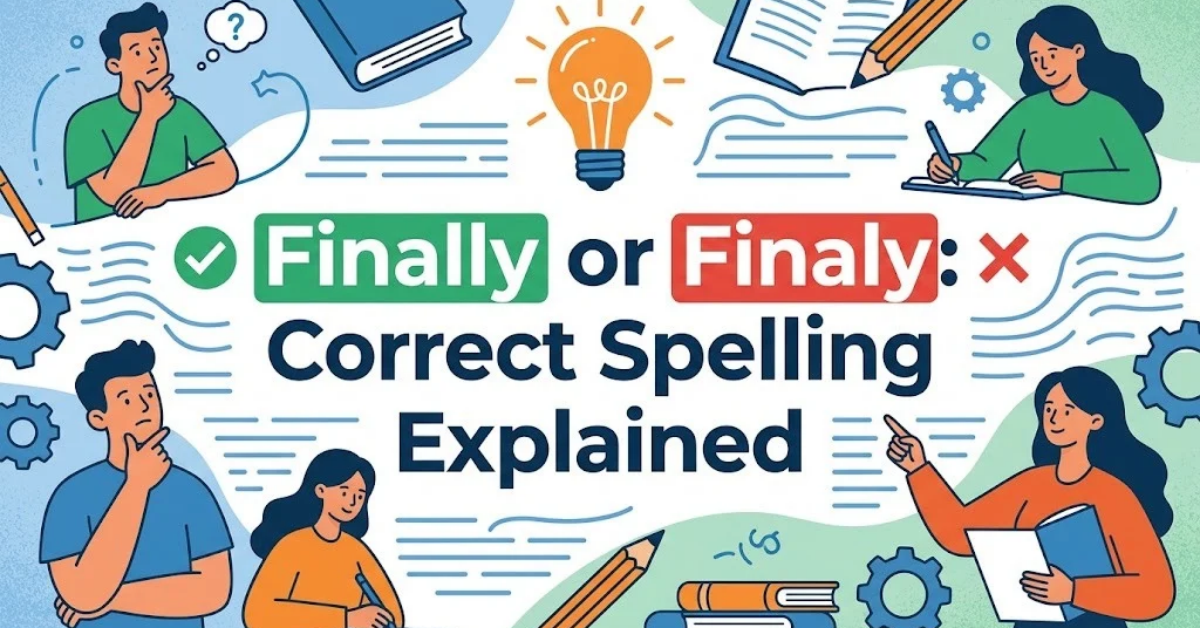
The correct spelling is finally, with two Ls in the middle and another L before the Y. Finaly is a misspelling of the word finally and should be avoided in formal writing, emails, school assignments, and professional content.
In this guide, you’ll learn what finally means, why it has two Ls, how to use it correctly in sentences, and how it differs from similar words such as final and at last.
Finally or Finaly: Which One Is Correct?
When comparing finally or finaly, the correct choice is finally.
- Finally: The correct English spelling. It is an adverb used to describe something that happens at the end of a process, after a delay, or as the last point in a sequence.
- Finaly: An incorrect spelling that usually results from accidentally leaving out an L.
For example:
Correct: I finally finished my homework.
Incorrect: I finaly finished my homework.
In the correct sentence, finally indicates that the homework is complete after some time or effort.
Remember this simple rule: whenever you mean at last, eventually, or in the end, write finally.
What Does Finally Mean?
The word finally is an adverb with several closely related meanings. It can describe the completion of an activity, the end of a waiting period, or the last item in a discussion.
Here are its three most common uses.
1. Finally Means At Last
Use finally when something happens after a long wait, a delay, or a period of difficulty.
Examples:
- I finally received the package I ordered.
- After hours of studying, she finally understood the lesson.
- We finally arrived at our destination.
- He finally found the keys he had lost.
In each example, the word emphasizes that something happened after waiting or making an effort.
2. Finally Means In the End
Finally can also describe the result of a process or a situation.
Examples:
- After considering every option, we finally chose the smaller apartment.
- The team finally agreed on a solution.
- She finally decided to pursue her dream career.
In these sentences, finally highlights the outcome of a decision or a series of events.
3. Finally Introduces the Last Point
In writing and speaking, finally can introduce the last item in a list or the last point in an explanation.
Examples:
- First, prepare the ingredients. Next, mix them together. Finally, bake the mixture.
- Finally, remember to save your work before closing the program.
- We discussed the budget, the schedule, and finally, the project’s expected results.
This use is especially common in essays, instructions, presentations, and professional communication.
Why Is Finally Spelled With Two Ls?
One of the easiest ways to understand the spelling is to look at how the word is formed.
Final + ly = finally
The adjective final becomes the adverb finally when the suffix -ly is added. Because final already ends in L, the resulting word retains that L and adds the L that begins the suffix.
The complete spelling is:
F-I-N-A-L-L-Y
This gives the word two consecutive Ls.
By contrast, finaly contains only one L and does not follow the standard spelling of the English adverb.
An Easy Trick to Remember Finally
Remember the word final first.
Then add -ly:
- Final
- Finally
A useful memory trick is:
Final has one L, and -ly adds another. Together, they make finally.
If you can spell final, you can use it to remember the correct spelling of finally.
Finally vs. Final: What’s the Difference?
Although finally comes from final, the two words serve different grammatical purposes.
Final is an adjective. It describes a noun and indicates that something is last or conclusive.
Finally is an adverb. It describes an action, marks the end of a sequence, or emphasizes that something happened after a delay.
| Word | Part of speech | Example |
|---|---|---|
| Final | Adjective | This is our final meeting. |
| Finally | Adverb | We finally held the meeting. |
Consider these additional examples:
- Final: She submitted her final report.
- Finally: She finally submitted her report.
- Final: The final decision belongs to the manager.
- Finally: The manager finally made a decision.
The simplest rule is to use final to describe a thing and finally to describe an action, an outcome, or the last point in a sequence.
Finally vs. Finaly: Common Sentence Examples
Seeing the correct spelling in context can help you recognize and avoid mistakes.
Here are 15 examples of finally used correctly:
- I finally completed the assignment after several hours of work.
- She finally called me back after a busy day.
- We finally reached the hotel just before midnight.
- He finally admitted that he had made a mistake.
- The rain finally stopped, allowing us to go outside.
- After weeks of searching, they finally found a suitable house.
- I finally understand how this software works.
- The students finally received their examination results.
- We finally decided where to spend our vacation.
- After several attempts, the machine finally started working.
- Finally, add the salt and stir the mixture thoroughly.
- Finally, I would like to thank everyone who helped with this project.
- The company finally announced its new product.
- She finally felt comfortable speaking in front of an audience.
- After a long discussion, both sides finally reached an agreement.
Notice that finally can appear at the beginning, middle, or end of a sentence, depending on what you want to emphasize.
Finally vs. Eventually vs. At Last
Several English expressions have meanings similar to finally. Although they can often be used interchangeably, each has a slightly different emphasis.
Finally
Finally emphasizes the completion of an action, the result of a process, or the last point in a sequence.
Example: We finally finished the project.
Eventually
Eventually emphasizes that something happens after a period of time, a series of events, or some delay.
Example: After months of practice, he eventually became a confident speaker.
At Last
At last often conveys relief, happiness, or impatience when something awaited for a long time finally happens.
Example: At last, the weekend has arrived!
Quick Comparison
| Expression | Main emphasis | Example |
|---|---|---|
| Finally | Completion or last point | Finally, we reached a decision. |
| Eventually | Something happens after time passes | She eventually found a job. |
| At last | Relief after waiting | At last, you’re here! |
| In the end | The ultimate result | In the end, we chose to stay home. |
These expressions overlap in meaning, but choosing the most appropriate one can make your writing more precise and natural.
Common Mistakes to Avoid When Using Finally
Even when you know the correct spelling, it’s helpful to understand a few common writing mistakes.
1. Leaving Out One L
Incorrect: We finaly completed the project.
Correct: We finally completed the project.
The correct form contains two consecutive Ls.
2. Confusing Finally With Final
Incorrect: She finally exam was difficult.
Correct: Her final exam was difficult.
Use final to describe the exam. Use finally when describing an action or sequence, as in, “She finally completed her exam.”
3. Using Finally Too Often
Although finally is useful, repeating it several times in a short paragraph can make writing sound awkward.
For example:
“Finally, we arrived. Finally, we ate dinner. Finally, we went home.”
A smoother version might be:
“We eventually arrived, ate dinner, and headed home.”
Use alternatives when they fit the context, but don’t replace finally simply for variety if it expresses your meaning most clearly.
4. Using Finally When You Mean Finely
The words finally and finely look similar but have different meanings.
- Finally: At last or at the end.
- Finely: In small pieces or with great precision.
Examples:
- We finally finished the meal.
- Chop the onions finely.
Choosing the correct word ensures that your sentence communicates the intended meaning.
Is Finally One Word or Two?
Finally is one word. It should not be written as two separate words, such as final ly.
It is a standard English adverb formed from final and the suffix -ly. The two parts combine to create a single word with the spelling finally.
Correct: She finally understood the instructions.
Incorrect: She final ly understood the instructions.
When writing, keep the word together.
Frequently Asked Questions About Finally or Finaly
Is it finally or finaly?
Finally is the correct spelling. Finaly is a misspelling that leaves out one of the two consecutive Ls.
Why does finally have two Ls?
The word is formed by adding the suffix -ly to the adjective final. The final L in final and the initial L in -ly create the double L in finally.
What does finally mean in simple words?
Finally means at last, eventually, or in the end. It can also introduce the last point in a list or explanation.
What is the difference between final and finally?
Final is an adjective that describes something last or conclusive, while finally is an adverb that describes an action, outcome, or sequence. For example, “the final chapter” uses the adjective, while “I finally finished the book” uses the adverb.
Is finaly ever correct?
Finaly is not the standard spelling of the adverb finally. In ordinary English writing, you should use finally when you mean at last or in the end.
What are some synonyms for finally?
Common alternatives include eventually, at last, in the end, ultimately, and lastly. The best choice depends on whether you are emphasizing a delay, a conclusion, or the last item in a sequence.
Can finally be used at the beginning of a sentence?
Yes. Finally can introduce the last point in a sequence or discussion.
Example: “Finally, check your answers before submitting the test.”
It can also appear at the beginning to emphasize a long-awaited event, as in, “Finally, the day we’ve been waiting for has arrived!”
Is finally an adverb?
Yes. Finally is an adverb. It can modify a verb or introduce a concluding point in a sequence or discussion.
What is the difference between finally and eventually?
Both words can describe something that happens after time passes. Finally can emphasize completion or a concluding point, whereas eventually focuses more on something happening after a period of time or a series of events.
How can I remember the correct spelling of finally?
Start with the word final and add -ly. The two Ls come together to form finally. Remembering final + ly = finally is a simple way to avoid the common misspelling finaly.
Conclusion: Finally or Finaly?
When choosing between finally or finaly, the correct spelling is finally. It contains two consecutive Ls and is used to describe something that happens at last, marks the end of a process, or introduces the final point in a sequence.
The easiest way to remember the spelling is to break the word into its two parts: final + ly = finally. Avoid finaly in everyday, academic, and professional writing because it is a spelling error.
Whether you’re writing an email, completing an assignment, or publishing an article, taking a moment to check small spelling details can make your writing clearer and more polished. For more practical spelling guides, explore related articles about commonly confused English words and improve your everyday writing one word at a time.