Have you ever wondered whether the correct spelling is steer or stear? English has plenty of words that sound alike but are spelled differently, and this is one of those confusing cases. Whether you’re writing an email, completing an assignment, or improving your vocabulary, knowing the correct spelling can help you communicate more confidently.
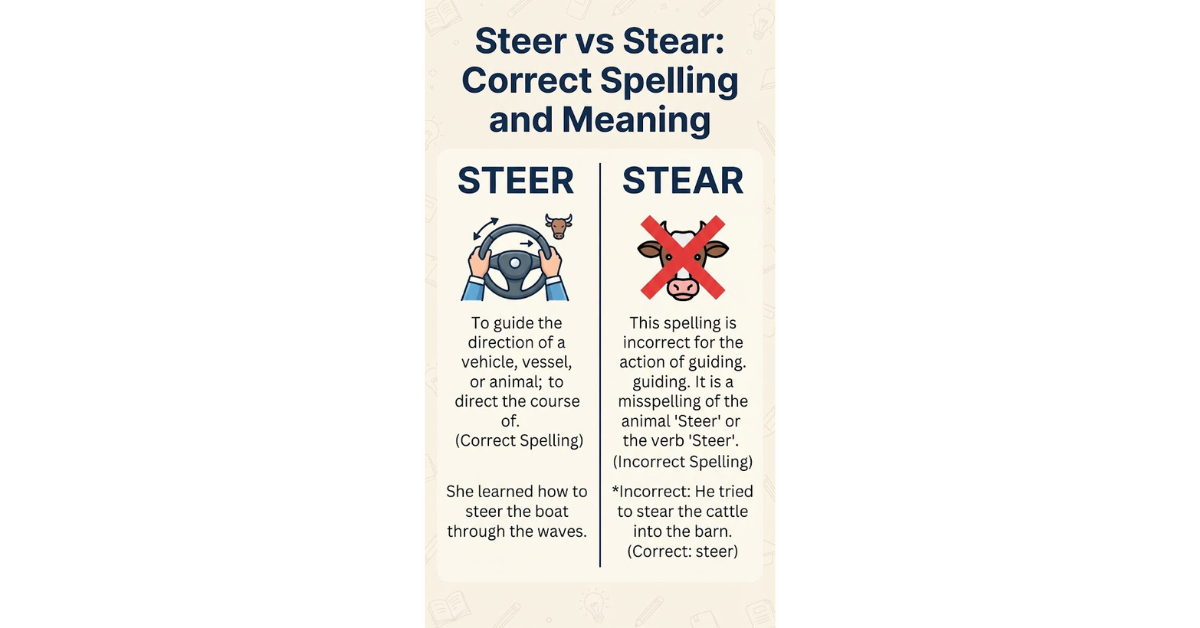
When comparing steer vs stear, the correct spelling is steer. The word steer is a standard English word with several meanings, while stear is generally a misspelling of steer in ordinary English writing.
Let’s explore the meaning of steer, how to use it in sentences, why people confuse these spellings, and how to remember the correct form.
Steer vs Stear: Which One Is Correct?
The correct spelling is steer, with two e’s. It is a recognized English word used as both a verb and a noun.
The spelling stear is not the standard spelling of the word in ordinary English usage. If you want to describe controlling a vehicle, guiding someone, or directing something toward a particular destination, you should use steer.
Here’s a quick comparison:
| Word | Correct or Incorrect? | Meaning |
| Steer | Correct | To guide, direct, or control something |
| Stear | Incorrect in standard usage | Common misspelling of steer |
| Steering | Correct | The act or mechanism of directing movement |
| Steered | Correct | Past tense of steer |
| Steers | Correct | Third-person singular verb or plural noun |
Remember: When writing about guidance, direction, or control, use steer, not stear.
What Does Steer Mean?
The word steer has several meanings depending on the context. Most commonly, it refers to directing or controlling the movement of something.
It can also describe influencing someone’s decisions, guiding a conversation, or helping a person move toward a particular outcome.
1. Steer as a Verb
As a verb, steer means to guide, direct, or control the movement or course of something.
For example:
- “She learned how to steer a car safely.”
- “The captain steered the boat toward the harbor.”
- “He tried to steer the conversation away from politics.”
- “The manager steered the company through a difficult period.”
In these examples, steer describes directing something toward a desired path or outcome.
2. Steer as a Noun
As a noun, steer refers to a male bovine, typically one that has been castrated and raised for beef production.
For example:
- “The farmer raised a steer on his ranch.”
- “The steer was moved into a separate pasture.”
- “The livestock auction featured several healthy steers.”
This meaning is common in agriculture, livestock farming, and discussions about cattle.
Why Is Steer Often Misspelled as Stear?
The confusion between steer and stear usually comes from the way English vowels sound in spoken language.
In many English accents, the vowel sound in steer may sound similar to other words containing different vowel combinations. This can make the spelling difficult to remember, especially for people learning English as a second language.
Here are some common reasons behind the mistake.
1. Similar Pronunciation
The word steer is generally pronounced like “steer,” with a long ee sound.
Because English spelling doesn’t always match pronunciation perfectly, some people mistakenly write stear after hearing the word.
2. Confusion With Other English Words
English contains several words with similar sounds but different spellings.
For example:
- Steer
- Clear
- Near
- Dear
- Fear
These words share similar vowel sounds in many accents, but their spelling patterns differ.
3. Typing Errors
Sometimes, the mistake is simply caused by typing too quickly. A person may accidentally replace the second e with an a without realizing it.
Spell-checking tools can help identify the error, but learning the correct spelling is the best long-term solution.
How to Remember the Correct Spelling of Steer
If you frequently confuse steer and stear, a simple memory trick can help.
Use the Double-E Memory Trick
Think of the word steer as containing two e’s that help you “lead” or “guide” something.
You can also associate the word with the phrase:
“Steer with your feet? No, steer with your hands!”
This simple phrase reinforces the spelling while connecting it to the familiar action of controlling a vehicle.
Another useful strategy is to practice the word in sentences.
- Write the word steer five times.
- Say the spelling aloud.
- Use it in a sentence about driving.
- Use it in another sentence about guiding a conversation.
For example: “I need to steer the car carefully through traffic.”
Practicing the word in context makes it easier to remember than memorizing the spelling alone.
Steer vs Stear: Examples in Everyday Sentences
The easiest way to understand the difference is to see how the correct word works in different situations.
| Sentence | Explanation |
| “You must steer the car carefully.” | Steer means control the direction of a vehicle. |
| “The captain steered the ship through rough waters.” | Steer means guide a vessel. |
| “She tried to steer the discussion toward a solution.” | Steer means influence the direction of a conversation. |
| “The farmer bought a young steer.” | Steer refers to a male bovine. |
| “He steered his career toward technology.” | Steer means guide or influence a future direction. |
Notice that the spelling remains steer regardless of the meaning.
What Is the Difference Between Steer, Steering, and Steered?
These words belong to the same word family, but they are used differently in sentences.
| Word | Part of Speech | Meaning | Example |
| Steer | Verb or noun | Guide or direct; a male bovine | “Steer the vehicle carefully.” |
| Steering | Noun or verb form | The act or mechanism of directing | “The steering system needs repair.” |
| Steered | Past-tense verb | Guided or directed | “She steered the boat safely.” |
| Steers | Verb or plural noun | Directs or multiple bovines | “He steers the car.” |
All these forms use the same spelling pattern with two e’s.
Steer vs. Guide: Are They the Same?
The words steer and guide are similar, but they are not always interchangeable.
To steer often suggests actively controlling direction or influencing the course of something. To guide can mean providing assistance, advice, or direction without necessarily controlling the entire process.
For example:
- Steer: “She steered the car around the obstacle.”
- Guide: “The teacher guided the students through the assignment.”
In the first sentence, the person directly controls movement. In the second, the teacher provides support and direction.
Both words can be used figuratively, too. Someone can steer a business toward success or guide a team through a difficult project.
Common Mistakes to Avoid When Using Steer
Understanding the spelling is only part of using the word correctly. You should also pay attention to its meaning and grammatical form.
Here are some mistakes to avoid:
- Writing “stear”: Always use steer when referring to guidance or direction.
- Confusing steer with steering: Use steering when referring to the act or mechanism of controlling direction.
- Using steer when you mean stare: Stare means to look at something for a long time, while steer means to guide or direct.
- Forgetting the past-tense form: The past tense is steered, not steared.
- Mixing up steer and stern: A stern is the rear part of a boat or ship, while steer describes guiding or controlling movement.
Choosing the right word helps make your writing more accurate and easier to understand.
Frequently Asked Questions
1. Is it steer or stear?
Steer is the correct spelling in standard English. Stear is generally a misspelling of the word.
2. What does steer mean?
To steer means to guide, direct, or control the movement of something. It can also mean influencing a conversation, decision, or situation.
3. Is steer a verb or a noun?
Steer can be both a verb and a noun. As a verb, it means to guide or direct something. As a noun, it refers to a male bovine, typically one that has been castrated.
4. How do you spell steer correctly?
The correct spelling is S-T-E-E-R. Remember that the word contains two e’s.
5. What is the past tense of steer?
The past tense of steer is steered. For example: “He steered the car around the corner.”
6. What is the difference between steer and stare?
Steer means to guide or direct something, while stare means to look at something for an extended period. For example, you steer a car but stare at a painting.
7. Is stear ever a correct English word?
In ordinary modern English writing, stear is not the standard spelling of steer. It may appear as a proper name, a specialized term, or a historical spelling in particular contexts, but it should not be used as a substitute for steer in everyday writing.
Conclusion
When comparing steer vs stear, the correct spelling is steer. The word contains two e’s and is used to describe guiding, directing, or controlling something. It can also refer to a male bovine raised for beef production.
The incorrect spelling stear is a common mistake caused by pronunciation confusion or typing errors. Remember the double-e pattern, practice using the word in sentences, and check your writing when necessary.
With a little practice, you’ll find it easier to use steer correctly in everyday conversations, professional writing, and academic work. If you’re interested in improving your English vocabulary, explore more guides on commonly confused words and spelling mistakes.