Have you ever typed a word, looked at it twice, and wondered whether you spelled it correctly? The difference between cheer and chear is a perfect example of how English spelling can be confusing, even when a word sounds familiar.
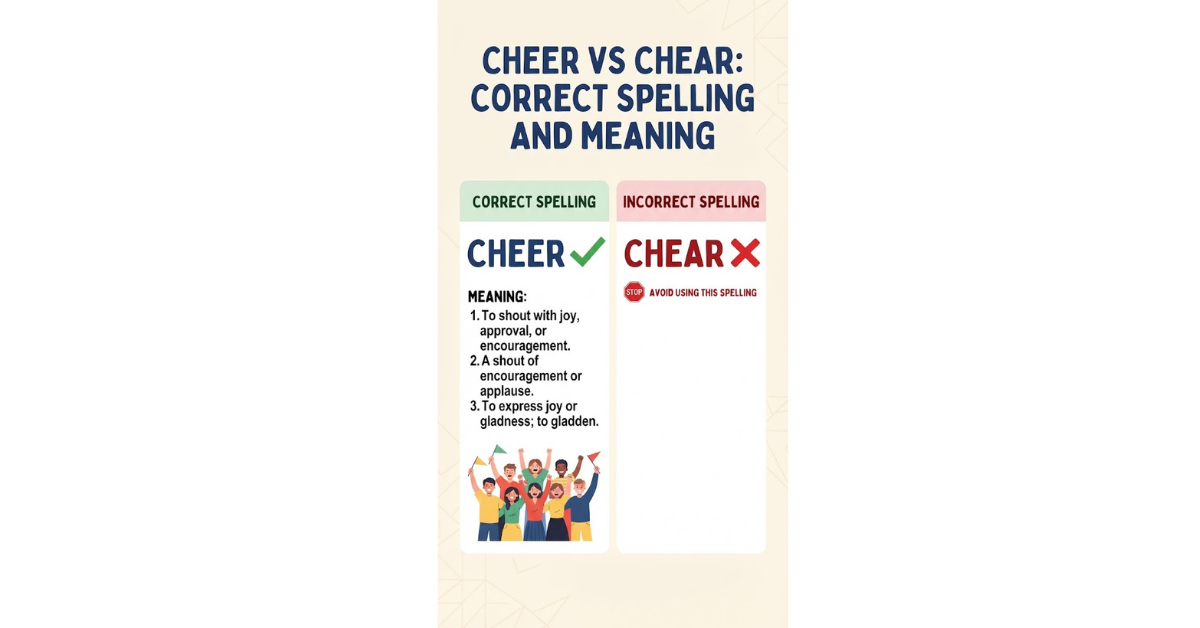
If you’re searching for Cheer vs Chear, here’s the answer: Cheer is the correct spelling in standard English. Chear is a misspelling and is not recognized as a standard English word.
Whether you’re writing a birthday message, cheering for your favorite sports team, or preparing a school assignment, knowing the correct spelling helps you communicate clearly. Let’s explore the meaning, pronunciation, usage, and easy ways to remember the difference.
Cheer vs Chear: Which One Is Correct?
The correct spelling is cheer, with the letters c-h-e-e-r.
The spelling chear is incorrect in standard modern English. Although it may appear in typing errors, informal messages, or historical texts, it should not be used in ordinary English writing.
Here’s a quick comparison:
| Word | Correct or Incorrect? | Meaning |
| Cheer | Correct | To encourage, express happiness, or show support |
| Chear | Incorrect | A misspelling of cheer |
| Cheered | Correct | Past tense of cheer |
| Cheering | Correct | The act of expressing encouragement or happiness |
| Cheerful | Correct | Happy, positive, or optimistic |
| Cheerfully | Correct | In a happy or positive manner |
The easiest way to remember the difference is that cheer contains two e’s in the middle.
What Does Cheer Mean?
The word cheer has several related meanings. It can describe happiness, encouragement, support, or the act of expressing excitement.
As a noun, cheer refers to a feeling or expression of happiness, encouragement, or enthusiasm.
As a verb, it means to encourage someone, express approval, or make someone feel happier.
For example:
- “The crowd gave a loud cheer when the team scored.”
- “We went to the stadium to cheer for our favorite team.”
- “Her kind words helped cheer me up.”
- “The children were cheering with excitement.”
In each sentence, the word expresses some form of positive emotion, encouragement, or support.
Why Is Cheer Often Misspelled as Chear?
The confusion between cheer and chear often comes from the unpredictable nature of English spelling.
Although the word is pronounced with a long e sound, people may mistakenly associate that sound with the spelling “ear.”
Several factors can contribute to this mistake.
1. Confusing Similar English Vowel Sounds
English contains many words that sound similar but use different vowel combinations.
For example:
- Cheer
- Clear
- Dear
- Hear
- Near
The words cheer and clear share the same ending sound in many accents, while dear, hear, and near use the “ear” spelling.
Because of these similarities, someone may accidentally write chear instead of cheer.
2. Typing Errors and Autocorrect
When people type quickly, they may accidentally replace one vowel with another. If the incorrect spelling is not caught by a spell-checking tool, it may remain in the final text.
This is particularly common in text messages, social media captions, and informal writing.
3. Unfamiliarity With the Word’s Spelling
People who are learning English as a second language may find it difficult to remember which vowel combination belongs to a particular word.
Reading regularly and practicing commonly confused words can help build stronger spelling habits.
How to Remember the Correct Spelling of Cheer
If you frequently confuse cheer and chear, a simple memory trick can make the correct spelling easier to remember.
Use the Double-E Memory Trick
Think of the word as:
CH + EE + R = CHEER
The two e’s represent the long e sound in the word.
You can also connect the spelling with its meaning:
“Two E’s bring extra energy to a cheer!”
This playful phrase can help you remember the double-e spelling, especially when writing quickly.
Practice With These Sentences
Try writing the following sentences to reinforce the correct spelling:
- “I cheer for my favorite football team.”
- “The audience gave a loud cheer.”
- “Her smile brought cheer to the room.”
- “The coach cheered the players after the victory.”
Practicing the word in different grammatical forms helps you recognize it more naturally.
Different Meanings and Uses of Cheer
The word cheer can be used in several ways, depending on the context.
Cheer as a Noun
As a noun, cheer refers to an expression of happiness, excitement, or encouragement.
Examples:
- “The crowd erupted into a cheer.”
- “The holiday season brings good cheer.”
- “Her cheerful personality lifted everyone’s spirits.”
Cheer as a Verb
As a verb, cheer describes the action of encouraging someone or expressing happiness.
Examples:
- “We cheer for our school team.”
- “The fans cheered when the players entered the field.”
- “I tried to cheer my friend up after a difficult day.”
Cheer in Sports and Entertainment
In sports, cheer commonly means showing support for a team or player.
For example, spectators may cheer when a player scores a goal, wins a match, or performs exceptionally well.
The word is also closely associated with cheerleading, where organized groups perform routines involving chants, movements, and encouragement.
Cheer vs. Cheerful vs. Cheering
Although these words share the same root, they serve different grammatical purposes.
| Word | Part of Speech | Meaning | Example |
| Cheer | Noun or verb | Happiness or encouragement | “We cheer for the team.” |
| Cheerful | Adjective | Happy or positive | “She has a cheerful personality.” |
| Cheering | Verb form or noun | Expressing encouragement | “The crowd was cheering.” |
| Cheered | Past-tense verb | Expressed encouragement or happiness | “They cheered after the win.” |
| Cheerfully | Adverb | In a happy manner | “He greeted everyone cheerfully.” |
All these words are spelled with the double-e combination.
Understanding their differences will help you use them correctly in everyday writing.
Is Chear Ever a Correct English Word?
In standard modern English, chear is not the accepted spelling of the word meaning happiness, encouragement, or support.
However, the spelling has appeared historically as an older variant of cheer. Historical spellings can differ from the forms used in contemporary English.
For modern writing, including academic assignments, business emails, website content, and social media posts, use cheer.
If you encounter chear in an old document, it may reflect historical spelling rather than a modern spelling mistake.
Common Expressions Using the Word Cheer
The word cheer appears in several familiar English expressions.
Cheer Up
“Cheer up” means to become happier or to encourage someone who feels sad.
Example: “Cheer up! Things will get better.”
Cheer Someone On
To cheer someone on means to encourage them while they are doing something.
Example: “We cheered our classmates on during the competition.”
Good Cheer
“Good cheer” refers to happiness, positivity, or a pleasant mood.
Example: “The holiday gathering was filled with good cheer.”
Three Cheers
“Three cheers” is an expression used to celebrate or congratulate someone.
Example: “Three cheers for the winning team!”
These expressions are useful in everyday conversations and help expand your vocabulary.
Frequently Asked Questions
1. Is it cheer or chear?
Cheer is the correct spelling in standard English. Chear is generally considered a misspelling, although it has appeared as a historical spelling variant.
2. What does cheer mean?
Cheer means to express happiness, encourage someone, or show support. It can be used as both a noun and a verb.
3. Why is cheer spelled with two e’s?
The standard spelling of cheer uses the double-e combination to represent its long e sound. The spelling must be memorized because English vowel patterns are not always predictable.
4. How do you use cheer in a sentence?
You can use cheer in several ways. For example, “We cheer for our favorite team” uses it as a verb, while “The crowd gave a loud cheer” uses it as a noun.
5. Is cheering the correct spelling?
Yes, cheering is correct. It is the present participle of cheer and describes the act of expressing happiness or encouragement.
6. What is the past tense of cheer?
The past tense of cheer is cheered. For example, “The fans cheered when their team won the match.”
7. What is the difference between cheer and cheerful?
Cheer can be a noun or verb referring to happiness or encouragement. Cheerful is an adjective describing someone or something that is happy, positive, or full of good spirits.
Conclusion
When deciding between Cheer vs Chear, the correct choice is cheer. The word is spelled with two e’s, while chear is not the standard modern English spelling.
Remember that cheer can refer to happiness, encouragement, or the act of supporting someone. Its related forms, such as cheered, cheering, and cheerful, also use the double-e spelling.
The best way to avoid this common spelling mistake is to practice the word in sentences and pay attention to its vowel combination. If you’re interested in improving your English spelling and vocabulary, explore more guides on commonly confused words and make your everyday writing clearer and more confident.