One missing letter can completely change how polished your writing looks. That is especially true when comparing seamless vs seemless, two spellings that look remarkably similar but do not have the same status in standard English.
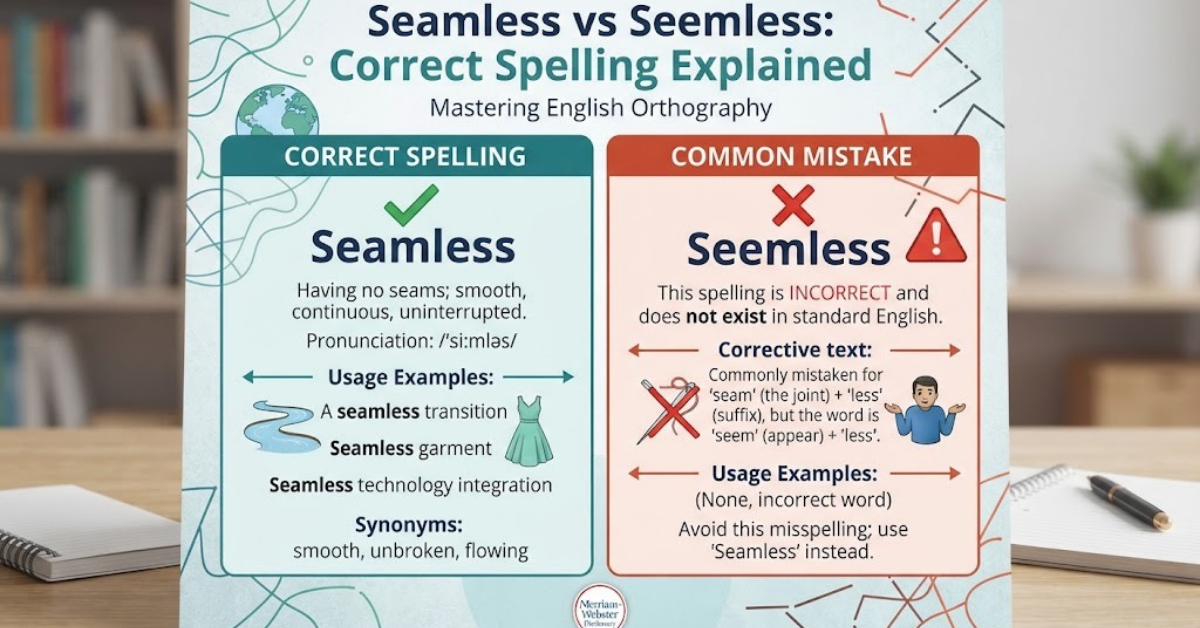
The correct spelling is seamless. The word seemless is generally a misspelling when someone intends to describe something smooth, continuous, or without seams.
But there is a good reason for the confusion: seem is a real English word, while seam is also a real word. Knowing the difference between them makes it much easier to remember why seamless is spelled with sea- rather than see-.
Seamless vs Seemless: Which One Is Correct?
When it comes to seamless vs seemless, use seamless in standard English.
- Seamless — correct
- Seemless — usually incorrect when intended as the adjective meaning “without seams”
Seamless means having no visible seams or joins, or, more broadly, happening smoothly without interruptions, problems, or noticeable transitions.
For example:
The two systems were integrated seamlessly.
This means the integration happened smoothly, without obvious difficulties or interruptions.
By contrast:
The two systems were integrated seemlessly.
is a spelling error. The correct form is seamlessly, with the word seam at its root.
What Does Seamless Mean?
The word seamless has both a literal and a figurative meaning.
Literal Meaning of Seamless
Literally, seamless describes something made without seams or visible joins.
For example:
She wore a seamless garment under her dress.
A seam is a line where two pieces of material are joined, particularly in sewing or manufacturing. Something described as seamless has no such visible joining line, or is constructed so that the join is not apparent.
Figurative Meaning of Seamless
In everyday and professional English, seamless is often used figuratively.
It can describe something that happens:
- Smoothly
- Continuously
- Without interruption
- Without noticeable transitions
- Without complications
- In an integrated way
For example:
The new software provides a seamless experience for users.
Here, seamless does not mean the software literally has no seams. It means the experience feels smooth and uninterrupted.
Why Is “Seemless” Incorrect?
The confusion comes from two legitimate English words: seam and seem.
Seam
A seam is a line or place where two things are joined.
For example:
The seam in the shirt began to loosen.
Seem
Seem is a verb meaning to appear or give the impression of being something.
For example:
You seem tired today.
Because seem is pronounced similarly to seam, writers sometimes accidentally create seemless when they mean seamless.
However, the adjective seamless is derived from seam, not seem.
The word can be broken down as:
seam + less = seamless
The suffix -less means “without.”
Therefore:
seamless = without a seam
This makes the spelling much easier to remember.
Seamless vs Seemless Meaning
The distinction becomes particularly clear when you look at the meanings behind the two spellings.
| Spelling | Standard usage | Meaning |
| Seamless | Correct | Without seams; smooth or uninterrupted |
| Seemless | Usually a misspelling | Not the standard form of seamless |
The key point is that seemless is not simply an alternative spelling of seamless.
Seamless Meaning in Simple English
In simple terms, seamless means:
Something that works or happens smoothly, without obvious breaks, interruptions, or problems.
For example:
The transition between the two scenes was seamless.
This means viewers could move from one scene to the next without noticing an awkward transition.
Another example:
The app offers a seamless checkout process.
Here, seamless suggests that buying something through the app is easy and uncomplicated.
Seamless Synonyms
Depending on the context, several words can have a similar meaning to seamless.
Common synonyms include:
- Smooth
- Continuous
- Uninterrupted
- Effortless
- Fluid
- Integrated
- Cohesive
- Consistent
- Unified
- Well-connected
- Trouble-free
However, these words are not interchangeable in every sentence.
For example, seamless integration is a common phrase in technology, while effortless integration emphasizes ease rather than the absence of noticeable transitions.
Common Examples of Seamless
The word seamless appears in many areas of modern English.
Technology
The software provides seamless integration with existing systems.
Business
The company created a seamless customer experience across its website and stores.
Travel
The new rail connection allows for seamless travel between the two cities.
Design
The colors create a seamless transition from one section to another.
Fashion
Seamless clothing is designed without conventional stitched seams.
Customer Service
The support team aims to provide a seamless experience from purchase to delivery.
Communication
Better communication can create a seamless workflow between departments.
Seamless vs Seamlessly
Another common grammar question concerns seamless and seamlessly.
Seamless is an adjective. It describes a noun.
We created a seamless experience.
Seamlessly is an adverb. It describes how an action happens.
The systems work seamlessly together.
A useful rule is:
- Seamless = describes something
- Seamlessly = describes how something happens
Compare These Examples
The transition was seamless.
Here, seamless describes the transition.
The transition happened seamlessly.
Here, seamlessly describes how the transition happened.
Both are correct, but they perform different grammatical jobs.
Seamless vs Smooth: Are They the Same?
Seamless and smooth can sometimes be used as synonyms, particularly when describing an experience or process.
For example:
We want to create a seamless customer journey.
and:
We want to create a smooth customer journey.
Both suggest that customers should encounter few difficulties.
There is, however, a slight difference in emphasis. Smooth generally focuses on ease or lack of difficulty, while seamless often emphasizes the absence of noticeable breaks, gaps, or transitions.
Why Do People Write “Seemless”?
The spelling mistake seemless is understandable because English contains the word seem.
Consider these words:
- seem
- seeming
- seemingly
They all contain seem, and their pronunciation can make seam and seem easy to confuse.
There is also a visual reason for the error. At first glance, seamless and seemless look almost identical.
But their roots are different:
seam + less → seamless
Not:
seem + less → seemless
Remembering the root word is the easiest solution.
How to Remember the Correct Spelling
Here’s a simple trick:
A seam is a join. Seamless means without a seam.
Think about clothing.
A shirt can have seams where pieces of fabric are stitched together. Something seamless is designed without those visible joins.
You can also use this formula:
SEAM + LESS = SEAMLESS
The word less means “without,” so seamless literally means “without a seam.”
This connection is much more useful than trying to memorize the spelling letter by letter.
Common Mistakes With Seamless
Mistake 1: Writing “Seemless”
Incorrect:
The website offers a seemless shopping experience.
Correct:
The website offers a seamless shopping experience.
Mistake 2: Confusing Seamless With Seamlessly
Incorrect:
The departments worked seamless together.
Correct:
The departments worked seamlessly together.
Because worked is an action, the adverb seamlessly is needed.
Mistake 3: Confusing Seam With Seem
Incorrect:
The seem of the fabric is visible.
Correct:
The seam of the fabric is visible.
A seam is the joining line. Seem is a verb meaning “appear.”
Seam vs Seem: Understanding the Difference
The easiest way to avoid the seamless vs seemless mistake is to understand seam and seem separately.
What Does “Seam” Mean?
A seam is a line where two pieces of material or other things are joined.
Example:
The tailor repaired the seam in my jacket.
The word can also be used figuratively:
There was a seam of tension running through the discussion.
What Does “Seem” Mean?
Seem is a verb meaning to appear to be true or to give a particular impression.
Examples:
You seem happy today.
It seems like a good idea.
She seemed surprised by the news.
These words sound alike in many varieties of English, but they have completely different meanings.
Is Seamless Always Positive?
Not necessarily, although seamless is frequently used positively.
When businesses describe a product, service, or process as seamless, they usually mean that it is easy, efficient, and free from noticeable interruptions.
For example:
The airline promised a seamless booking experience.
However, context determines the meaning. In some situations, the word may be used critically or ironically.
For example:
The supposedly seamless update caused several problems.
Here, seamless is being used sarcastically to contrast the promise with the actual experience.
“Seamless Experience” Meaning
Seamless experience is one of the most common phrases containing the word.
It generally means an experience in which different stages, platforms, services, or interactions connect smoothly.
For example, an online retailer might aim for a seamless experience that allows customers to:
- Find a product.
- Add it to their cart.
- Pay easily.
- Receive order confirmation.
- Track delivery.
- Contact support if necessary.
If each step connects naturally, the customer may experience the entire process as seamless.
“Seamless Integration” Meaning
Another popular phrase is seamless integration.
It means that two or more systems, technologies, processes, or services work together smoothly without requiring significant disruption or awkward manual steps.
For example:
The accounting software offers seamless integration with the company’s payment platform.
This suggests that the systems can communicate or operate together efficiently.
Frequently Asked Questions About Seamless vs Seemless
Is “seemless” correct?
No, seemless is generally a misspelling when you mean something smooth, continuous, or without seams. The correct spelling is seamless.
What is the correct spelling: seamless or seemless?
The correct spelling is seamless, with sea at the beginning.
Seamless ✓
Seemless ✗
What does seamless mean?
Seamless literally means “without seams.” Figuratively, it means smooth, continuous, integrated, or without noticeable interruptions.
Why is seamless spelled with “sea”?
Because it comes from the noun seam, which refers to a line or place where two things are joined.
Seam + less = seamless.
Is seamless one word?
Yes. Seamless is written as one word.
What is the difference between seamless and seamlessly?
Seamless is an adjective:
It was a seamless transition.
Seamlessly is an adverb:
The transition happened seamlessly.
Is seamless the same as smooth?
They can be synonyms in many contexts. However, seamless often emphasizes the absence of noticeable breaks or transitions, while smooth more broadly describes something that happens without difficulty.
What is the opposite of seamless?
Depending on context, possible opposites include disjointed, interrupted, rough, awkward, disconnected, or discontinuous.
What is an example of seamless in a sentence?
The new system provides a seamless connection between the company’s website and mobile app.
Here, seamless means that the connection works smoothly without noticeable interruptions.
How can I remember the spelling of seamless?
Remember:
Seam + less = seamless.
A seam is a join, and something seamless is without a seam.
Final Verdict: Seamless vs Seemless
When comparing seamless vs seemless, there is a clear answer: seamless is the correct standard spelling.
The word comes from seam + less, meaning literally “without a seam.” Over time, it has also developed an important figurative meaning: something that is smooth, continuous, integrated, or free from noticeable interruptions.
Seemless is a common spelling mistake caused largely by the similar pronunciation of seam and seem. When in doubt, remember the root:
SEAM + LESS = SEAMLESS.
Whether you’re writing a business document, website copy, academic assignment, email, or social media post, choosing the correct spelling helps keep your writing clear and professional. If you’re interested in more commonly confused English words, exploring related spelling and grammar guides can make these small but important distinctions much easier to remember.