Have you ever typed “shiney” and wondered whether it should actually be “shiny”? You’re not alone. This is a surprisingly common spelling question, especially because the word shine seems to suggest that its adjective should be spelled shiney.
The correct spelling is shiny. While “shiney” may look logical at first glance, it is generally considered a misspelling in standard English. In this guide, we’ll explain why shiny is correct, what the word means, how it is used in sentences, and why people often write “shiney” by mistake.
Shiney or Shiny: What Is the Correct Spelling?
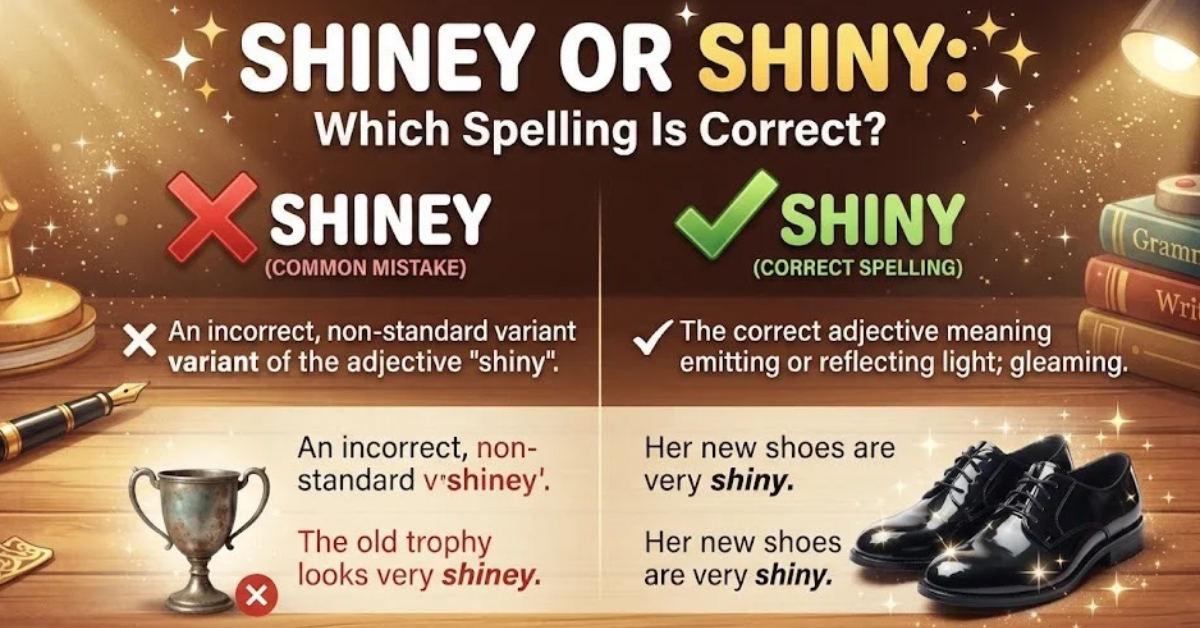
If you’re choosing between shiney or shiny, the correct standard-English spelling is shiny.
- Shiny — correct
- Shiney — generally incorrect
Shiny is an adjective that describes something with a bright, smooth, or reflective surface. It can also describe something that looks new, polished, or attractive.
Examples of “shiny”
- She bought a shiny new pair of shoes.
- The car has a shiny black exterior.
- His shoes looked shiny after being polished.
- Sunlight reflected off the shiny metal.
- The children were fascinated by the shiny decorations.
So, if you’re writing an email, article, school assignment, product description, or social media post, shiny is the spelling you should use.
Why Is “Shiny” Spelled Without the E?
The confusion becomes easier to understand when you look at how English forms adjectives.
The word shiny comes from the verb shine combined with the suffix -y. However, English spelling rules don’t always mean that every letter from the original word remains when a suffix is added.
In this case:
shine + y → shiny
The final e is dropped before -y.
This pattern appears in other English words as well. For example:
- noise + y → noisy
- ice + y → icy
- spice + y → spicy
- taste + y → tasty
- haze + y → hazy
Following the same pattern gives us:
shine + y → shiny
That is why shiney is not the standard spelling.
What Does “Shiny” Mean?
The adjective shiny generally means reflecting light because a surface is smooth, polished, or naturally bright.
For example, a freshly polished table may have a shiny surface because light reflects from it.
The word can describe many different things, including:
- Metal
- Shoes
- Cars
- Jewelry
- Hair
- Floors
- Clothing
- Paper
- Objects with polished surfaces
Shiny can also mean “new-looking”
In casual English, shiny can describe something that looks new, attractive, or recently purchased.
For example:
“He showed everyone his shiny new phone.”
Here, “shiny” may literally describe the phone’s appearance, but the phrase “shiny new” also emphasizes that it is new and appealing.
Shiny vs. Shiney: Common Spelling Mistake
Why do people write shiney if the correct spelling is shiny?
The most obvious reason is pronunciation and word formation.
When people see the verb shine, they may naturally assume that adding -y produces:
shine + y = shiney
That seems reasonable because many English words retain their spelling when suffixes are added. However, shiny follows the spelling convention in which the final e is removed before the suffix -y.
The mistake is therefore understandable, but it doesn’t make “shiney” correct in standard written English.
How to Pronounce “Shiny”
Shiny is usually pronounced:
SHY-nee
In phonetic notation, it is commonly represented as:
/ˈʃaɪni/
The first syllable sounds like “shy,” while the second sounds like “nee.”
For example:
“That is a shiny car.”
You would pronounce it approximately as:
“That is a SHY-nee car.”
The pronunciation is essentially the same regardless of whether someone accidentally writes “shiney.”
Shiny in Different Contexts
The word shiny is versatile and appears in everyday conversation, writing, advertising, and product descriptions.
1. Shiny objects
This is the most literal use of the word.
“The child picked up a shiny coin.”
The coin reflects light, making it appear bright or polished.
2. Shiny hair
The word is frequently used to describe healthy-looking or glossy hair.
“She used a conditioner that left her hair shiny.”
In this context, shiny hair generally means hair that reflects light and has a smooth or glossy appearance.
3. Shiny shoes
Shoes can become shiny after polishing.
“He polished his shoes until they were shiny.”
4. Shiny surfaces
The word can describe furniture, floors, appliances, and other surfaces.
“The kitchen has shiny marble countertops.”
5. Shiny new products
“Shiny” is also common in marketing and informal speech.
“I just bought a shiny new laptop.”
Here, the phrase suggests something appealing, modern, and new.
Shiny vs. Glossy: Are They the Same?
Shiny and glossy are closely related, but they aren’t always interchangeable.
Shiny is a broad term for something that reflects light or has a bright appearance.
Glossy often describes a particularly smooth surface that reflects light, especially when talking about materials such as paper, paint, photographs, hair, or cosmetics.
For example:
- Shiny metal
- Glossy magazine paper
- Shiny shoes
- Glossy hair
There is considerable overlap between the two words, but glossy can sound more specific when describing a polished or smooth finish.
Shiny vs. Bright
These words can also be confused.
Bright usually refers to the amount of light something gives off, reflects, or appears to have.
Shiny focuses more specifically on the reflective quality or appearance of a surface.
Compare:
“The room is bright.”
This suggests that there is plenty of light.
“The table is shiny.”
This suggests that the table’s surface reflects light.
Something can therefore be bright without being shiny, and something can be shiny without being particularly bright.
Is “Shiney” Ever Correct?
In standard English, “shiney” is generally not the correct spelling of the adjective meaning reflective or glossy.
You may still encounter shiney online, in usernames, brand names, informal posts, or names of fictional characters. A proper name or brand can intentionally use an unusual spelling.
That doesn’t change the standard spelling of the English adjective.
If you’re writing formal or professional English, use shiny.
Common Sentences With “Shiny”
Here are some natural examples to help you remember the correct spelling:
- The new car has a shiny exterior.
- She wore shiny silver earrings.
- His shoes were clean and shiny.
- The floor looked shiny after it was polished.
- I bought a shiny new watch.
- The metal surface is extremely shiny.
- The sunlight made the water look shiny.
- She has long, shiny hair.
- The children collected shiny stones.
- The gift was wrapped in shiny paper.
Notice that shiny works naturally before a noun and after linking verbs such as look and be.
How to Remember the Correct Spelling
If you frequently confuse shiney or shiny, try this simple trick:
Remember: “Drop the E”
Start with:
shine
Then add:
-y
Drop the final e:
shine → shiny
You can also remember similar words:
- ice → icy
- spice → spicy
- noise → noisy
- taste → tasty
- shine → shiny
This makes the spelling pattern easier to recognize.
Shine, Shiny, Shining, and Shined: What’s the Difference?
These related words have different grammatical functions.
Shine
Shine is primarily a verb.
“The sun will shine tomorrow.”
It can also be a noun in certain contexts.
“Give the shoes a shine.”
Shiny
Shiny is an adjective.
“The shoes are shiny.”
It describes the appearance or surface of something.
Shining
Shining is usually the present participle or gerund form of shine.
“The sun is shining.”
It can also work as an adjective:
“She has a shining personality.”
Shone
Shone is the past tense and past participle of shine when referring to emitting or reflecting light.
“The moon shone brightly last night.”
These words are related, but they should not be used interchangeably.
Is “Shiney” a Word?
You may find shiney in online dictionaries, user-generated content, names, or other specialized contexts, but it is not the standard spelling of the common adjective meaning “reflecting light.”
For normal English writing, the safest and accepted choice is:
Shiny.
If you’re completing an academic assignment, writing professionally, or creating SEO content, use shiny rather than shiney.
Why the Shiney or Shiny Confusion Is So Common
English contains many spelling patterns that aren’t immediately obvious from pronunciation.
When a word ends in a silent e, people may expect that letter to remain when a suffix is added. That’s why shiney can look perfectly plausible at first glance.
However, English spelling is based on established patterns rather than simply adding letters mechanically. In this case, the conventional form is shiny.
The good news is that once you learn the pattern, the distinction is easy to remember.
Quick Comparison: Shiney vs. Shiny
| Word | Correct? | Meaning |
| Shiny | Yes | Bright, reflective, or glossy |
| Shiney | Generally no | Common misspelling of “shiny” |
| Shine | Yes | To emit or reflect light |
| Shining | Yes | Giving off or reflecting light |
| Shone | Yes | Past form of “shine” in relevant uses |
Frequently Asked Questions About Shiney or Shiny
Is “shiny” the correct spelling?
Yes. Shiny is the standard spelling of the adjective used to describe something that reflects light or has a bright, polished appearance.
Is “shiney” grammatically correct?
“Shiney” is generally considered a spelling error when you mean the adjective shiny. Standard English uses shiny.
Why do people spell shiny as “shiney”?
The mistake usually happens because people see the word shine and assume that adding -y creates shiney. However, the standard spelling drops the final e, producing shiny.
How do you spell shiny correctly?
The correct spelling is:
S-H-I-N-Y
Not:
S-H-I-N-E-Y
What is the meaning of shiny?
Shiny means reflecting light or having a smooth, bright, or polished appearance. It can describe objects such as metal, shoes, cars, jewelry, hair, and surfaces.
What is the difference between shiny and glossy?
Both words describe surfaces that reflect light. Shiny is a broader term, while glossy often suggests a particularly smooth or polished finish.
Is “shiny” an adjective?
Yes. Shiny is an adjective because it describes a characteristic or quality of a noun.
For example:
“She bought a shiny dress.”
What is the opposite of shiny?
Depending on the context, possible opposites include dull, matte, rough, or non-reflective.
For example:
“The shiny surface became dull over time.”
Final Verdict: Shiney or Shiny?
When deciding between shiney or shiny, choose shiny.
Shiny is the standard English adjective for something that reflects light or has a bright, smooth, polished, or glossy appearance. Shiney is usually a misspelling caused by incorrectly keeping the final e from the word shine.
The easiest way to remember it is simple:
shine + y = shiny
So the next time you’re describing polished shoes, glossy hair, a new phone, or a reflective surface, write shiny.
If you’re interested in improving your English spelling and vocabulary, exploring other commonly confused words can be a great next step. Learning these small spelling patterns can make everyday writing much clearer and more confident.