Have you ever paused while writing a sentence because you weren’t sure whether to spell the word exaggerate or exagerate? You’re not alone. This is a common spelling question because the word sounds relatively simple when spoken, but its correct spelling contains a double letter that is easy to overlook.
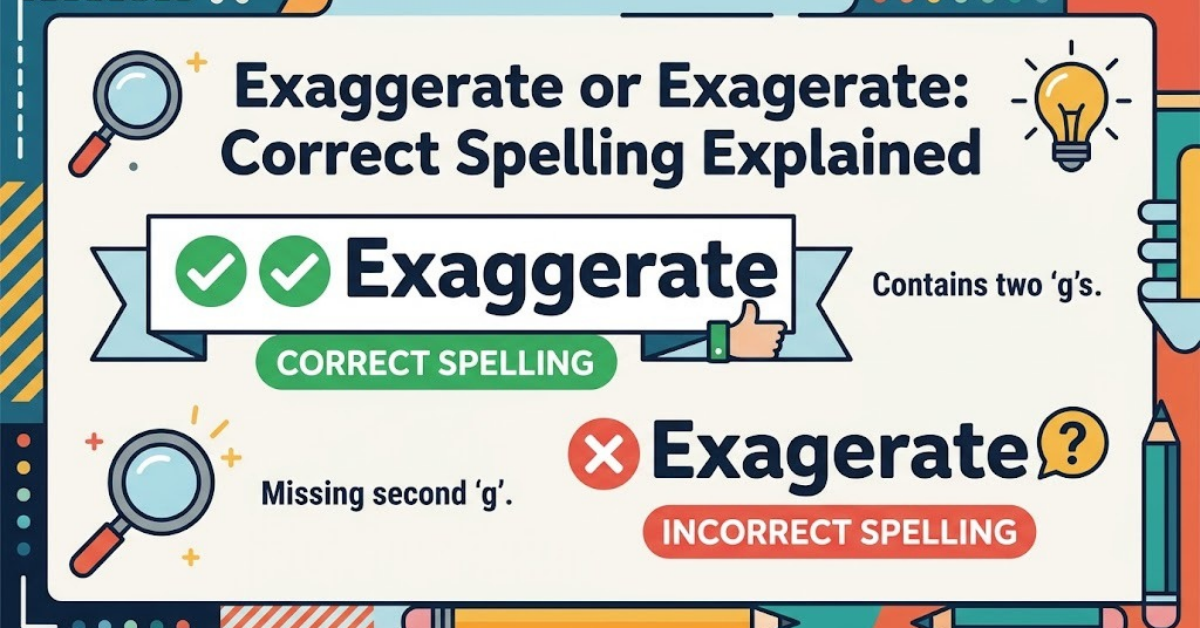
The correct spelling is exaggerate, with two g’s. Exagerate is a misspelling and is not accepted as the standard spelling in English dictionaries.
Whether you’re writing a school assignment, sending a professional email, or creating online content, understanding this difference will help you communicate more clearly. Let’s explore the meaning, pronunciation, examples, and spelling tricks that make the correct form easier to remember.
Exaggerate or Exagerate: Which One Is Correct?
The correct spelling is exaggerate. It contains two g’s after the letter e in the middle of the word: ex-ag-ger-ate.
The incorrect form, exagerate, leaves out one g. Although readers will often understand what you mean, using the incorrect spelling can make your writing appear less polished.
Here’s a quick comparison:
| Word | Correct or Incorrect? | Explanation |
| Exaggerate | Correct | Standard English spelling |
| Exagerate | Incorrect | Missing one g |
| Exaggerated | Correct | Past tense or past participle |
| Exaggerating | Correct | Present participle or gerund |
| Exaggeration | Correct | Noun form |
| Exaggerative | Correct | An adjective meaning tending to exaggerate, though less common |
Remember: If you’re choosing between exaggerate and exagerate, always use exaggerate.
What Does Exaggerate Mean?
To exaggerate means to describe something as bigger, better, worse, more serious, or more important than it really is. It involves overstating facts, details, feelings, or events.
People exaggerate for different reasons. Sometimes they do it to make a story more entertaining, express strong emotions, or emphasize a point. In other situations, exaggeration can mislead people by making an event or situation seem different from reality.
For example, imagine someone says, “I’ve been waiting for a hundred years!” when they have actually been waiting for only 20 minutes. The statement is an exaggeration because the speaker is making the waiting time sound much longer than it was.
Examples of Exaggerate in Everyday Sentences
Here are several examples that show how to use the word correctly:
- “Don’t exaggerate how difficult the exam was.”
- “He tends to exaggerate when telling stories about his travels.”
- “She exaggerated the amount of money she spent on shopping.”
- “My brother says he has a million things to do today.”
- “The advertisement exaggerated the product’s benefits.”
- “I don’t want to exaggerate, but that was one of the best meals I’ve ever had.”
In each example, the word describes an overstatement rather than a completely accurate account.
Why Is Exaggerate Often Misspelled as Exagerate?
The mistake usually happens because people rely on pronunciation rather than spelling. When speaking, the two g’s in exaggerate are not always obvious, so writers may accidentally leave one out.
Several factors contribute to this common error:
1. The Double G Is Easy to Forget
English contains many words with doubled consonants, and remembering which words require them can be challenging. Because exaggerate is a relatively long word, the double g may be overlooked when typing quickly.
2. Pronunciation Doesn’t Reveal Every Letter
The word is commonly pronounced ig-ZAJ-uh-rayt or eg-ZAJ-uh-rayt, depending on accent and pronunciation guide. The sound does not clearly signal that the spelling requires two g’s.
3. Typing Quickly Can Cause Errors
People often type familiar words from memory without checking their spelling. If someone has repeatedly seen or typed exagerate, the incorrect version may start to look familiar even though it is wrong.
A useful solution is to slow down when writing words you commonly misspell and use a spell-checking tool when necessary.
How to Remember the Correct Spelling of Exaggerate
If you frequently confuse exaggerate with exagerate, a simple memory trick can help.
Use the Double-G Trick
Break the word into smaller parts:
Exag + gerate = Exaggerate
Focus on the two g’s in the middle. You can also remember the phrase “exaggeration gets bigger,” using the double g as a visual reminder.
Another helpful technique is to write the word correctly several times while saying each letter aloud:
- Exaggerate
- Exaggerate
- Exaggerate
Then use it in a sentence, such as, “I don’t want to exaggerate the situation.”
Practicing the word in context is generally more useful than memorizing the spelling in isolation because it helps you recognize how the word works in everyday writing.
Exaggerate vs. Exaggeration vs. Exaggerated
These words share the same root but serve different grammatical purposes.
| Word | Part of Speech | Meaning | Example |
| Exaggerate | Verb | To overstate something | “Don’t exaggerate the facts.” |
| Exaggeration | Noun | An overstated description or claim | “That sounds like an exaggeration.” |
| Exaggerated | Past-tense verb or adjective | Something that was overstated or made to seem greater | “His reaction was exaggerated.” |
| Exaggerating | Verb form or gerund | The act of overstating something | “You’re exaggerating the problem.” |
Understanding these forms helps you choose the right word for different sentences. Notice that each spelling retains the double g.
What Is the Difference Between Exaggerate and Overstate?
Exaggerate and overstate have similar meanings, but their usage can differ slightly.
To exaggerate is to make something seem greater, more extreme, or more significant than it really is. To overstate is to express something too strongly or claim more than the facts justify.
For example:
- Exaggerate: “She exaggerated the size of the fish she caught.”
- Overstate: “The report overstated the financial benefits of the proposal.”
Both words suggest that a description goes beyond what the facts support. However, overstate is often used in formal, professional, or analytical contexts.
Is Exaggerate a Verb?
Yes, exaggerate is a verb. It describes the action of making something seem more significant, extreme, or impressive than it actually is.
For example, in the sentence “He tends to exaggerate his achievements,” the verb exaggerate describes what he does.
The word can appear in several forms depending on the sentence:
- Present: exaggerate
- Third-person singular: exaggerates
- Past tense: exaggerated
- Present participle: exaggerating
Each form keeps the double g, so the spelling rule remains consistent.
Is Exaggeration Always a Bad Thing?
Not necessarily. Exaggeration can be harmless or entertaining when people understand that a statement isn’t meant to be taken literally.
For example, saying “I’m so hungry I could eat a horse” is a familiar type of hyperbole. The speaker isn’t making a literal claim but using an exaggerated expression to communicate strong hunger.
However, exaggeration becomes problematic when it misrepresents important facts. Inflating qualifications on a résumé, overstating a product’s benefits, or making a minor problem sound like a serious emergency can damage trust.
The difference often comes down to context, intention, and whether the audience understands that the statement is figurative.
Common Mistakes to Avoid When Using Exaggerate
Knowing the correct spelling is important, but using the word appropriately matters too.
Watch out for these common mistakes:
- Writing “exagerate”: Always include both g’s.
- Confusing exaggerate with exaggeration: Use exaggerate for the action and exaggeration for the statement or idea.
- Using exaggeration as a factual claim: Make sure readers can distinguish an expressive statement from a literal one.
- Overusing the word: Depending on the context, alternatives such as overstate, embellish, inflate, or overemphasize may communicate your meaning more precisely.
Choosing the right word makes your writing clearer and more effective.
Frequently Asked Questions
1. Is it exaggerate or exagerate?
Exaggerate is the correct spelling. The word contains two g’s, while exagerate is a common spelling mistake.
2. Why does exaggerate have two g’s?
The standard English spelling of exaggerate includes a double g. Although the pronunciation may not make both letters obvious, the accepted spelling must be learned and remembered.
3. How do you spell exaggerate correctly?
Spell it E-X-A-G-G-E-R-A-T-E. A useful strategy is to remember the two g’s in the middle and practice the word in a sentence.
4. What is the meaning of exaggerate?
To exaggerate means to make something seem greater, smaller, more serious, or more extreme than it really is. For example, saying you have a thousand tasks when you have only a few is an exaggeration.
5. What is the past tense of exaggerate?
The past tense is exaggerated. For example: “He exaggerated the story when he told it to his friends.”
6. What is the noun form of exaggerate?
The noun form is exaggeration. It refers to an overstatement or the act of making something seem more significant than it actually is.
7. Is exaggerate a formal or informal word?
Exaggerate works in both formal and informal English. You can use it in everyday conversations, academic writing, news reports, and professional communication.
Conclusion
When deciding between exaggerate or exagerate, the correct choice is always exaggerate. The word contains two g’s, and the version with only one g is a spelling error.
Remember that exaggerate means to make something seem greater, more serious, or more extreme than it really is. Its related forms, including exaggerated, exaggerating, and exaggeration, also retain the double g.
To strengthen your spelling, practice writing the word, use it in everyday sentences, and proofread your work before publishing or submitting it. If you enjoy learning about commonly confused English words, explore more spelling guides to improve your vocabulary and make your writing clearer and more confident.