Have you ever typed “puting” and wondered whether it looks right? You are not alone. The correct spelling is “putting”, with two t’s.
The confusion usually comes from a common English spelling rule involving verbs that end in a single consonant. When the verb put takes the -ing ending, it becomes putting, not puting. Understanding why this happens can make the spelling easier to remember and help you avoid similar mistakes in everyday writing.
Puting or Putting: Which One Is Correct?
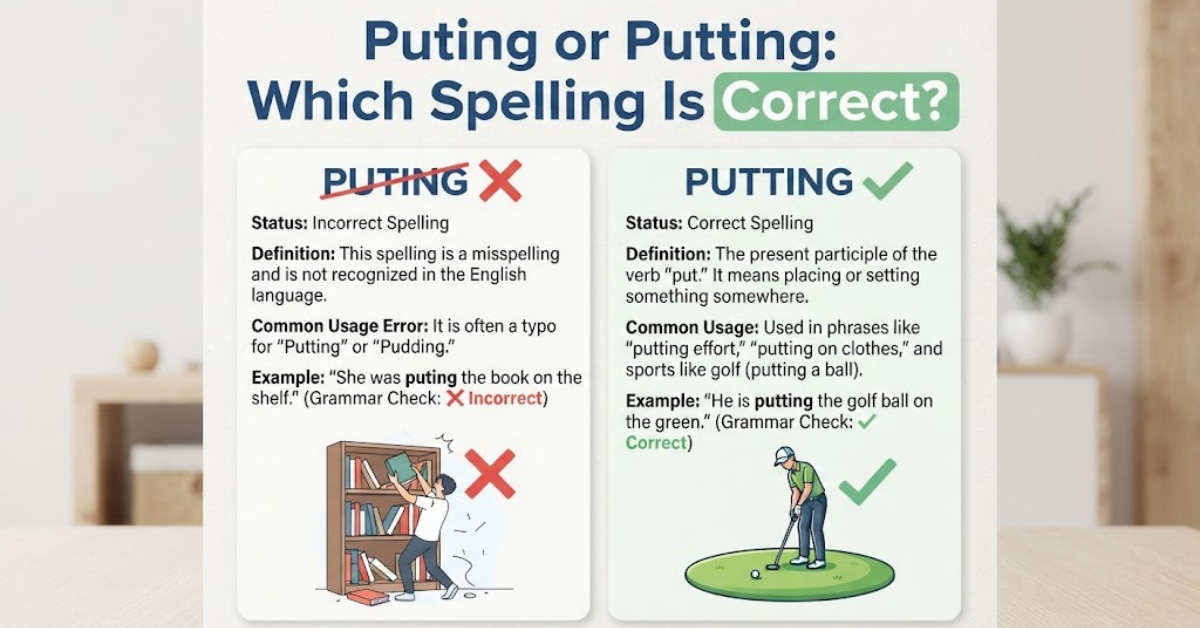
The correct spelling is putting.
- Puting — incorrect
- Putting — correct
Putting is the present participle and gerund form of the verb put.
For example:
She is putting the books on the shelf.
I am putting my phone on the table.
He enjoys putting together puzzles.
The spelling “puting” is a common mistake, but it is not accepted as the standard English spelling of the word.
Why Is “Putting” Spelled With Two T’s?
The answer comes from the way the verb put is combined with the suffix -ing.
The base verb is:
put
Add -ing:
put + ing = putting
The final t is doubled, producing tt.
This is part of a broader spelling pattern in English where a final consonant may be doubled before adding a suffix. However, put has an important characteristic: it is a short, one-syllable verb ending in a single consonant.
The resulting word is therefore:
PUT + TING → PUTTING
It is useful to remember the word as put + ting, rather than trying to spell it as put + ing.
What Does “Putting” Mean?
Putting is the -ing form of “put.” The verb put has several meanings depending on the context, but its central idea is generally to move, place, or position something somewhere.
For example:
- Putting the keys on the desk means placing the keys there.
- Putting on a jacket means wearing a jacket.
- Putting an idea into practice means applying an idea.
- Putting someone under pressure means causing someone to experience pressure.
The word can function as part of a verb phrase or as a gerund.
“Putting” as Part of a Verb
When putting is used with a form of be, it commonly describes an action that is happening.
Examples:
- I am putting the dishes away.
- She is putting her shoes on.
- They are putting the furniture inside.
- We were putting everything back in its place.
“Putting” as a Gerund
A gerund is an -ing form of a verb that functions as a noun.
Examples:
- Putting things off can create unnecessary stress.
- Putting your thoughts into writing can be helpful.
- Putting safety first is important.
- Putting in extra effort often produces better results.
In these sentences, putting describes an activity or concept rather than simply forming a continuous verb tense.
Puting vs. Putting Examples
Seeing the two spellings side by side makes the difference easy to remember.
| Incorrect | Correct |
| I am puting the book away. | I am putting the book away. |
| She is puting on her shoes. | She is putting on her shoes. |
| He is puting the food in the refrigerator. | He is putting the food in the refrigerator. |
| They are puting everything together. | They are putting everything together. |
| We are puting the plan into action. | We are putting the plan into action. |
The key point is simple: always spell it “putting” when you mean the -ing form of “put.”
Why Do People Spell “Putting” as “Puting”?
The mistake is understandable because many English verbs simply take -ing without doubling their final consonant.
For example:
- play → playing
- read → reading
- help → helping
- clean → cleaning
A writer may therefore assume:
put + ing = puting
But English spelling does not always work that mechanically. Some verbs double their final consonant when -ing or another suffix is added.
That is why it is important to learn common spelling patterns rather than relying only on pronunciation.
The Spelling Rule Behind Double Consonants
A useful general rule is that a one-syllable verb ending in one vowel followed by one consonant often doubles the final consonant before adding -ing.
Examples include:
- run → running
- sit → sitting
- stop → stopping
- swim → swimming
- get → getting
- plan → planning
Compare these with verbs that do not normally double the final consonant:
- read → reading
- rain → raining
- look → looking
- jump → jumping
The exact rules become more complicated with longer words, stress patterns, and different endings, so it is best to treat this as a useful guideline rather than an absolute rule for every English verb.
Is “Puting” Ever Correct?
In standard modern English, “puting” is not the correct spelling of the -ing form of the verb “put.”
If you are writing an email, essay, article, school assignment, business document, or social media post, use putting.
There may be unusual cases where a similar-looking sequence appears as part of a proper name, username, brand, or another specialized term. Those are separate from the ordinary English verb put.
For normal English usage, the choice is straightforward:
Putting is correct. Puting is incorrect.
Common Phrases With “Putting”
Because put is such a versatile English verb, putting appears in hundreds of everyday expressions.
Here are some common examples:
Putting on
Means placing clothing or another item on your body.
She is putting on her coat.
Putting away
Means returning something to its proper place.
Please finish putting away the groceries.
Putting together
Can mean assembling something or combining ideas.
We are putting together a presentation.
Putting off
Means delaying something.
He keeps putting off his homework.
Putting up with
Means tolerating something unpleasant or annoying.
I don’t know how she keeps putting up with the noise.
Putting into practice
Means applying an idea or theory in a real situation.
The students are putting their new skills into practice.
Putting first
Means treating something as a priority.
The company is putting customer safety first.
Putting in Different Types of Sentences
Learning the word through examples is one of the easiest ways to remember its spelling.
Present Continuous
I am putting the dishes away.
Past Continuous
She was putting the children to bed.
As a Gerund
Putting things off can make problems worse.
After a Preposition
He is interested in putting his ideas into action.
In an Idiomatic Expression
They are putting all their effort into the project.
These examples show that putting can appear in several grammatical structures while retaining the same spelling.
Putting vs. Put: What Is the Difference?
The words put and putting are forms of the same verb, but they are used differently.
Put is the base form:
Please put the keys on the table.
Putting is the -ing form:
She is putting the keys on the table.
Another important point is that put is an irregular verb. Its basic forms are:
- Present: put
- Past: put
- Past participle: put
- -ing form: putting
The past tense does not change to putted in standard English.
For example:
I put the book on the desk yesterday.
Not:
I putted the book on the desk yesterday.
Common Spelling Mistakes Similar to “Puting”
If you struggle with putting, you may also encounter similar mistakes involving doubled consonants.
Here are a few examples:
- runing → running
- siting → sitting
- stoping → stopping
- begining → beginning
- planing → planning
The correct spelling depends on the word and its spelling pattern. Simply adding -ing to every verb without checking the final consonant can lead to errors.
How to Remember the Correct Spelling of Putting
A simple memory trick is to break the word into two parts:
put + ting = putting
Notice that the word contains two t’s in the middle:
puTTing
You can also connect it with other familiar words such as:
- sitting
- getting
- hitting
- running
- stopping
Once you become familiar with the double-consonant pattern, putting becomes much easier to remember.
“Puting or Putting” in American and British English
There is no major American-versus-British spelling difference here.
Both American English and British English use:
putting
So whether you are writing for a reader in the United States, United Kingdom, Canada, Australia, or another English-speaking region, putting is the standard spelling.
Is “Putting” a Verb or a Noun?
Putting can serve different grammatical functions depending on how it is used.
It is commonly the present participle of put:
She is putting the books away.
It can also function as a gerund:
Putting your goals on paper can help you stay focused.
In both cases, the spelling remains putting.
The context determines its grammatical role.
Quick Trick: Puting or Putting?
If you only need the answer quickly, remember this:
Put + ing = putting
Not:
put + ing = puting
The correct word has two t’s:
PUTTING
This is the spelling you should use in formal and informal English.
Frequently Asked Questions About Puting or Putting
Is “puting” or “putting” correct?
Putting is correct. Puting is a misspelling when you mean the -ing form of the verb put.
Why does putting have two T’s?
The final consonant is doubled when forming putting from put. The spelling follows a common English consonant-doubling pattern found in words such as sitting, running, and stopping.
Is “puting” a word?
“Puting” is not the standard spelling of the -ing form of put. In ordinary English writing, use putting instead.
What is the past tense of put?
The past tense of put is also put.
For example:
I put the keys on the table yesterday.
The word does not become putted in standard English.
What is the correct spelling of put + ing?
The correct spelling is putting.
Put + ing → putting
Is putting spelled with one or two T’s?
It is spelled with two t’s:
PUTTING
What does putting mean?
Putting is the -ing form of put. It generally refers to placing, moving, positioning, or causing something to be in a particular state or situation.
Is putting the same in British and American English?
Yes. Putting is spelled the same way in both British and American English.
Final Verdict: Puting or Putting?
When deciding between puting or putting, there is only one standard spelling to choose: putting.
The word comes from the verb put and is formed by adding -ing, with the final t doubled:
put → putting
If you are writing an essay, sending a professional email, creating website content, or simply texting someone, use putting rather than puting.
The easiest way to remember it is to picture the word as puTTing. Once that double t becomes familiar, this common spelling mistake is easy to avoid.