Have you ever written breakroom and wondered whether it should actually be break room? You’re not alone. The spelling breakroom vs break room can be confusing because both forms appear in workplace signs, employee handbooks, office documents, and everyday conversations.
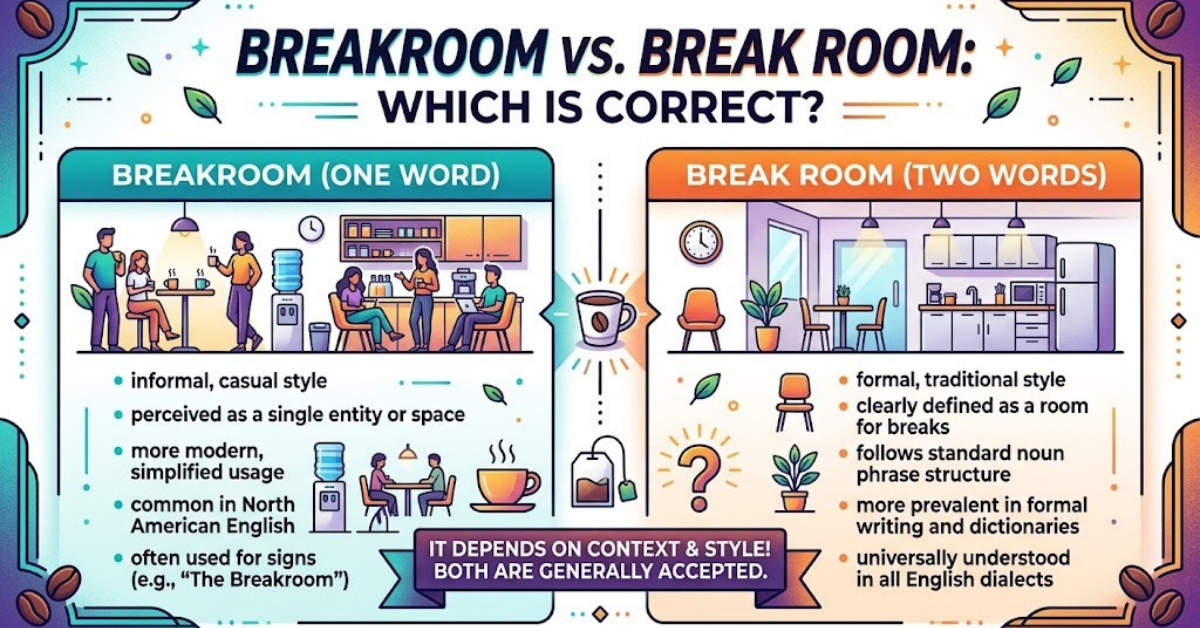
The good news is that both “breakroom” and “break room” are acceptable spellings when referring to a designated place where employees relax, eat, or take a short break. However, the two-word form, break room, is widely used in standard American English, while breakroom is also common, particularly in workplace materials and compound-word usage.
The best choice depends on your writing style, audience, and any spelling conventions your organization follows. Let’s look at the meanings, examples, and practical rules that can help you choose the right form.
Breakroom vs Break Room: Which One Is Correct?
Both breakroom and break room can be correct. They refer to the same place: a room where people take breaks, eat meals, drink coffee, or relax during working hours.
Here’s a quick comparison:
- Break room: The conventional two-word spelling, widely used in American English.
- Breakroom: A recognized closed-compound spelling that also appears in modern workplace writing.
For example, both of these sentences are acceptable:
- Employees can enjoy their lunch in the break room.
- Employees can enjoy their lunch in the breakroom.
Neither version changes the intended meaning.
However, if you’re writing a formal document and don’t have a specific style guide to follow, break room is a sensible default. It is familiar to readers and commonly used in general American English writing.
What Does Break Room Mean?
A break room is a designated space in a workplace where employees can step away from their usual duties for a short period.
Depending on the workplace, it may include tables, chairs, a refrigerator, a microwave, a coffee machine, vending machines, or other basic amenities.
Break rooms are common in many settings, including:
- Corporate offices
- Hospitals and medical facilities
- Factories and warehouses
- Retail stores
- Schools and universities
- Restaurants and hotels
- Call centers
- Construction sites
The purpose of a break room is to give employees a place to eat, rest, socialize, or recharge before returning to work.
Although the term is especially common in workplace settings, people sometimes use it more broadly for a shared room where members of a group can take a break.
Why Are Breakroom and Break Room Both Used?
English frequently combines words into closed compounds over time. Words that were once written separately may eventually appear as one word, while other compounds retain their spaces.
Examples include:
| Two-word form | Closed-compound form |
| Break room | Breakroom |
| Living room | Livingroom (less common in standard usage) |
| Coffee shop | Coffeeshop (usage varies by context) |
| Website | Website |
| Work space | Workspace |
These examples also show why compound-word spelling cannot always be predicted by one universal rule. Some compounds are conventionally written as one word, some as two, and others have more than one accepted form.
In the case of break room, both spellings are used, although the two-word version is a familiar conventional choice.
Breakroom vs Break Room in American English
In American English, break room is a widely established spelling for a room where employees take breaks.
You may encounter it in:
- Employee policies
- Workplace notices
- Office building directories
- Job descriptions
- Facility management documents
- Health and safety instructions
For example:
Please keep the break room clean after using the microwave.
The closed form, breakroom, is also used by businesses, particularly in internal communications, signage, and workplace-related content.
If you’re writing for an American audience, either form may be understood. The key is to follow the spelling conventions used throughout your document.
Breakroom vs Break Room in British English
British English also uses the term break room, especially when describing a designated room for employees to rest or eat.
However, workplace vocabulary can vary by region and industry. In some British workplaces, people may use terms such as staff room, staffroom, or common room instead.
These expressions can overlap in meaning, but they aren’t always interchangeable:
- Break room: A place primarily intended for taking breaks.
- Staff room: A shared room for employees, often used for breaks, meetings, or informal conversations.
- Common room: A shared space in an institution, school, university, or other community setting.
If you’re writing for an international audience, break room is a clear and easily understood option.
Break Room vs Staff Room: What’s the Difference?
Although a break room and a staff room may serve similar purposes, their typical uses can differ.
A break room is generally intended for employees to take short breaks, have a snack, drink coffee, or eat lunch.
A staff room is a shared space for employees that may also be used for meetings, discussions, planning, or storing personal belongings.
For example:
- The factory workers ate lunch in the break room.
- The teachers discussed their lesson plans in the staff room.
In some workplaces, the same room may serve both purposes. The preferred term often depends on the workplace’s location and established terminology.
Break Room vs Breakroom: Examples in Sentences
The easiest way to understand the difference is to see both forms used in context.
Examples Using Break Room
- The employees gathered in the break room for lunch.
- Please turn off the lights when leaving the break room.
- Our office break room has a refrigerator and microwave.
- The manager posted the new schedule on the break room noticeboard.
- Staff members can relax in the break room during their scheduled breaks.
Examples Using Breakroom
- The company recently renovated its breakroom.
- Employees are responsible for keeping the breakroom tidy.
- A new coffee machine has been installed in the breakroom.
- The breakroom is located beside the main office.
- The supervisor reminded everyone not to leave food in the breakroom overnight.
Both sets of examples communicate the same meaning. The difference is simply the spelling.
Is Breakroom One Word or Two?
This is one of the most common questions about the term.
Break room is conventionally written as two words, but breakroom is also an accepted spelling in common usage.
The two-word version treats break and room as separate words that work together to describe a particular kind of room.
The one-word version treats the expression as a closed compound.
Neither spelling automatically makes a sentence more professional. What matters most is using a form that is recognized by your audience and applying it consistently.
Which Spelling Should You Use?
Follow these simple guidelines:
- For general writing: Choose break room as a familiar default.
- For company documents: Follow your organization’s preferred spelling.
- For website content: Use the form that best matches your audience and maintain consistency.
- For signs and labels: Either can work; prioritize readability and consistency.
- For school assignments: Follow your teacher’s or style guide’s preference.
If a company already uses Breakroom throughout its employee materials, there is usually no reason to change it unless a specific editorial standard requires the two-word form.
Common Mistakes When Using Break Room
Although the spelling difference is straightforward, a few related mistakes are worth avoiding.
1. Switching Between Both Forms Without a Reason
Using break room in one paragraph and breakroom in the next can make a document look inconsistent.
Choose one form and use it throughout the same document unless a proper name or quotation requires otherwise.
2. Confusing Break Room With Break Time
A break room is a place. Break time is the period when someone takes a break.
For example:
- Correct: I went to the break room during my break time.
- Incorrect in meaning: I went to the break time to eat lunch.
Remember that room refers to a physical space, while time refers to a period.
3. Confusing Break Room With Restroom
A break room is intended for resting or eating during work. A restroom is a facility used for personal hygiene.
The two terms describe different spaces and should not be used interchangeably.
4. Assuming One Spelling Is Always Wrong
Because both breakroom and break room are used, it is inaccurate to label the closed form as universally incorrect. The two-word version is a reliable default, but the one-word form is also found in established usage.
How to Choose the Best Spelling for Workplace Writing
If you’re preparing workplace content, choosing between breakroom and break room is less important than making the writing clear and consistent.
Consider the following approach:
- Employee handbook: Use the spelling established by the company’s editorial style.
- Workplace sign: Choose a short, readable label such as “Break Room.”
- Office website: Use the spelling that fits your existing content.
- Formal report: Prefer the conventional two-word form unless your style guide specifies otherwise.
- Internal chat: Either form is generally understandable.
For example, a sign reading “Please Keep the Break Room Clean” is clear and professional.
A sign reading “Please Keep the Breakroom Clean” is also understandable and acceptable.
Frequently Asked Questions About Breakroom vs Break Room
Is breakroom one word or two?
Both forms are used. Break room is the conventional two-word spelling and a good default for general writing, while breakroom is also a recognized closed-compound form.
Is breakroom grammatically correct?
Yes. Breakroom is used as a closed compound in contemporary English, especially in workplace contexts. If you’re following a specific dictionary or style guide, check its preferred spelling.
What is the plural of break room?
The usual plural is break rooms. For example, “The company renovated three break rooms across its offices.” The plural of the closed form is also written as breakrooms when that spelling is used.
Should I write break room or breakroom on a sign?
Either spelling can work. Break Room is a clear, conventional choice for workplace signage, but Breakroom is also understandable. Use whichever form matches the organization’s existing signs and materials.
Is break room hyphenated?
No. The standard forms are break room and breakroom, without a hyphen. Writing break-room is generally unnecessary when referring to the employee area.
What is another word for break room?
Depending on the workplace, alternatives include staff room, employee lounge, staff lounge, and common room. These terms can have slightly different meanings depending on the region and setting.
What is the difference between a break room and a lounge?
A break room is generally intended for employees to eat, rest, and take scheduled breaks. A lounge often emphasizes comfortable seating and relaxation, although some workplaces use the terms interchangeably.
Is break room the same as lunchroom?
Not always. A lunchroom is primarily associated with eating meals, while a break room may be used for meals, coffee breaks, relaxation, and informal conversations. In some workplaces, one room serves both purposes.
Which spelling is better for SEO: breakroom or break room?
The best choice depends on your audience and search intent. Both expressions may appear in searches, so use the most natural spelling in your main content and include the alternative where it fits naturally. Avoid repeating both forms excessively just to target keywords.
Conclusion: Breakroom vs Break Room
When comparing breakroom vs break room, both spellings are acceptable for describing a workplace area where employees take breaks, eat, or relax. The two-word form, break room, is a familiar conventional choice in American English, while breakroom is also widely used in workplace writing.
For most general, professional, or educational writing, break room is a sensible default. If your workplace or publication consistently uses breakroom, you can follow that convention instead.
The most important rule is to choose a spelling that suits your audience and use it consistently. If you’re exploring other commonly confused English words, learning these small distinctions can make your writing clearer, more polished, and easier to understand.