Have you ever wondered whether to write aisle or isle? These two words sound exactly alike in standard English pronunciation, but they have completely different meanings. Choosing the wrong one can change the meaning of your sentence, whether you’re talking about shopping at a grocery store or visiting a beautiful island.
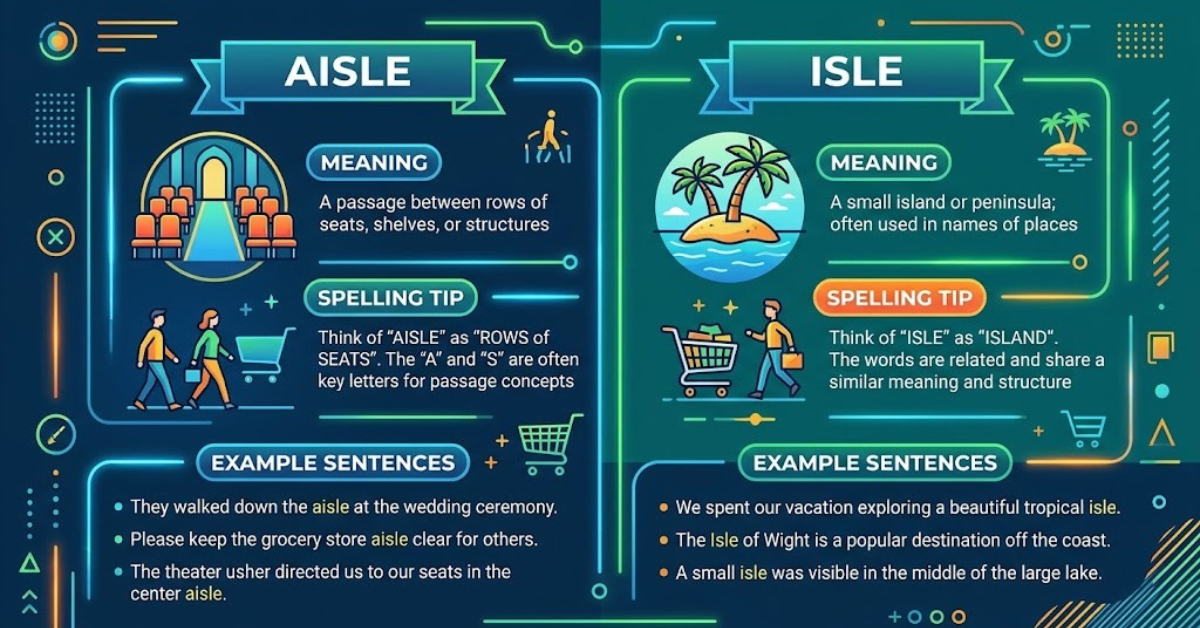
Understanding aisle vs isle is easier than it might seem once you know what each word describes. An aisle is a passage between rows of seats, shelves, or other objects, while an isle is an island or a piece of land surrounded by water.
In this guide, we’ll explain their meanings, show you how to use each word correctly, and share simple tricks to remember the difference.
Aisle vs Isle: What Is the Difference?
The main difference between aisle and isle is their meaning and usage. Although both words are pronounced the same way, they refer to entirely different things.
| Word | Meaning | Example |
| Aisle | A passage between rows of objects, seats, or shelves | “She walked down the grocery aisle.” |
| Isle | An island or a small island | “They spent their vacation on a tropical isle.” |
Aisle is commonly used when discussing supermarkets, airplanes, churches, theaters, and wedding ceremonies. Isle appears more often in descriptions of geography, travel, literature, and island destinations.
The easiest way to remember the distinction is to associate aisle with walking space and isle with an island.
What Does Aisle Mean?
An aisle is an open passage that allows people to move between rows of seats, shelves, furniture, or other structures. It provides access through an area without requiring people to move the objects around it.
You’ll encounter aisles in many everyday settings, including:
- Grocery stores and supermarkets
- Airplanes and trains
- Churches and wedding venues
- Movie theaters and auditoriums
- Libraries and warehouses
For example, when you walk between shelves to find a product at a supermarket, you’re walking down an aisle.
Examples of Aisle in Sentences
Here are some examples that show how to use aisle correctly:
- “You can find the cereal in the third aisle of the supermarket.”
- “Please keep the airplane aisle clear during boarding.”
- “The bride walked down the aisle toward her partner.”
- “We chose seats near the aisle so we could leave easily.”
- “The store employee restocked the shelves along the cleaning products aisle.”
- “A narrow aisle separated the rows of chairs.”
In each sentence, aisle refers to a passage or walkway between rows of things.
Common Expressions Using Aisle
The word aisle also appears in several familiar expressions.
Walk down the aisle: This expression often refers to getting married. It describes the traditional act of walking toward the front of a ceremony venue, although the phrase can also refer more generally to moving through an aisle.
Aisle seat: A seat positioned next to a walkway, commonly on an airplane, bus, train, or in a theater.
Center aisle: A passage running through the middle of a space, such as a church or auditorium.
Down-the-aisle shopping: A phrase sometimes used informally to describe shopping for products displayed along supermarket aisles.
Understanding these expressions makes it easier to recognize the correct spelling in everyday writing.
What Does Isle Mean?
An isle is an island or a piece of land surrounded by water. The word is often associated with smaller islands, scenic destinations, and poetic or literary descriptions of places.
Although isle and island are closely related in meaning, isle tends to sound more literary or descriptive in some contexts. It frequently appears in place names, travel writing, poetry, and historical references.
For example, someone might describe a peaceful vacation destination as a “beautiful tropical isle.”
Examples of Isle in Sentences
Consider these sentences:
- “The travelers sailed toward a remote isle.”
- “The small isle was covered in green vegetation.”
- “They explored a quiet isle off the coast of Scotland.”
- “The island’s inhabitants protected the natural beauty of their isle.”
- “A lighthouse stood on the rocky isle.”
- “The ship passed several tiny isles during its journey.”
In each example, isle refers to land surrounded by water rather than a passage between rows.
Famous Places That Use Isle
The word isle appears in the names of several well-known geographical locations.
- Isle of Man: A self-governing British Crown Dependency located in the Irish Sea.
- Isle of Wight: An island off the southern coast of England.
- Isle Royale: An island in Lake Superior, part of the U.S. state of Michigan.
- Isles of Scilly: An archipelago southwest of mainland Cornwall, England.
These examples are useful reminders that isle relates to islands and geographical locations.
Aisle vs Isle Pronunciation: Do They Sound the Same?
Yes. In standard English, aisle and isle are homophones, meaning they share the same pronunciation but have different meanings and spellings.
Both words are pronounced like “eye-ul”, with one syllable. The letter s is silent in both words.
| Word | Pronunciation | Syllables |
| Aisle | /aɪl/ | 1 |
| Isle | /aɪl/ | 1 |
The pronunciation is the same in common English accents, so you cannot determine which spelling is correct simply by hearing the word. You need to consider the context of the sentence.
For instance:
- “Please meet me in the aisle.” This refers to a passage.
- “Please meet me on the isle.” This refers to an island.
The surrounding words help you identify the intended meaning.
How to Remember Aisle vs Isle
If you regularly confuse these words, a simple memory trick can help you choose the right spelling.
1. Remember That Aisle Has an A
Think of aisle as a passage you might find in an aisle-filled area, such as an airplane or a grocery store. The extra letters distinguish it from isle.
Another useful association is aisle seat. If you’re thinking about sitting beside a walkway, the word you need is aisle.
2. Connect Isle With Island
The word isle is closely related in meaning to island. Both words describe land surrounded by water, making this the easiest connection to remember.
When writing about beaches, coastal landscapes, or island destinations, isle may be the correct choice.
3. Use the Sentence Context
Ask yourself what the word describes:
- Is it a walkway between rows? Use aisle.
- Is it a piece of land surrounded by water? Use isle.
This approach is especially helpful when spell-checking tools cannot identify an error because both spellings are legitimate English words.
Aisle vs Isle vs Island: What’s the Difference?
Although aisle, isle, and island may appear in similar discussions, their meanings are not interchangeable.
| Word | Definition | Example |
| Aisle | A passage between rows or sections | “The books are in the next aisle.” |
| Isle | An island, often used in descriptive or literary contexts | “The boat approached a distant isle.” |
| Island | Land completely surrounded by water | “They live on a small island.” |
The words isle and island are synonyms in many contexts, although their style and usage can differ. An isle is not necessarily smaller than every island, despite the common association between isle and small islands.
An aisle, on the other hand, has no geographical connection to an island. It describes a space people use to move through a building or another arranged area.
Common Mistakes When Using Aisle and Isle
Because the two words sound alike, spelling mistakes are easy to make. Here are some common errors and how to correct them.
Mistake 1: Using Isle for a Store Walkway
Incorrect: “I found the milk in the third isle.”
Correct: “I found the milk in the third aisle.”
The sentence describes a passage between store shelves, so aisle is the correct word.
Mistake 2: Using Aisle for an Island
Incorrect: “They visited a remote aisle in the Pacific Ocean.”
Correct: “They visited a remote isle in the Pacific Ocean.”
The sentence refers to a piece of land surrounded by water, so isle is appropriate. You could also use island.
Mistake 3: Confusing the Words in Wedding Writing
Incorrect: “The bride walked down the isle.”
Correct: “The bride walked down the aisle.”
A wedding aisle is the passage the bride or couple walks along during the ceremony. It is not an island.
Mistake 4: Relying Only on Spell-Check
Spell-checking software may not flag aisle when you intended to write isle, because both are correctly spelled words. Always check the meaning of the sentence instead of relying entirely on automatic corrections.
Aisle vs Isle: Quick Practice Quiz
Test your understanding by choosing the correct word in each sentence.
1. The passengers walked down the airplane _____ to find their seats.
2. The explorers discovered a small _____ near the coast.
3. The bride smiled as she walked down the _____.
4. The family spent a week on a peaceful tropical _____.
5. You can find the pasta in the next grocery store _____.
Answers:
- Aisle
- Isle
- Aisle
- Isle
- Aisle
If you answered all five correctly, you’ve mastered the basic difference between these commonly confused words.
Frequently Asked Questions
1. Is it aisle or isle?
Both spellings are correct, but they have different meanings. Aisle refers to a passage between rows of seats, shelves, or objects, while isle means an island.
2. What is the difference between aisle and isle?
The difference is their meaning and usage. An aisle is a walkway, such as the passage between supermarket shelves, while an isle is a piece of land surrounded by water.
3. Are aisle and isle pronounced the same?
Yes. Both words are pronounced /aɪl/, similar to “eye-ul,” with one syllable. They are homophones because they sound alike but have different meanings and spellings.
4. Is it “walk down the aisle” or “walk down the isle”?
The correct expression is “walk down the aisle.” It commonly refers to a person walking toward the front of a wedding ceremony. Writing isle would change the meaning to an island.
5. Is an isle the same as an island?
In many contexts, yes. An isle is another word for an island, often used in geographical names or descriptive writing. The two words can generally be used interchangeably when referring to land surrounded by water.
6. How do you remember the difference between aisle and isle?
Associate aisle with walkways, grocery stores, and airplane seats. Connect isle with island. Remembering these two associations makes it easier to select the correct spelling.
7. Which word should I use for a grocery store?
Use aisle when referring to a grocery store walkway. For example, “The snacks are in aisle five.” The word isle is incorrect in this context because it refers to an island.
8. Can aisle and isle be used interchangeably?
No. Although they sound the same, their meanings are different. Use aisle for a passage and isle for an island to make your writing accurate and clear.
Conclusion
The difference between aisle vs isle comes down to one simple distinction: an aisle is a passage, while an isle is an island. Both words are pronounced the same way, which explains why people frequently confuse them in writing.
To remember the correct spelling, associate aisle with grocery store walkways, airplane seats, and wedding ceremonies. Connect isle with islands, coastlines, and geographical names.
With a little practice and attention to context, you’ll be able to use both words confidently. If you’re interested in improving your English spelling and vocabulary, explore more guides on commonly confused words and homophones to make your everyday writing clearer and more precise.