Have you ever wanted to write about the musical instrument known for its distinctive sound but suddenly wondered whether it’s spelled accordion or accordian? You’re not alone. This spelling confusion is surprisingly common, especially because both versions look and sound almost identical.
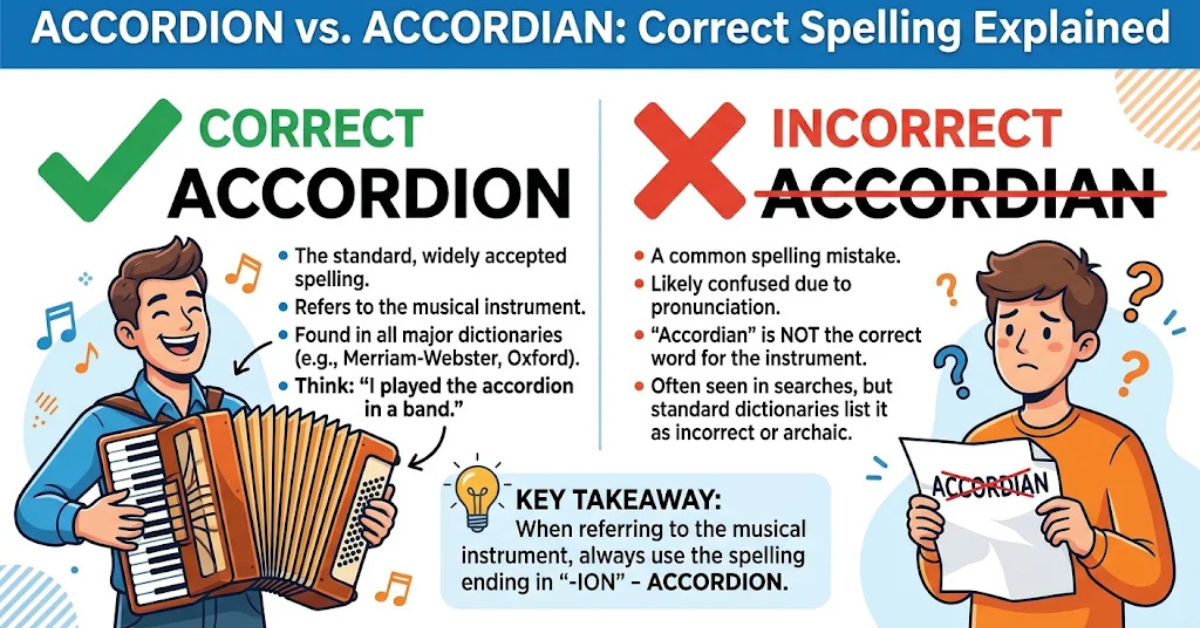
When comparing accordion vs accordian, there is only one correct spelling in standard English: accordion. The spelling accordian is incorrect and is generally considered a typographical or spelling error.
Whether you’re writing a school assignment, searching for musical instruments online, or improving your English vocabulary, knowing the correct spelling can help you avoid unnecessary mistakes. Let’s explore the meaning, pronunciation, origin, examples, and practical ways to remember this word.
Accordion vs Accordian: Which Spelling Is Correct?
The correct spelling is accordion, with an o after the second c. The incorrect spelling, accordian, replaces that o with an i.
Here’s a simple comparison:
| Spelling | Correct or Incorrect? | Explanation |
| Accordion | Correct | Standard English spelling |
| Accordian | Incorrect | Common misspelling |
| Accordions | Correct | Plural form |
| Accordionist | Correct | A person who plays the accordion |
| Accordion-like | Correct | Resembling an accordion |
The easiest way to remember the difference is to focus on the middle of the word:
- Correct: Accordi? No — accordion is not the spelling.
- Correct spelling: Accordi? The actual sequence is a-c-c-o-r-d-i-o-n.
- Incorrect: Accord-i-a-n.
In other words, the word has an o immediately after the letter i near its ending. Remember the full spelling: A-C-C-O-R-D-I-O-N.
What Does Accordion Mean?
An accordion is a musical instrument that produces sound when air passes through reeds inside its body. It has a flexible, expandable section called a bellows, along with buttons or a keyboard that musicians use to play different notes and chords.
The instrument is recognizable because of its folding, box-shaped design. When a musician pushes and pulls the bellows, air moves through the internal reeds, producing musical sounds.
Accordions are used in many musical traditions and genres, including:
- Folk music
- Polka
- Traditional European music
- Latin American music
- French musette
- Tango
- Contemporary pop and world music
The instrument is especially popular in musical traditions where lively melodies and rhythmic accompaniment are important.
Why Is Accordian a Common Spelling Mistake?
Although accordion is not an unusually long word, many people accidentally write accordian. There are several reasons behind this confusion.
1. Pronunciation Can Be Confusing
The word is commonly pronounced uh-KOR-dee-uhn. When people hear it spoken, the final syllables may sound similar to other English words ending in “ian.”
As a result, writers sometimes replace the correct ending with a spelling that feels more familiar.
2. The Word Contains Several Vowels
The sequence of vowels in accordion can make it difficult to remember, particularly for people learning English as a second language.
Writers may remember the beginning correctly but become uncertain about the final letters.
3. Typing Errors and Autocorrect
People often type quickly without checking every letter. Since accordian looks familiar, the mistake can easily go unnoticed.
Autocorrect and spell-checking tools can help identify the error, but they should not replace a basic understanding of correct spelling.
How to Remember the Correct Spelling of Accordion
If you frequently confuse accordion with accordian, a few simple techniques can make the correct spelling easier to remember.
Use the O-I-O Pattern
Break the word into its letters:
A-C-C-O-R-D-I-O-N
Pay special attention to the three vowels in the middle and ending: O, I, O.
The final part of the word is particularly important because accordian incorrectly changes the ending.
Connect the Word With the Instrument
Picture an accordion with its bellows expanding and contracting. Associate the correct spelling with the instrument itself.
Visual memory can make unfamiliar words easier to recall, especially when you connect a spelling with a recognizable object.
Practice With Simple Sentences
Writing the word in context helps reinforce its spelling.
Try these examples:
- My grandfather enjoys playing the accordion.
- She bought a new accordion for her music lessons.
- The accordion player performed traditional folk songs.
- Accordions are popular in several musical cultures.
- He wants to become a professional accordionist.
After practicing these sentences, the correct spelling should become more familiar.
How to Use Accordion in a Sentence
Understanding how to spell a word is only part of learning it. You should also know how it works in everyday communication.
Here are some examples of the word accordion used correctly:
- “The musician played a beautiful melody on his accordion.”
- “My uncle has been learning to play the accordion for two years.”
- “The accordion is an important instrument in traditional folk music.”
- “We heard accordion music during the cultural festival.”
- “She purchased a beginner-friendly accordion to practice at home.”
- “The sound of the accordion filled the entire room.”
Notice that the spelling remains the same regardless of how the word is used in a sentence.
What Is the Plural of Accordion?
The plural form of accordion is accordions.
You simply add an s to the end of the singular word. The spelling does not otherwise change.
Examples:
- Singular: The accordion is an interesting musical instrument.
- Plural: The store sells several different accordions.
You may also encounter the word accordionist, which refers to someone who plays the instrument.
For example: “The accordionist performed a traditional melody at the concert.”
Where Did the Word Accordion Come From?
The word accordion comes from the German word Akkordion, which is associated with the musical instrument’s ability to produce chords.
The instrument’s name is connected to the musical concept of harmony and chords. This is fitting because many accordions allow musicians to play bass notes and accompanying chords while performing melodies.
The accordion became popular in Europe during the nineteenth century and eventually spread to different parts of the world. Over time, it developed into several varieties, including piano accordions and button accordions.
Its distinctive sound and portable design helped it become an important instrument in folk, dance, and traditional music.
Different Types of Accordions
If you’re researching the instrument itself, it helps to know that accordions come in several different designs.
1. Piano Accordion
<image-placeholder/>
The piano accordion has a keyboard similar to that of a piano on its right-hand side. Its left-hand side usually contains buttons for bass notes and chords.
It is a popular choice among musicians because the keyboard layout is familiar to people who already play piano.
2. Button Accordion
<image-placeholder/>
A button accordion uses buttons instead of piano-style keys to produce notes. Depending on its design, it may be diatonic or chromatic.
These instruments are common in traditional folk music and various regional musical styles.
3. Chromatic Accordion
<image-placeholder/>
A chromatic accordion allows musicians to play all the notes of the chromatic scale. It is commonly used in classical music, jazz, and other musical genres.
4. Diatonic Accordion
<image-placeholder/>
A diatonic accordion is designed around one or more musical keys. In many models, pulling and pushing the bellows produces different notes when the same button is pressed.
It is particularly popular in folk and traditional music.
Accordion vs Accordian in American and British English
Some English words have different spellings in American and British English. For example, color and colour are both accepted forms in their respective varieties.
However, accordion is the standard spelling in both American and British English.
There is no regional spelling rule that makes accordian correct in either variety.
| English Variety | Correct Spelling |
|---|---|
| American English | Accordion |
| British English | Accordion |
| Canadian English | Accordion |
| Australian English | Accordion |
Therefore, regardless of where you’re writing or speaking English, you should always use accordion.
Frequently Asked Questions (FAQs)
1. Is it accordion or accordian?
Accordion is the correct spelling. Accordian is a common misspelling and is not accepted as the standard English form.
2. Why is accordion spelled with an O instead of an A?
The standard spelling comes from the word’s historical development, including its connection to the German Akkordion. The accepted English spelling is accordion, and the final letters should not be changed to create accordian.
3. How do you pronounce accordion?
Accordion is commonly pronounced uh-KOR-dee-uhn. The pronunciation may vary slightly depending on the speaker’s accent, but the standard spelling remains unchanged.
4. What is the plural of accordion?
The plural is accordions. For example: “The music store has several accordions available for beginners.”
5. Is accordion a musical instrument?
Yes. An accordion is a free-reed musical instrument that produces sound when air passes through reeds as the player operates its bellows.
6. What do you call someone who plays the accordion?
A person who plays the accordion is called an accordionist. Accordionists perform in folk bands, orchestras, solo concerts, and many other musical settings.
7. Is accordion spelled the same in the USA and UK?
Yes. Both American and British English use accordion. The spelling accordian is incorrect in both varieties.
8. What is the easiest way to remember accordion?
Remember the complete letter sequence: A-C-C-O-R-D-I-O-N. Pay special attention to the final three letters, I-O-N, rather than accidentally writing I-A-N.
Conclusion
When it comes to accordion vs accordian, the correct spelling is always accordion. Although the incorrect version may look familiar and sound similar, it is not a recognized standard English spelling.
An accordion is a musical instrument that produces sound through vibrating reeds and a manually operated bellows. Its name has a distinctive spelling that remains consistent across American, British, and other major varieties of English.
To avoid this common mistake, remember the O-I-O vowel pattern, practice writing the word in sentences, and check your spelling before publishing important content.
If you’re interested in improving your English vocabulary, continue exploring spelling guides that explain commonly confused words and their correct usage.