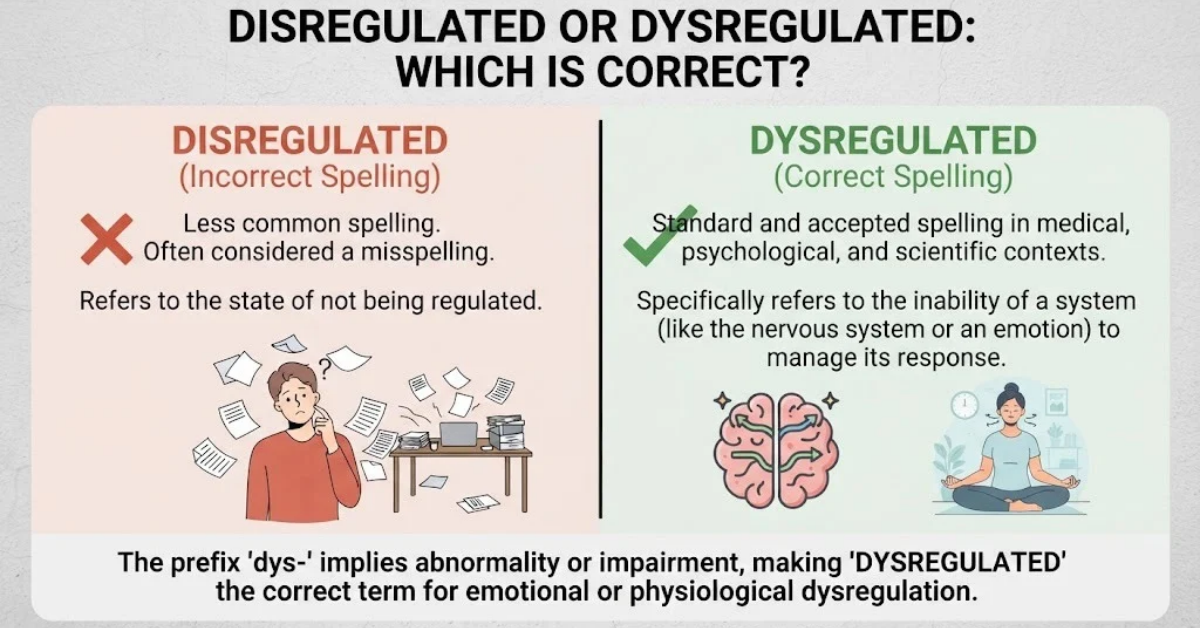
Have you ever wondered whether the correct word is disregulated or dysregulated? The two spellings look similar, and both may appear in discussions about emotions, mental health, behavior, and the body’s responses to stress. However, they are not equally common or interchangeable in standard English.
Dysregulated is the established and widely accepted term when describing difficulty controlling or maintaining a regulated process, such as emotions, attention, behavior, or physiological functions. Disregulated is much less common and is generally considered a nonstandard choice in these contexts.
Understanding the difference matters, particularly when writing about emotional regulation, psychology, child development, or health. Let’s explore what each word means, why the confusion occurs, and how to use the correct term in everyday and professional writing.
Disregulated vs. Dysregulated: Which Spelling Is Correct?
When comparing disregulated or dysregulated, dysregulated is generally the correct choice for the intended meaning of impaired or disrupted regulation.
Here’s a quick comparison:
| Word | Usage | Example |
| Dysregulated | Established term for impaired regulation | The child became emotionally dysregulated after a stressful day. |
| Disregulated | Uncommon and generally nonstandard in this context | The child became disregulated after a stressful day. |
The word dysregulated is widely used in psychology, medicine, neuroscience, and discussions of emotional well-being. It describes a situation in which a system has difficulty regulating itself effectively.
For example, someone experiencing emotional dysregulation may struggle to manage intense anger, anxiety, frustration, or sadness. Similarly, a physiological process can be described as dysregulated when its normal control mechanisms are not functioning as expected.
Remember: If you’re writing about emotional regulation, the nervous system, behavior, or a biological process, dysregulated is usually the appropriate word.
What Does Dysregulated Mean?
Dysregulated is an adjective that describes something that is not being regulated effectively or is functioning outside its normal regulatory pattern.
The word is built from two parts:
- Dys-: A prefix meaning abnormal, impaired, difficult, or disordered.
- Regulated: Controlled, managed, or maintained within an appropriate range.
Together, they convey the idea of impaired regulation.
The term can describe several different processes, depending on the context.
Emotional Dysregulation
Emotional dysregulation occurs when a person has difficulty managing emotional responses in a way that fits the situation or supports their needs.
For example, a person may experience anger that feels overwhelming, struggle to calm down after an argument, or find it difficult to recover emotionally from disappointment.
Emotional dysregulation does not necessarily mean that someone is immature, deliberately overreacting, or unable to control themselves. Stress, fatigue, environmental circumstances, developmental factors, and various health conditions can all influence emotional regulation.
Nervous System Dysregulation
The term nervous system dysregulation is often used to describe difficulties in the processes that help the body respond to stress and return to a balanced state.
People may use it when discussing heightened alertness, difficulty relaxing, or persistent stress responses. However, the phrase can be used broadly, and these experiences do not automatically establish a specific medical condition.
A healthcare professional can help determine whether symptoms reflect a recognized disorder or another cause.
Physiological Dysregulation
Dysregulation can also describe biological processes that are not being controlled appropriately.
Examples include:
- Blood glucose regulation
- Hormonal regulation
- Immune system activity
- Sleep-wake cycles
- Inflammatory responses
In these contexts, dysregulated describes a problem with a regulatory process rather than necessarily identifying its cause.
What Does Disregulated Mean?
Disregulated is occasionally used as an alternative to dysregulated, particularly when a writer intends to communicate that regulation has been disrupted or lost.
However, it is not the usual established term in psychology and medicine for impaired emotional or physiological regulation.
The distinction is partly related to how English uses prefixes.
The prefix dis- commonly expresses separation, reversal, absence, or an opposing action. For example, disconnected means no longer connected, while disorganized means lacking organization.
The prefix dys-, by contrast, commonly indicates that a function is impaired or abnormal. This makes dysregulated the conventional choice for describing a regulatory process that is not functioning properly.
Although the intended meaning of disregulated may be understandable, writers should generally choose dysregulated for clarity and consistency.
Why Do People Confuse Disregulated and Dysregulated?
The confusion is understandable because both words contain regulated, and their intended meanings can appear similar.
There are several reasons the incorrect spelling may occur.
1. The Prefixes Look Similar
English contains many words beginning with dis-, including disconnected, disrupted, and disorganized. Writers may naturally apply the same prefix to regulated.
However, the established psychological and medical term uses dys-.
2. Both Words Seem Logical
Someone may reason that if a process is no longer regulated, it must be disregulated. While that interpretation seems reasonable, conventional word usage does not always follow the most intuitive construction.
In established clinical and scientific terminology, dysregulated is the preferred form.
3. Informal Writing Spreads Alternative Spellings
Online discussions, social media posts, and informal articles can circulate uncommon spellings. Seeing a term repeatedly does not necessarily make it standard.
When accuracy matters, consult reputable dictionaries and professional sources rather than relying on search frequency alone.
Dysregulated vs. Dysregulation: What’s the Difference?
Another common source of confusion is the difference between dysregulated and dysregulation.
Both words are correct, but they serve different grammatical functions.
Dysregulated is an adjective. It describes a person, process, or system.
Example:
The patient showed signs of dysregulated sleep patterns.
Dysregulation is a noun. It refers to the difficulty or impairment in regulation itself.
Example:
Sleep dysregulation can affect daytime functioning.
Here is a simple comparison:
| Word | Part of speech | Example |
| Dysregulated | Adjective | His emotional responses became dysregulated. |
| Dysregulation | Noun | Emotional dysregulation affected his relationships. |
| Regulate | Verb | Breathing exercises may help regulate stress responses. |
| Regulation | Noun | Emotional regulation is a skill that can be developed. |
Knowing which form to use helps make your writing more precise.
How to Use Dysregulated in a Sentence
The easiest way to understand the word is to see how it works in different contexts.
Emotional and Psychological Examples
- After a stressful conversation, she felt emotionally dysregulated and needed time to calm down.
- The child became dysregulated when the classroom grew too noisy.
- He found it difficult to manage his emotions when he was tired and overwhelmed.
- Emotional dysregulation can make stressful situations harder to navigate.
Parenting and Child Development Examples
- The toddler became dysregulated after missing a nap.
- A calm environment may help an overwhelmed child regain emotional balance.
- Children may need adult support to develop effective emotional regulation skills.
It is important to avoid treating every tantrum, emotional outburst, or difficult behavior as evidence of a clinical problem. Children’s behavior is influenced by their age, environment, needs, and developmental stage.
Medical and Scientific Examples
- Researchers investigated dysregulated immune responses.
- The study examined dysregulated glucose metabolism.
- Scientists explored how disrupted hormonal regulation affects sleep.
- The researchers examined dysregulated inflammatory activity.
These examples demonstrate how the same word can apply to different systems without implying that their causes or treatments are identical.
What Is Emotional Dysregulation?
Because dysregulated appears frequently in conversations about mental health, emotional dysregulation deserves a closer look.
Emotional regulation is the ability to recognize, manage, and respond to emotions in ways that help a person function and adapt to different situations. It does not mean suppressing every negative feeling or remaining calm all the time.
Emotional dysregulation describes difficulties with this process. A person might experience emotions that feel unusually intense, have trouble calming down, or react in ways that they later regret.
Possible signs can include:
- Feeling overwhelmed by relatively minor stressors
- Finding it difficult to calm down after becoming upset
- Experiencing rapid or intense emotional shifts
- Reacting impulsively when distressed
- Struggling to express feelings constructively
- Taking a long time to recover after an emotionally difficult event
These experiences can happen to anyone, especially during periods of exhaustion, stress, or uncertainty. Persistent difficulties may sometimes be associated with mental health conditions, trauma, developmental differences, or other factors, but the term itself is not a diagnosis.
What Can Help With Emotional Regulation?
Strategies that may support emotional regulation include:
- Recognizing emotional triggers: Notice which situations, thoughts, or environmental factors tend to increase distress.
- Pausing before reacting: Take a few slow breaths or step away briefly when it is safe to do so.
- Maintaining healthy routines: Regular sleep, balanced meals, movement, and rest can support overall well-being.
- Naming the emotion: Identifying feelings such as frustration, fear, disappointment, or embarrassment can make them easier to understand.
- Seeking support: A trusted person or qualified mental health professional may help when emotional difficulties are persistent or disruptive.
These strategies are not a substitute for professional assessment when symptoms are severe or interfere significantly with everyday life.
Dysregulated vs. Disorganized vs. Disrupted
These terms may appear similar, but they describe different ideas.
- Dysregulated: A process is not being regulated effectively.
- Disorganized: Something lacks structure, order, or coordination.
- Disrupted: Something has been interrupted or disturbed.
Consider these examples:
- Dysregulated emotions: A person struggles to manage intense feelings.
- Disorganized thoughts: A person’s thoughts or explanations lack clear structure.
- Disrupted sleep: A person’s usual sleep pattern has been interrupted.
Choosing the right word helps readers understand exactly what you mean.
Is Dysregulated a Medical Diagnosis?
No. Dysregulated is a descriptive term, not a standalone medical diagnosis.
A healthcare professional might use it to describe emotional responses, behavior, or a physiological process. However, the word alone does not explain why the problem occurs or establish that a person has a particular disorder.
For instance, emotional dysregulation can occur in many circumstances, including periods of intense stress. It may also be discussed in connection with certain mental health or developmental conditions.
A diagnosis requires consideration of the person’s symptoms, history, circumstances, and appropriate clinical criteria. It is therefore important not to assume that someone has a particular condition simply because they are described as dysregulated.
Frequently Asked Questions
Is it dysregulated or disregulated?
Dysregulated is the established and preferred spelling when describing impaired emotional, behavioral, or physiological regulation. Disregulated is uncommon and generally nonstandard in these contexts.
Is dysregulated a real word?
Yes. Dysregulated is a recognized English term used in psychology, medicine, neuroscience, and biology to describe impaired or abnormal regulation.
What does dysregulated mean in simple terms?
It means that a person, process, or system is having difficulty regulating itself effectively. For example, someone who is emotionally dysregulated may struggle to calm down after becoming upset.
What is the difference between dysregulated and unregulated?
Dysregulated generally suggests that a regulatory process is impaired or functioning abnormally. Unregulated more directly means that something is not regulated or controlled. The most appropriate term depends on the context.
Is dysregulation the same as emotional dysregulation?
Not exactly. Dysregulation is a broad term that can describe impaired regulation in many systems. Emotional dysregulation specifically refers to difficulty managing emotional responses.
Can a child become dysregulated?
Yes. Children can become emotionally overwhelmed when they are tired, hungry, frustrated, overstimulated, or dealing with unfamiliar situations. Their ability to regulate emotions develops over time, and supportive adults can help them learn effective coping skills.
Does being dysregulated mean someone has a mental health condition?
No. Emotional dysregulation can occur without a diagnosed mental health condition. If the difficulties are persistent, severe, or disruptive, a qualified professional can help assess possible causes and appropriate support.
How do you use dysregulated in a sentence?
You could write: “After a long and stressful day, he felt emotionally dysregulated and needed some quiet time.” The word describes difficulty managing emotional responses.
What is the noun form of dysregulated?
The noun form is dysregulation. For example, “Emotional dysregulation can make stressful situations harder to manage.”
Is dysregulated the same as deregulated?
No. Dysregulated describes impaired or abnormal regulation. Deregulated commonly refers to removing rules, controls, or restrictions, particularly in business, government, and economic contexts.
Conclusion: Disregulated or Dysregulated?
When deciding between disregulated or dysregulated, choose dysregulated for the standard meaning of impaired or abnormal regulation.
The word is widely used in discussions of emotional regulation, child development, mental health, and physiological processes. Disregulated may appear in informal writing, but it is generally not the preferred term in these contexts.
To remember the distinction, keep it simple: dysregulated describes a process that is not regulating effectively, while dysregulation names the difficulty itself.
Using the established spelling makes your writing clearer, more accurate, and easier for readers to understand. If you’re exploring related terminology, learning the differences between emotional regulation, dysregulation, and self-regulation is a useful next step.