English has plenty of words that look almost identical but have completely different meanings. A good example is stared vs. starred. The two words are pronounced similarly, and both are commonly used in everyday writing, but they describe entirely different actions.
The difference becomes easier to understand when you look at their original verbs. Stared comes from stare, meaning to look at someone or something for a noticeable period. Starred, on the other hand, comes from star and can mean to feature someone in a movie, mark something with a star symbol, or give something a starring role.
Choosing the wrong spelling can change the meaning of an entire sentence. Let’s explore both words, their definitions, spelling rules, and practical examples so you can use them confidently.
What Does Stared Mean?
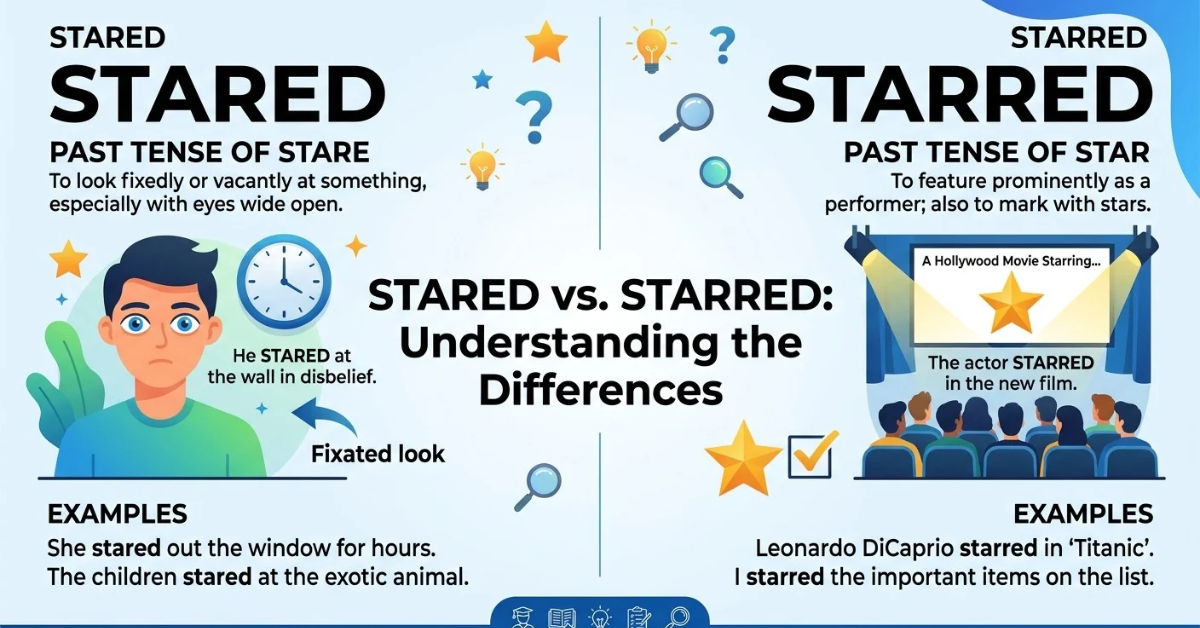
Stared is the simple past tense and past participle of the verb stare. It describes looking at someone or something continuously, usually with noticeable attention.
People may stare because they are surprised, curious, confused, frightened, or simply trying to understand what they are seeing.
Examples of Stared in Sentences
Here are some everyday examples:
- She stared at the beautiful painting for several minutes.
- The little boy stared at the magician in amazement.
- Everyone stared when the unexpected announcement was made.
- He stared out of the window, thinking about his future.
- I stared at my computer screen because I couldn’t understand the error.
In each example, the word describes an extended act of looking.
When Should You Use Stared?
Use this word when describing someone looking at something for a relatively long time.
Common situations include:
- Surprise: She stared at the enormous birthday cake.
- Confusion: He stared at the instructions without understanding them.
- Anger: The teacher stared at the students after hearing their excuses.
- Curiosity: The child stared at the colorful butterflies.
- Disbelief: I stared at the message, wondering whether it was real.
What Is the Base Form of Stared?
The base form is stare. Its common verb forms are:
| Verb Form | Word |
|---|---|
| Base form | Stare |
| Third-person singular | Stares |
| Present participle | Staring |
| Simple past | Stared |
| Past participle | Stared |
For example:
- Present: She stares at the screen.
- Past: She stared at the screen.
- Present continuous: She is staring at the screen.
- Present perfect: She has stared at the screen for several minutes.
What Does Starred Mean?
Starred is the simple past tense and past participle of the verb star. Its meaning depends on the context.
It commonly refers to featuring someone in a leading role, marking something with a star symbol, or giving something special recognition.
Examples of Starred in Sentences
Consider these examples:
- The famous actor starred in three successful movies last year.
- She starred in the school’s annual drama production.
- I starred the most important emails so I could find them later.
- The restaurant starred in several popular travel magazines.
- He starred the best-performing products in the spreadsheet.
Notice that none of these sentences describes someone simply looking at something. Instead, the word relates to starring roles, symbols, or recognition.
Different Meanings of Starred
The word has several common uses.
1. Appeared in a leading role
This is particularly common in the entertainment industry.
Example: The actress starred in a popular television series.
2. Marked with a star symbol
People often use star symbols to identify important information.
Example: I starred the questions that needed further review.
3. Featured or highlighted
Something can be described as starred when it receives special attention or recognition.
Example: The hotel received a starred rating from the travel organization.
What Is the Base Form of Starred?
The base form is star. Its common verb forms are:
| Verb Form | Word |
|---|---|
| Base form | Star |
| Third-person singular | Stars |
| Present participle | Starring |
| Simple past | Starred |
| Past participle | Starred |
Examples:
- Present: She stars in a television show.
- Past: She starred in a television show.
- Present continuous: She is starring in a new production.
- Present perfect: She has starred in several films.
Stared vs. Starred: Key Differences Explained
Although these words differ by only one letter, their meanings are not interchangeable.
| Feature | Stared | Starred |
|---|---|---|
| Base verb | Stare | Star |
| Meaning | Look continuously | Feature, mark, or highlight |
| Part of speech | Verb form | Verb form |
| Pronunciation | /ster/ | /stɑːrd/ (American English) |
| Example | He stared at me. | He starred in a movie. |
| Common context | Looking, surprise, confusion | Movies, ratings, symbols |
The easiest way to remember the distinction is to focus on the original verbs:
- Stare: To look at something for a noticeable period.
- Star: To feature someone or mark something with a star.
If the sentence describes looking, use stared. If it involves a performance, a star symbol, or recognition, use starred.
Why Does Starred Have Two R’s?
One common source of confusion is the spelling of the past tense of star.
The word star follows a standard English spelling rule. When a one-syllable verb ends in a consonant-vowel-consonant pattern, the final consonant is generally doubled before adding an ending that begins with a vowel, such as -ed.
The spelling changes as follows:
- Star + ed = Starred
- Stop + ed = Stopped
- Plan + ed = Planned
- Shop + ed = Shopped
The same rule explains why starring has two R’s.
However, stare ends with a silent E. When adding -ed, the E is retained and no extra consonant is added.
- Stare + d = Stared
- Smile + d = Smiled
- Hope + d = Hoped
This simple spelling rule explains why the two words look different.
Common Mistakes When Using Stared and Starred
Even experienced English speakers sometimes confuse these spellings, particularly when writing quickly.
Here are some mistakes worth avoiding.
Mistake 1: Using starred when describing someone looking
Incorrect: She starred at the beautiful sunset.
Correct: She stared at the beautiful sunset.
Why? The sentence describes looking at something, so the correct verb is stare.
Mistake 2: Using stared when describing an actor’s role
Incorrect: He stared in the latest action movie.
Correct: He starred in the latest action movie.
Why? The sentence means that he appeared in the movie, so starred is appropriate.
Mistake 3: Confusing starring with staring
Incorrect: The movie is staring a famous actor.
Correct: The movie is starring a famous actor.
Why? The sentence refers to the actor’s role in the production.
Mistake 4: Using the wrong word for marking information
Incorrect: I stared the important documents in my folder.
Correct: I starred the important documents in my folder.
Why? The intended meaning is that the documents were marked with star symbols.
Stared vs. Starred in Different Contexts
Understanding how these words work in different situations makes it easier to choose the correct spelling.
In Movies and Television
The entertainment industry frequently uses starred to describe actors who appear in films, television programs, and theatrical productions.
Examples:
- The actor starred in a successful Hollywood production.
- She starred alongside several internationally recognized performers.
- The series starred a talented young cast.
In Everyday Conversations
When discussing someone’s reaction or behavior, stared is usually the appropriate choice.
Examples:
- Why did you stare at me?
- Everyone stared at the strange object.
- He stared at the floor during the conversation.
In Emails and Digital Applications
The word starred is also common in digital communication.
For example, Gmail allows users to star important emails so they can find them quickly.
Examples:
- I starred your email for future reference.
- She starred the message that required an immediate response.
- All starred conversations are available in a separate section.
In Ratings and Reviews
The word starred can describe ratings or recognition systems.
Examples:
- The restaurant received a five-star rating.
- The hotel was awarded a four-star classification.
- The guide featured several highly rated, starred properties.
Remember that five-star is an adjective describing a rating, while starred is a verb form or participial adjective depending on the sentence.
Easy Tricks to Remember the Difference
If you frequently mix up these spellings, a few simple memory tricks can help.
1. Associate stared with eyes.
Think of someone staring at you. The word relates directly to looking.
2. Associate starred with a star symbol.
Imagine placing a star beside an important sentence or featuring an actor in a movie.
3. Remember the original verbs.
- Stare → Stared
- Star → Starred
4. Check the sentence meaning.
Before choosing a spelling, ask yourself:
- Is someone looking at something? Use stared.
- Is someone appearing in a production or marking something? Use starred.
This quick check can prevent most spelling mistakes.
Frequently Asked Questions (FAQs)
1. Is it stared or starred?
Both spellings are correct, but they have different meanings. Stared means looked at something continuously, while starred means featured someone in a production or marked something with a star.
2. What is the difference between stare and star?
Stare means to look at someone or something for an extended period. Star can mean to feature in a leading role or mark something with a star symbol.
3. Is stared a real word?
Yes. Stared is the simple past tense and past participle of stare. For example, “He stared at the photograph.”
4. Is starred a real word?
Yes. Starred is the simple past tense and past participle of star. For example, “She starred in a television series.”
5. Why does starred have two R’s?
The final consonant is doubled when adding -ed to the one-syllable verb star. This follows a common English spelling rule for consonant-vowel-consonant words.
6. Is it staring or starring?
Both are correct, but they have different meanings. Staring describes looking continuously, while starring describes appearing in a leading role or marking something with a star.
Examples:
- He is staring at the television.
- She is starring in a new movie.
7. How do you use starred in a sentence?
You can use it to describe an actor’s role or marking something as important.
Examples:
- The actress starred in a popular film.
- I starred the important tasks in my notebook.
8. Can stared and starred be used interchangeably?
No. Although they look and sound similar, they communicate different ideas. Substituting one for the other can make a sentence grammatically incorrect or change its meaning.
9. What is the past tense of stare?
The past tense of stare is stared. For example, “The audience stared at the performer.”
10. What is the past tense of star?
The past tense of star is starred. For example, “The actor starred in the award-winning film.”
Conclusion
The difference between these two words comes down to their original verbs and the actions they describe. Stared refers to looking at someone or something for a noticeable period, while starred describes appearing in a leading role, marking something with a star, or highlighting information.
Remember the simple distinction: stare is about looking, whereas star is about featuring or marking. Once you understand this connection, choosing the correct spelling becomes much easier.
If you’re working on improving your English vocabulary and writing accuracy, explore more grammar comparisons and commonly confused words to strengthen your everyday communication.