Have you ever filled out an award application, election form, or official document and wondered whether you should write your name under nominator or nominee? These two words look similar, but they describe two completely different roles.
Understanding nominator vs nominee is important because both terms are commonly used in award ceremonies, job applications, political elections, professional recommendations, and legal documents. Using the wrong word can create confusion, particularly when completing official forms.
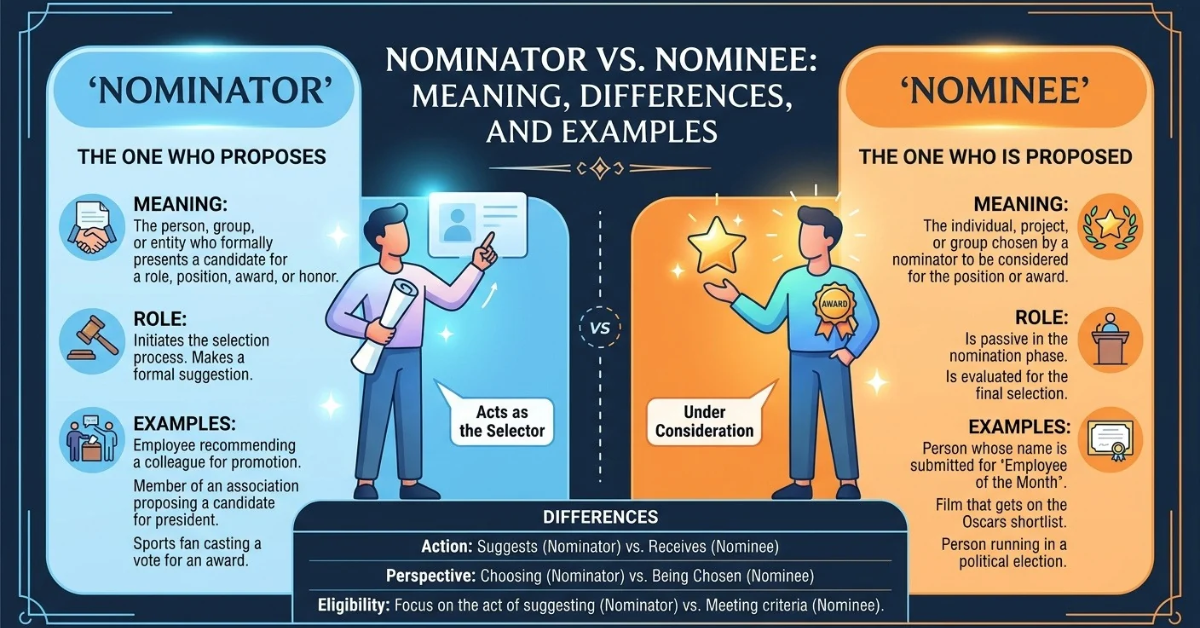
The simplest way to understand the difference is that a nominator is the person who recommends or puts someone forward for a position, award, or opportunity, while a nominee is the person being recommended or considered.
Let’s explore their meanings, responsibilities, practical examples, and correct usage.
What Does Nominator Mean?
A nominator is an individual or organization that officially recommends someone for a particular position, award, recognition, or opportunity.
In other words, the nominator takes the initiative to suggest a candidate. They believe that the person deserves consideration because of their qualifications, achievements, experience, or contributions.
For example, if a manager recommends an employee for an Employee of the Year award, the manager is the nominator.
Responsibilities of a Nominator
The responsibilities of a nominator can vary depending on the nomination process and its requirements. However, they commonly include:
- Identifying suitable candidates: Finding individuals who meet the eligibility requirements for an award, position, or opportunity.
- Submitting nominations: Providing the candidate’s name and relevant information through an official application or nomination form.
- Providing recommendations: Explaining why the proposed candidate deserves consideration.
- Supporting the nomination: Sharing evidence, achievements, references, or supporting documents when required.
- Meeting deadlines: Ensuring that the nomination is submitted within the specified period.
A nominator does not necessarily have the authority to select the final winner. Their primary responsibility is to put forward a suitable candidate.
What Does Nominee Mean?
A nominee is a person who has been officially recommended, proposed, or selected for consideration for an award, position, responsibility, or opportunity.
Unlike the person making the recommendation, the nominee is the individual whose name is submitted for consideration.
For instance, if a teacher recommends a student for an academic excellence award, the student becomes the nominee.
Being nominated does not automatically mean someone has won an award or secured a position. It simply means they have been put forward or selected for consideration.
Responsibilities of a Nominee
A nominee’s responsibilities depend on the nature of the nomination. They may include:
- Providing personal information: Submitting accurate details required by the organization.
- Meeting eligibility criteria: Demonstrating that they qualify for the award, position, or opportunity.
- Providing supporting documents: Sharing certificates, professional records, achievements, or references when requested.
- Participating in evaluations: Attending interviews, presentations, voting sessions, or selection procedures.
- Accepting the nomination: Confirming their willingness to participate when acceptance is required.
In some situations, nominees may have very little involvement in the initial nomination process. Someone else can recommend them without their direct participation, although the organization may later request their consent.
Nominator vs Nominee: Key Differences
Although both words are associated with the same nomination process, their meanings and functions are different.
Here is a simple comparison:
| Basis of comparison | Nominator | Nominee |
|---|---|---|
| Meaning | Person who recommends someone | Person who is recommended |
| Main role | Proposes a candidate | Is proposed as a candidate |
| Responsibility | Submits the nomination | May participate in the selection process |
| Position | Makes the recommendation | Receives the recommendation |
| Example | Teacher recommending a student | Student being recommended |
| In an award | Person submitting the entry | Person considered for the award |
| In an election | Person proposing a candidate | Candidate being proposed |
The easiest way to remember the distinction: The nominator gives someone’s name, while the nominee is the person whose name is given.
Practical Examples of Nominator and Nominee
Understanding definitions is helpful, but real-world examples make the distinction much easier to remember.
Let’s look at how these terms work in different situations.
1. In Award Ceremonies
Imagine a company organizing an annual employee recognition ceremony.
A department manager recommends Sarah for the Best Employee Award because of her excellent performance and dedication.
In this situation:
- The department manager is the nominator.
- Sarah is the nominee.
- The award committee evaluates the nomination.
- Sarah may eventually become the award winner.
This example demonstrates that being nominated and winning an award are two separate things.
2. In Political Elections
Nomination is also an important part of the political process.
Suppose a political party wants to select a candidate for an upcoming election. A party member or an authorized group proposes an individual to represent the party.
Here:
- The person or authorized group proposing the candidate is the nominator.
- The proposed political candidate is the nominee.
- Party members or the relevant selection authority may decide whether the candidate receives the official nomination.
The exact procedure depends on the country’s electoral laws and the political party’s rules.
3. In Educational Institutions
Schools, colleges, and universities frequently use nomination procedures for scholarships, academic awards, and leadership positions.
For example, a university professor recommends a student for a scholarship based on academic performance and extracurricular achievements.
In this case, the professor is the nominator, and the student is the nominee.
The scholarship committee then reviews the application and determines whether the student qualifies for financial assistance.
4. In Workplace Promotions
Consider a situation where a company is looking for an employee to become a team leader.
A department head recommends an experienced employee for the position.
The department head is the nominator, while the employee is the nominee.
The company may then conduct interviews, review performance records, and evaluate other candidates before making its final decision.
5. In Professional Recognition
Professional associations sometimes invite existing members to recommend colleagues for industry awards or special recognition.
For example, an experienced engineer may recommend another engineer for an Outstanding Professional Achievement Award.
The person submitting the recommendation is the nominator, and the engineer being recommended is the nominee.
How to Use Nominator and Nominee in Sentences
The best way to avoid confusing these terms is to understand how they function in everyday English.
Here are some examples of correct usage.
Examples of Nominator
- The nominator explained why the employee deserved the recognition.
- Each nominator can recommend up to three candidates.
- The organization asked the nominator to provide supporting documents.
- The nominator submitted the application before the deadline.
- The award committee contacted the nominator for additional information.
Examples of Nominee
- She was selected as a nominee for the Best Student Award.
- Every nominee must meet the organization’s eligibility requirements.
- The nominees will be announced next week.
- He became a nominee for the company’s annual leadership award.
- Each nominee will receive an official notification.
Examples Using Both Words
- The nominator recommended James for the award, and James became one of the nominees.
- Every nominee must be supported by an eligible nominator.
- The organization thanked the nominators and congratulated all the nominees.
- The nominator provided evidence to support the nominee’s achievements.
These examples show that both words can appear in the same sentence because they describe different participants in the same process.
Nominator vs Nominee in Legal and Financial Documents
The distinction becomes particularly important when dealing with official paperwork, contracts, and financial arrangements.
In many legal and administrative contexts, a nominator is the person who puts forward another individual for consideration or designation.
A nominee, however, can have a broader meaning depending on the document.
For example, in financial arrangements, a nominee may be a person designated to receive certain benefits or act in a specified capacity. In some securities arrangements, a nominee may hold registered ownership on behalf of the actual beneficial owner.
This means the word does not always refer to an award candidate.
Examples of Nominee in Financial Settings
- A person named to receive certain benefits under an insurance policy.
- An individual designated to receive funds under a particular financial arrangement.
- A person or entity holding registered securities on behalf of another party.
The precise rights and responsibilities depend on the applicable agreement and local laws. Therefore, it is important to read the relevant document rather than assume that every nominee has the same legal status.
Common Mistakes When Using These Terms
People sometimes use these words interchangeably because they share the same root word. However, doing so can change the meaning of a sentence.
Here are some common mistakes to avoid.
1. Calling the Award Candidate a Nominator
Incorrect: Sarah is the nominator for the Best Employee Award.
Correct: Sarah is the nominee for the Best Employee Award.
If Sarah is the person being considered for the award, she is the nominee.
2. Calling the Recommending Person a Nominee
Incorrect: The manager is the nominee because he recommended Sarah.
Correct: The manager is the nominator because he recommended Sarah.
The person making the recommendation is the nominator, not the nominee.
3. Assuming a Nominee Is Already a Winner
Incorrect: Every nominee has won the award.
Correct: Every nominee has been considered for the award.
A nomination indicates consideration, not necessarily victory. The final outcome depends on the selection process.
4. Assuming the Nominator Always Selects the Winner
A nominator may recommend a candidate, but the final decision usually belongs to an authorized committee, organization, employer, or voting body.
The person submitting a nomination and the person responsible for selecting the winner may be entirely different.
Nominator, Nominee, and Nomination: Understanding All Three Terms
Another common source of confusion is the word nomination.
Although these three words are closely related, each serves a different purpose.
| Term | Meaning | Example |
|---|---|---|
| Nominator | Person making the recommendation | The teacher |
| Nominee | Person being recommended | The student |
| Nomination | The act or process of recommending someone | The teacher’s submission |
Consider this example:
A teacher submits a nomination for a student to receive an academic excellence award.
- Nominator: The teacher.
- Nominee: The student.
- Nomination: The recommendation submitted by the teacher.
Once you understand these three terms, it becomes much easier to complete nomination forms and communicate accurately.
Tips for Completing a Nomination Form
If you are filling out an official nomination form, identifying the correct role is essential.
Follow these simple steps:
- Read the instructions: Check whether the form asks for the person recommending someone or the person being recommended.
- Identify the candidate: Determine whose name is being submitted for consideration.
- Enter the nominator’s details: Provide the information of the person making the recommendation.
- Enter the nominee’s details: Add the information of the individual being proposed.
- Review the supporting information: Make sure all required documents and details are accurate.
- Check the submission requirements: Confirm that the nomination follows the organization’s rules and deadlines.
If you are unsure about a particular field, contact the organization responsible for the nomination rather than guessing.
Frequently Asked Questions (FAQs)
1. What is the main difference between a nominator and a nominee?
A nominator is the person who recommends someone for an award, position, or opportunity. A nominee is the person being recommended. The first proposes a candidate, while the second is the candidate.
2. Can the same person be both a nominator and a nominee?
Yes, depending on the organization’s rules. Someone can recommend another individual in one nomination process and be recommended by someone else in a separate process. However, whether self-nomination is permitted depends on the specific rules.
3. Is a nominee the same as a winner?
No. A nominee is someone being considered for an award or position. A winner is the person who ultimately receives the award or is selected for the position.
4. Who should fill in the nominator section of a form?
The person recommending or proposing the candidate should complete the nominator section. This could be a teacher, manager, colleague, organization representative, or another eligible individual.
5. Can someone nominate themselves?
Yes, some awards, competitions, and professional programs allow self-nominations. Others require an independent recommendation from another person. Always check the eligibility and submission guidelines.
6. What is the plural of nominator and nominee?
The plural of nominator is nominators, while the plural of nominee is nominees.
For example, several nominators submitted recommendations, and the organization announced five nominees.
7. Does being nominated mean someone has been selected?
Not necessarily. Nomination means someone has been proposed or placed under consideration. Final selection may involve interviews, voting, document reviews, or an evaluation by a committee.
8. What is the difference between a nominee and a candidate?
The terms can overlap. A nominee is someone formally proposed or designated for consideration, while a candidate is someone seeking or being considered for a position, award, or opportunity. Their exact meanings depend on the context.
9. What does nominee mean in insurance?
In insurance, a nominee is generally a person designated to receive policy benefits under specified circumstances, such as the policyholder’s death. The nominee’s rights and legal status depend on the policy terms and applicable law.
10. Is a nominator responsible for the nominee’s actions?
Not automatically. A nominator may be responsible for providing accurate information and meeting nomination requirements, but recommending someone does not generally make the nominator legally responsible for everything the nominee does.
The applicable rules or agreement may establish additional responsibilities.
Conclusion
Understanding the difference between a nominator and a nominee is simple once you recognize the role each person plays in the nomination process.
A nominator is the individual who recommends or proposes someone, while a nominee is the person whose name is put forward for consideration. Whether the context involves an academic award, workplace promotion, political election, professional recognition, or financial documentation, the distinction remains important.
Remember this simple rule: the nominator recommends, and the nominee is recommended.
The next time you complete an application or nomination form, you will know exactly which information belongs in each section. For more useful explanations of commonly confused English words, explore our related language and vocabulary guides.