Have you ever been asked how your day went, how a meal tasted, or how someone performed, and struggled to decide between saying “fair” or “good”? Although these words may seem similar, they communicate different levels of quality, satisfaction, and performance.
Understanding fair vs good is particularly useful in everyday conversations, workplace evaluations, school grading, customer reviews, and performance assessments. While both words can describe something positively, they do not carry exactly the same meaning.
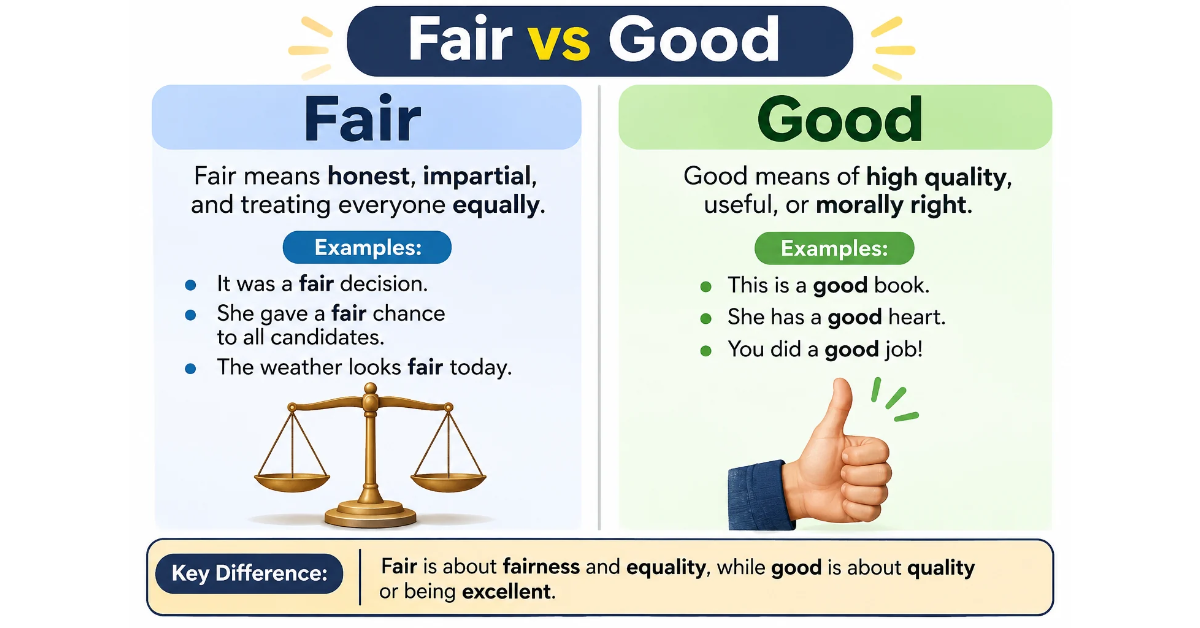
In simple terms, good generally describes something that meets expectations or has a positive quality, whereas fair usually indicates an acceptable but average or limited level of quality. However, the context can change how each word is understood.
Let’s explore their definitions, differences, examples, and practical applications to understand when to use each one.
What Does Fair Mean?
The word “fair” has several meanings depending on how it is used. When describing quality, performance, or condition, it generally refers to something that is acceptable but not particularly impressive.
Something described as fair may meet basic expectations without exceeding them. It often suggests an average, moderate, or satisfactory result.
For example:
- The restaurant’s food was fair, but nothing special.
- His performance in the examination was fair.
- The weather was fair enough for an outdoor activity.
- The quality of the product was fair for its price.
Other Meanings of Fair
Apart from describing quality, fair can also have different meanings:
1. Just and impartial
Fair can describe something reasonable, unbiased, or morally right.
Example: Everyone deserves a fair opportunity to succeed.
2. Reasonable or acceptable
It can describe a price, offer, or decision that is neither excessive nor unreasonable.
Example: The seller offered a fair price for the used laptop.
3. Favorable weather
In weather descriptions, fair often means pleasant, clear, or reasonably good conditions.
Example: Tomorrow’s forecast predicts fair weather.
4. Light in appearance
Fair can also describe relatively light hair or skin in certain contexts.
Example: She has fair hair and blue eyes.
What Does Good Mean?
“Good” is a positive adjective used to describe something that has desirable qualities, performs well, or meets expectations successfully.
Unlike fair, which often suggests an average or acceptable result, good generally communicates a higher level of satisfaction.
Something good does not necessarily have to be perfect or exceptional. It simply means that the quality, performance, or experience is positive.
For example:
- The restaurant served good food.
- She received good marks in her final examination.
- His presentation was good and well-organized.
- The company provides good customer service.
Different Meanings of Good
The word good can be applied in several situations:
1. High quality
It describes something that is well-made, reliable, or enjoyable.
Example: This is a good smartphone for everyday use.
2. Positive behavior
It can describe someone who behaves responsibly or treats others kindly.
Example: He is a good friend who always supports others.
3. Skill or ability
Good can indicate that someone performs a particular activity successfully.
Example: She is good at digital marketing.
4. Health and well-being
It can describe someone’s physical or emotional condition.
Example: I am feeling good today.
5. Beneficial or useful
It can describe something that produces a positive result.
Example: Regular exercise is good for your health.
Fair vs Good: Key Differences
The biggest difference between these two words is the level of quality or satisfaction they communicate.
Fair usually represents an average or acceptable standard, while good suggests a more positive and satisfactory experience.
Here is a simple comparison:
| Comparison | Fair | Good |
|---|---|---|
| General meaning | Acceptable or average | Positive or satisfactory |
| Quality | Moderate | Above average |
| Performance | Meets basic expectations | Performs well |
| Satisfaction | Limited or neutral | Generally positive |
| Impression | Nothing exceptional | Favorable |
| Common usage | Average results or conditions | Positive results or experiences |
Is Fair Better Than Good?
Generally, no. When discussing quality, performance, or satisfaction, good is usually considered better than fair.
For example, imagine receiving feedback about your work:
- Fair performance: You completed the assigned tasks, but there is room for improvement.
- Good performance: You completed your tasks successfully and met expectations.
However, the interpretation depends on the situation. In some professional settings, a fair price or fair decision may be a very positive description because it emphasizes justice and reasonableness.
Fair vs Good on a Rating Scale
These words are frequently used in customer satisfaction surveys, product reviews, school assessments, and employee evaluations.
A common rating scale might look like this:
| Rating | Meaning |
|---|---|
| Excellent | Outstanding performance or quality |
| Very Good | Strong performance or quality |
| Good | Satisfactory and positive |
| Fair | Average or acceptable |
| Poor | Below expectations |
This is a general example rather than a universal rating system. Different organizations may use different definitions.
What Does a Fair Rating Mean?
A fair rating generally indicates that something is acceptable but has noticeable limitations.
For example, if a customer gives a restaurant a fair rating, they may mean:
- The food was acceptable but not memorable.
- The service was average.
- The atmosphere was ordinary.
- The overall experience could be improved.
What Does a Good Rating Mean?
A good rating usually indicates that the customer or evaluator had a positive experience.
For example:
- The product worked as expected.
- The service was helpful.
- The quality was satisfactory.
- The experience met or exceeded expectations.
Fair vs Good in Different Situations
Understanding the context is essential because these words can communicate slightly different messages depending on the situation.
1. In Academic Performance
When discussing examination results or academic progress, fair generally indicates average performance, while good suggests stronger achievement.
Examples:
- Fair: He achieved fair results in mathematics.
- Good: She received good grades throughout the semester.
A good academic result typically reflects stronger understanding and performance.
2. In Workplace Performance
Employers often use these words when evaluating employees.
Examples:
- Fair: The employee completes assigned responsibilities but needs improvement in certain areas.
- Good: The employee consistently completes responsibilities and meets performance expectations.
In this context, good is generally a more favorable evaluation.
3. In Product Reviews
Customers use both terms to describe their shopping experiences.
Examples:
- Fair: The headphones offer fair sound quality for their price.
- Good: The headphones provide good sound quality and comfortable fitting.
A fair product review often indicates acceptable value, while a good review communicates greater satisfaction.
4. In Customer Service
These words can also describe the quality of customer support.
Examples:
- Fair: The representative answered my questions, but the process was slow.
- Good: The representative was friendly, helpful, and resolved my issue quickly.
5. In Everyday Conversations
People frequently use both words when discussing their feelings, activities, or daily experiences.
Examples:
- How was your weekend? It was fair.
- How was your weekend? It was good.
- How are you feeling? I’m doing fair.
- How are you feeling? I’m feeling good.
One important distinction is that “I’m doing fairly well” is generally more natural in everyday English than “I’m doing fair.”
Examples of Fair and Good in Sentences
The following examples demonstrate how these words work in different contexts.
Sentences Using Fair
- The hotel offered fair accommodation at a reasonable price.
- His performance during the interview was fair.
- The restaurant received a fair review from its customers.
- We experienced fair weather during our trip.
- The teacher gave everyone a fair opportunity to participate.
- The product quality was fair considering its low price.
- Her understanding of the subject is fair.
- The company made a fair decision after reviewing the complaints.
Sentences Using Good
- She delivered a good presentation at the conference.
- This restaurant is known for its good food.
- He has good communication skills.
- The company provides good opportunities for professional growth.
- I had a good experience shopping online.
- Regular reading is a good habit.
- The student achieved good results in the examination.
- We received good feedback from our customers.
Common Mistakes When Using Fair and Good
Although both words are relatively simple, people sometimes use them incorrectly.
Here are a few mistakes worth avoiding:
Mistake 1: Treating both words as identical
Fair and good do not always communicate the same level of satisfaction. Using fair instead of good can make an otherwise positive statement sound less enthusiastic.
Mistake 2: Using fair when describing excellent performance
If someone performs exceptionally well, describing their work as fair may unintentionally suggest average results.
Mistake 3: Confusing fair with fairly
Fairly is an adverb that can mean reasonably or moderately.
For example:
- Correct: She performed fairly well.
- Incorrect: She performed fair well.
Mistake 4: Ignoring the context
Fair can be strongly positive when discussing justice, equality, or reasonable pricing. Therefore, it should not always be interpreted as an average rating.
How to Remember the Difference
A simple way to remember these words is to associate them with different levels of satisfaction.
- Fair: Acceptable, average, or reasonable.
- Good: Positive, satisfactory, or desirable.
- Excellent: Outstanding or exceptional.
Consider this example:
Imagine buying a new pair of shoes.
- Fair quality: The shoes are wearable, but the material and finishing could be better.
- Good quality: The shoes are comfortable, durable, and well-made.
- Excellent quality: The shoes offer outstanding comfort, durability, and craftsmanship.
This simple comparison makes the distinction easier to remember.
Frequently Asked Questions (FAQs)
1. Is fair better than good?
No. When describing quality, performance, or satisfaction, good is generally considered better than fair. Fair usually indicates an acceptable or average standard, whereas good communicates a more positive assessment.
2. Does fair mean average?
Yes, fair can mean average or acceptable when describing quality, performance, or results. However, it can also mean just, impartial, or reasonable depending on the context.
3. Is a fair rating considered positive or negative?
A fair rating is generally neutral or mildly positive. It suggests that something meets basic expectations but may have room for improvement.
4. What is the difference between fair and good in a performance review?
Fair performance generally means an employee meets some basic requirements but may need improvement. Good performance indicates that the employee successfully meets expectations and demonstrates satisfactory skills.
5. What comes after fair on a rating scale?
On many common rating scales, good comes after fair, followed by very good and excellent. However, rating systems can vary between organizations.
6. Can fair be used as a compliment?
Yes. Fair can be a compliment when describing someone’s honesty, impartiality, or reasonable behavior. For example, “She is a fair manager” suggests that she treats employees equally and makes balanced decisions.
7. Is fairly good better than fair?
Yes. The expression “fairly good” generally means reasonably good or quite satisfactory. It communicates a more positive impression than simply describing something as fair.
8. Which word should I use in customer reviews?
Use good when you want to express a positive experience or satisfaction. Use fair when the experience was acceptable but had noticeable shortcomings.
Conclusion
Understanding the difference between these two common English adjectives can help you communicate more accurately in everyday conversations, academic settings, workplace evaluations, and customer reviews.
The main distinction is straightforward: fair generally describes something acceptable, average, or reasonable, while good expresses a more positive level of quality or satisfaction.
Remember that context matters. A fair price or fair decision can be an excellent compliment, even though a fair quality rating may suggest average performance.
The next time you write a review, evaluate someone’s performance, or describe an experience, choose the word that best represents what you actually mean. For more helpful English vocabulary comparisons, explore related grammar and word-usage guides.