Have you ever written the word scary and wondered whether it should actually be spelled scarey? It’s an understandable question because both versions look familiar, especially when you’re trying to write quickly or relying on how a word sounds.
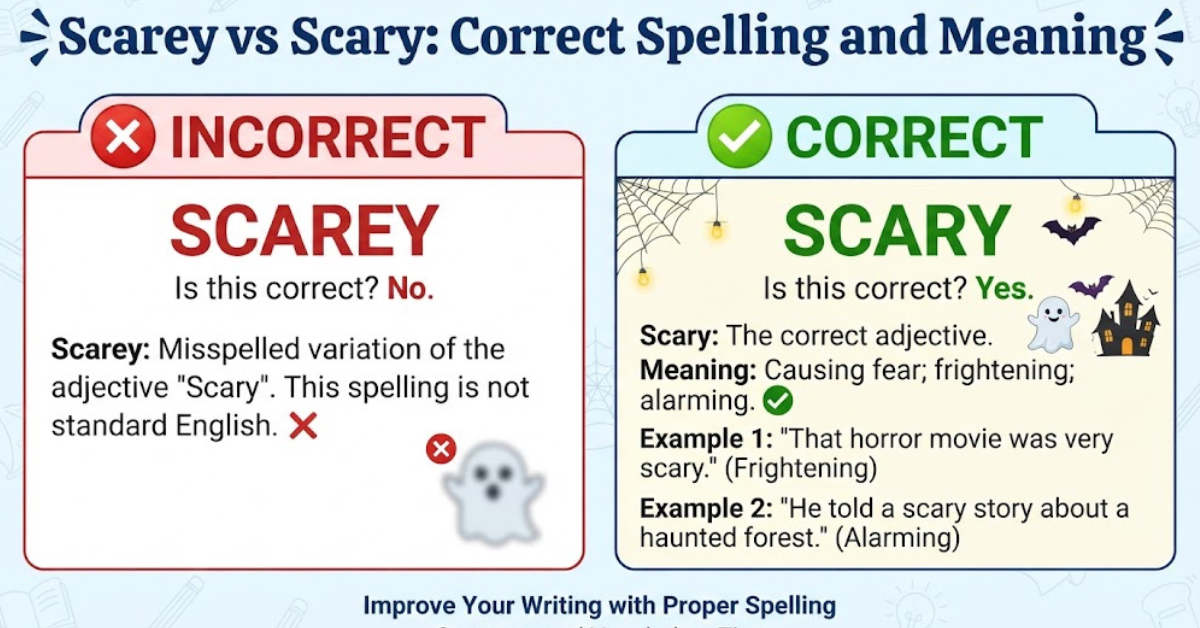
When comparing Scarey vs Scary, the correct spelling in modern standard English is scary. The spelling scarey is generally considered a misspelling, although it may occasionally appear as an informal or intentional variation in names, creative writing, or stylized text.
Whether you’re writing a school assignment, posting a Halloween caption, or sending a message to a friend, knowing which spelling to use will help you avoid an unnecessary grammar mistake. Let’s look at the difference, meaning, pronunciation, examples, and spelling rules behind these two words.
Scarey vs Scary: Which Spelling Is Correct?
Scary is the correct and widely accepted English spelling. It is an adjective used to describe something frightening, frighteningly unpleasant, or capable of causing fear.
Scarey is not the standard spelling. Although some people use it because it seems like a logical variation of the word scare, it is not the accepted spelling in standard English dictionaries.
Here’s a quick comparison:
| Spelling | Correct or Incorrect? | Explanation |
| Scary | <badge color=”success”>Correct</badge> | Standard English spelling |
| Scarey | <badge color=”danger”>Incorrect</badge> | Nonstandard spelling |
| Scared | <badge color=”success”>Correct</badge> | Past tense or past participle of scare |
| Scaring | <badge color=”success”>Correct</badge> | Present participle of scare |
| Scarier | <badge color=”success”>Correct</badge> | Comparative form of scary |
| Scariest | <badge color=”success”>Correct</badge> | Superlative form of scary |
The simple rule: Whenever you want to describe something frightening, write scary, not scarey.
What Does Scary Mean?
The word scary means frightening, alarming, or likely to cause fear. It describes something that makes a person feel afraid, uncomfortable, nervous, or threatened.
The word can refer to real situations as well as fictional experiences. For instance, a horror movie can be scary because of its disturbing scenes, while driving through a dangerous storm can be scary because of the genuine risks involved.
Here are some common examples:
- “That horror movie was really scary.”
- “Walking alone through the dark forest felt scary.”
- “The sudden noise was scary because nobody expected it.”
- “She had a scary experience while traveling.”
- “Some people find spiders scary, while others think they’re fascinating.”
In each example, scary describes something that produces fear or a sense of danger.
Why Do People Confuse Scarey and Scary?
The confusion between scarey and scary usually comes from the way English spelling works. People often assume that words related to one another should follow similar spelling patterns.
Since the verb is spelled scare, some writers naturally assume that adding a descriptive ending should produce scarey. However, English spelling doesn’t always work that way.
There are several reasons this particular mistake happens.
1. Confusion About the Letter E
The word scare contains an e at the end. When people turn it into an adjective, they may mistakenly believe that the e should remain before the letter y.
However, the correct spelling is formed by dropping the final e and adding y:
Scare + y = Scary
2. Similar English Spelling Patterns
English has several words that retain an e or use different spelling patterns when forming adjectives. This can make it difficult to remember which rule applies to a particular word.
For example:
- Shine → Shiny
- Spite → Spiteful
- Ice → Icy
- Noise → Noisy
- Scare → Scary
These examples show that the final e is often removed before adding a suffix, although English has exceptions.
3. Typing and Autocorrect Habits
Another reason people write scarey is that they type quickly and rely on familiar-looking words. If someone has repeatedly encountered the incorrect spelling online, it may begin to look correct.
Using a dictionary or proofreading tool can help catch this mistake before publishing or submitting written work.
What Is the Difference Between Scary and Scare?
Although scary and scare are closely related, they have different grammatical functions.
- Scare: A verb or noun referring to the act or experience of frightening someone.
- Scary: An adjective describing something that causes fear.
Consider these examples:
- “The loud thunder scared the children.”
- “The thunderstorm was scary.”
- “I didn’t mean to scare you.”
- “That was a scary moment.”
The easiest way to remember the difference is that scare describes an action or experience, while scary describes the thing that causes fear.
Scary vs Scared: Understanding the Difference
One of the most common English mistakes involves confusing scary with scared. Both words relate to fear, but they describe different things.
Scary describes something that causes fear.
Scared describes the person or animal experiencing fear.
For example:
- “The haunted house is scary.” (The house causes fear.)
- “I am scared of the haunted house.” (You experience fear.)
Here is another comparison:
| Word | Meaning | Example |
| Scary | Causing fear | The movie was scary. |
| Scared | Feeling fear | I was scared during the movie. |
| Scarier | More frightening | This movie is scarier than the last one. |
| Scariest | Most frightening | That was the scariest experience of my life. |
Understanding these differences will help you use the words naturally in everyday conversations and formal writing.
How to Remember the Correct Spelling of Scary
If you regularly confuse scarey with scary, a simple spelling trick can make things easier.
Remember the Scare + Y Rule
Start with the word scare. Remove its final e and add y.
- Scare → Scary
- Shine → Shiny
- Ice → Icy
- Noise → Noisy
This pattern is a useful reminder that the final e disappears when forming these adjectives.
Practice With Simple Sentences
Writing the correct spelling in context can help you remember it more easily.
Try these sentences:
- The scary story kept me awake all night.
- That was the scariest roller coaster I’ve ever ridden.
- The dark hallway looked scarier than usual.
- I had a scary experience during my vacation.
- The sudden movement gave everyone a scare.
After practicing a few examples, the correct spelling should become more familiar.
What Are the Comparative and Superlative Forms of Scary?
Like many adjectives, scary has comparative and superlative forms.
The comparative form is scarier, which means more frightening than something else. The superlative form is scariest, which describes the most frightening person, thing, or experience in a particular comparison.
Examples include:
- “This haunted house is scarier than the one we visited last year.”
- “That was the scariest horror movie I’ve ever watched.”
- “The second chapter gets even scarier.”
- “October is the scariest month for people who love horror stories.”
Notice that the letter y changes to i before adding the comparative or superlative ending.
| Form | Spelling | Example |
| Base adjective | Scary | The movie is scary. |
| Comparative | Scarier | This movie is scarier. |
| Superlative | Scariest | This is the scariest movie. |
Avoid spellings such as scareier or scareyest. They are not standard English forms.
Is Scarey Ever an Acceptable Spelling?
In standard English writing, scarey is considered incorrect. You should use scary in academic assignments, professional emails, articles, business communication, and other situations where correct spelling matters.
However, you might occasionally see Scarey used deliberately in:
- Fictional character names.
- Brand names or business names.
- Halloween decorations and themed designs.
- Creative writing or humorous social media posts.
- Stylized usernames and online content.
In these situations, the unusual spelling may be intentional rather than an accidental spelling mistake.
That doesn’t make scarey a standard alternative to scary. It simply means creative names and stylized language do not always follow conventional spelling rules.
Frequently Asked Questions About Scarey vs Scary
1. Is it scarey or scary?
Scary is the correct spelling in standard English. Scarey is a common misspelling and should generally be avoided in formal and informal writing.
2. Why is scary spelled without an e?
The word comes from scare, but its final e is dropped before adding the letter y. This creates the correct spelling, scary.
3. Is scarey a real word?
Scarey may appear in creative names or informal online writing, but it is not recognized as the standard spelling of the adjective. Use scary when describing something frightening.
4. What is the plural of scary?
Scary is an adjective, so it does not have a conventional plural form. It remains the same regardless of whether it describes one thing or several things.
For example, you can say “a scary movie” or “several scary movies.”
5. What is the past tense of scary?
Scary is an adjective, not a verb, so it does not have a past tense. The related verb scare has the past-tense form scared.
For example: “The unexpected noise scared me.”
6. Is it scarier or scareyer?
Scarier is the correct comparative form of scary. The y changes to i before adding the comparative ending -er.
7. Is it scariest or scareyest?
Scariest is the correct superlative form. It follows the spelling pattern in which the final y changes to i before adding -est.
8. Can I use scary in formal writing?
Yes. Scary is a standard English adjective and can be used in both formal and informal writing. In highly technical or academic contexts, words such as frightening, alarming, or intimidating may sometimes be more precise.
Conclusion
When comparing Scarey vs Scary, the correct spelling is always scary in standard English. The alternative spelling scarey is a common mistake that happens because people mistakenly retain the final e from the word scare.
Remember the simple spelling rule: remove the final e from scare and add y to form scary. Also, use scared when describing someone experiencing fear, scarier when making a comparison, and scariest when describing the most frightening experience.
Getting small spelling details right can make a noticeable difference in your writing. If you want to improve your English vocabulary further, explore more guides covering commonly confused words, spelling differences, and everyday grammar mistakes.