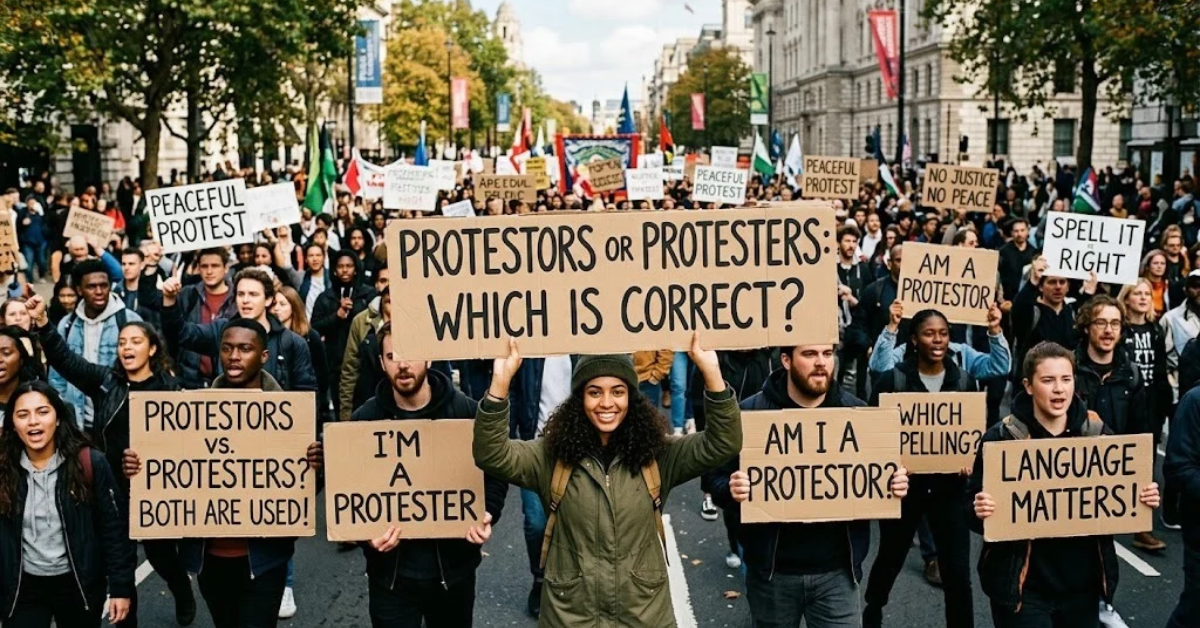
Have you ever paused while writing a sentence and wondered whether to use protestors or protesters? Both spellings appear in newspapers, news reports, academic writing, and everyday conversations, so it is easy to assume that one must be incorrect.
The good news is that both protestors and protesters are correct English spellings. They refer to people who take part in a protest, demonstrate against something, or publicly express opposition to a policy, decision, or situation.
However, protesters is generally the more common spelling in contemporary English, particularly in American English. Understanding the difference between these two forms, their usage, and the reason behind the spelling variation can help you write more confidently.
Protestors vs Protesters: Which Spelling Is Correct?
When comparing protestors or protesters, neither spelling is inherently wrong. Both are accepted nouns, and both describe people who participate in protests.
Here is a quick comparison:
| Word | Correct spelling? | Meaning |
| Protesters | Yes | People who participate in a protest |
| Protestors | Yes | People who participate in a protest |
The difference is primarily a matter of spelling preference and usage rather than meaning.
For example, both of these sentences are correct:
- Thousands of protesters gathered outside the government building.
- Thousands of protestors gathered outside the government building.
Both sentences communicate the same idea. Neither spelling changes the meaning of the sentence.
Which Spelling Is More Common?
Protesters is generally the more widely used form in modern English, especially in American English and mainstream news reporting.
You will frequently encounter it in articles about demonstrations, political movements, labor disputes, environmental campaigns, and civil rights activities.
Protestors is also established English usage, but it tends to be less common in many contemporary publications.
If you are unsure which form to choose, protesters is a reliable default for general writing.
What Does Protester Mean?
A protester is someone who publicly expresses disagreement, objection, or opposition to a particular issue.
A protest may be organized around political, social, economic, environmental, religious, or workplace concerns. People can protest through peaceful marches, rallies, demonstrations, picketing, sit-ins, and other forms of public expression.
For example:
- Environmental protesters called for stronger climate policies.
- Protesters gathered outside the courthouse to demand justice.
- Student protesters organized a peaceful demonstration on campus.
- Workers joined protesters calling for better wages and safer working conditions.
The word does not automatically imply violence, illegal behavior, or hostility. Protesters may demonstrate peacefully and lawfully, and the word itself does not indicate whether a protest is peaceful or disruptive.
What Is the Difference Between Protestors and Protesters?
The primary difference between protestors and protesters is their spelling.
Both words have the same meaning and grammatical function. They are plural nouns referring to people who protest.
Protesters: The More Common Form
Protesters is formed by adding the suffix -er to the verb protest.
It is widely used in American English and is a familiar choice in modern journalism, educational writing, and general communication.
Examples:
- Protesters marched through the city center.
- Police monitored the crowd as protesters gathered.
- The protesters demanded changes to the proposed law.
Protestors: An Accepted Alternative
Protestors is an alternative spelling that uses the suffix -or.
English has many nouns ending in -or, such as actor, editor, and investigator. Although protestor is less common in many contexts, it is still an accepted spelling.
Examples:
- Protestors assembled near the parliament building.
- The report described the concerns raised by protestors.
- Several protestors held signs calling for reform.
The key takeaway is simple: both spellings are correct, but protesters is usually the safer choice when you want to follow common contemporary usage.
Why Are There Two Spellings?
English spelling has developed over centuries through influences from different languages, historical writing conventions, and changing patterns of word formation.
One reason for the variation is that English uses both -er and -or to form nouns referring to people who perform an action or role.
Consider these examples:
- Teach → teacher
- Write → writer
- Act → actor
- Investigate → investigator
The suffix -er is particularly common for nouns formed from everyday verbs, while -or appears in many words with historical roots in Latin and French. However, these patterns are not absolute rules.
Both protester and protestor have become established through English usage. Their coexistence is an example of how spelling variation can persist even when two words have identical meanings.
There is no need to treat protestor as a grammatical error simply because protester is more widely used.
Protesters or Protestors in American English
In American English, protesters is generally the more familiar and frequently used spelling.
American newspapers, online publications, and everyday writing commonly use protesters when describing public demonstrations.
For example:
Protesters gathered outside City Hall to oppose the new policy.
This spelling is appropriate for:
- American news articles
- School and college assignments
- Blog posts
- Social media updates
- Business and professional writing
- General informational content
Although protestors is also valid in American English, choosing protesters can help your writing align with common editorial preferences.
Protesters or Protestors in British English
Both spellings can also be found in British English.
British writing includes numerous words with different spelling conventions from American English, such as colour instead of color and organise instead of organize. However, the choice between protesters and protestors is not a simple British-versus-American distinction.
Both forms occur in British publications, and protesters is widely used there as well.
If you are writing for a British audience, follow the spelling used by your publication, school, organization, or preferred style guide. Consistency is more important than assuming that one version belongs exclusively to a particular country.
Protester vs Protestors: Singular and Plural Forms
Another useful distinction is the difference between singular and plural forms.
| Singular | Plural | Meaning |
| Protester | Protesters | One or more people taking part in a protest |
| Protestor | Protestors | One or more people taking part in a protest |
Use the singular form when referring to one person:
- A protester spoke to the reporters.
- A protestor held a sign outside the building.
Use the plural form when referring to multiple people:
- The protesters gathered in the square.
- The protestors called for government action.
Both forms follow ordinary English pluralization rules.
How to Use Protester or Protestor in a Sentence
Understanding how the word works in a sentence can help you avoid common writing mistakes.
1. Use It as a Noun
Both spellings identify a person who participates in a protest.
Correct: The protesters demanded an explanation.
Correct: The protestors demanded an explanation.
2. Match the Verb to the Subject
When referring to one protester, use a singular verb. When referring to multiple protesters, use a plural verb.
Singular: The protester is standing near the entrance.
Plural: The protesters are standing near the entrance.
3. Be Consistent Within the Same Article
Although both spellings are correct, switching between them without a reason can make your writing look inconsistent.
For example, avoid writing:
The protesters gathered in the square. Later, the protestors addressed the crowd.
A cleaner version is:
The protesters gathered in the square. Later, the protesters addressed the crowd.
Unless you are quoting a source that uses a different spelling, choosing one form and maintaining it throughout the article is a sensible editorial practice.
Common Words Related to Protesters
If you are writing about demonstrations or public movements, several related terms may help you express your ideas more precisely.
| Word | Meaning |
|---|---|
| Protester | A person who publicly expresses opposition |
| Demonstrator | A person who participates in a public demonstration |
| Activist | Someone who works to promote social, political, or other changes |
| Dissenter | A person who disagrees with an accepted opinion or position |
| Campaigner | Someone who actively works toward a particular cause |
| Marcher | A person participating in an organized march |
| Demonstration | A public gathering expressing support or opposition |
| Protest | An expression of disagreement or objection |
These words are related, but they are not always interchangeable.
For example, an activist may campaign for a cause over many years without attending a protest. A demonstrator, on the other hand, may participate in a single public gathering without being involved in a broader movement.
Choosing the most precise word helps readers understand the situation you are describing.
Protesters vs Demonstrators: Is There a Difference?
Protesters and demonstrators often refer to the same people, but their emphasis can differ slightly.
A protester is someone expressing opposition to a particular policy, decision, action, or situation.
A demonstrator is someone participating in a public demonstration, whether to oppose something or show support for a cause.
For example:
- Protesters marched against a proposed tax increase.
- Demonstrators gathered to support a new environmental initiative.
In practice, a person can be both a protester and a demonstrator. The most appropriate term depends on the context and what the writer wants to emphasize.
Common Mistakes to Avoid
When using protesters or protestors, keep these points in mind.
Mistake 1: Assuming one spelling is always wrong.
Both protesters and protestors are accepted. The difference is not a matter of correct versus incorrect spelling.
Mistake 2: Assuming the spellings have different meanings.
They refer to the same thing. Neither word automatically describes a peaceful, violent, lawful, or unlawful protest.
Mistake 3: Changing spellings throughout an article.
Choose one form and use it consistently unless a direct quotation or specific editorial requirement calls for something different.
Mistake 4: Confusing a protester with an activist.
A protester participates in a protest, while an activist works to bring about change and may use many methods beyond public demonstrations.
Mistake 5: Assuming British and American English use completely different forms.
Both spellings appear in both varieties of English. Regional preference and publication style can influence which one is selected.
Frequently Asked Questions
Is it protestors or protesters?
Both spellings are correct. Protesters is generally more common in contemporary English, making it a good default for most writing.
Which spelling is correct in the United States: protestors or protesters?
Both are accepted in American English, but protesters is generally the more common form in modern American usage.
Is protestors a real word?
Yes. Protestors is an established alternative spelling of protesters. It is not inherently incorrect, although it is less common in many publications.
Are protesters and protestors the same thing?
Yes. Both words refer to people who participate in protests or publicly express opposition to something. There is no meaningful difference in their standard definitions.
Is protester singular or plural?
Protester is singular, referring to one person. Protesters is plural, referring to two or more people. The same pattern applies to protestor and protestors.
Should I use protesters or protestors in an essay?
Use protesters unless your teacher, institution, or chosen style guide specifies otherwise. It is widely recognized and commonly used in contemporary writing.
Which spelling do newspapers prefer?
Many contemporary newspapers use protesters, but editorial preferences vary. If you are writing for a particular publication, check its style guide or follow its established usage.
What is another word for protester?
Depending on the context, alternatives include demonstrator, activist, dissenter, campaigner, and marcher. These terms have slightly different meanings, so choose the one that best describes the person or situation.
How do you pronounce protesters and protestors?
Both words are generally pronounced similarly, with the main stress on the second syllable: pruh-TES-ters and pruh-TES-tors. Pronunciation may vary slightly by accent, but the spelling difference does not create a major difference in meaning or usage.
Conclusion: Protestors or Protesters?
When deciding between protestors or protesters, remember that both are correct English spellings with the same basic meaning. The main difference is usage: protesters is generally more common in contemporary writing, while protestors remains an accepted alternative.
For blog posts, news articles, school assignments, and professional documents, protesters is usually the best default choice. Whichever form you select, use it consistently and consider the preferences of your audience or publication.
If you’re exploring other commonly confused English words, comparing their meanings, spellings, and real-world examples is a practical way to improve your writing and communicate more confidently.