Have you ever paused while writing a sentence because you weren’t sure whether to spell the word prefer or perfer? It is an easy mistake to make, especially when typing quickly or relying on how a word sounds. However, when it comes to prefer or perfer, only one spelling is correct in standard English: prefer.
The word prefer means to like or choose one thing rather than another. For example, you might prefer tea over coffee or prefer working in the morning instead of late at night. Perfer, on the other hand, is a common misspelling and should not be used in formal or professional writing.
In this guide, you’ll learn the correct spelling, meaning, pronunciation, grammar rules, and examples to help you remember the difference.
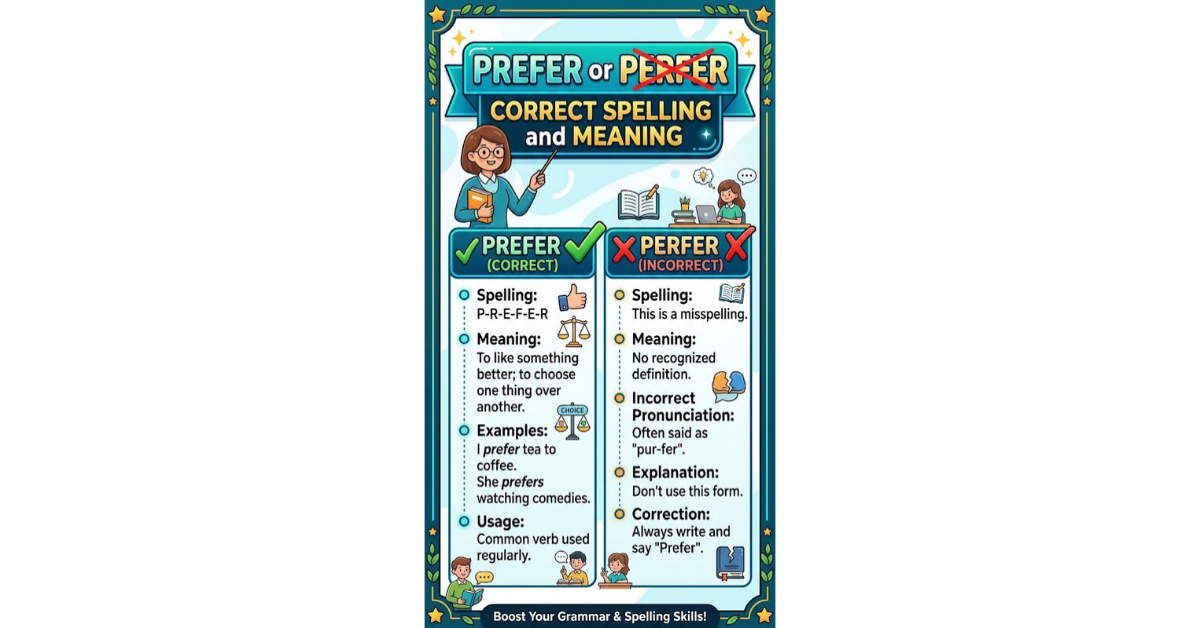
Prefer or Perfer: Which Spelling Is Correct?
The correct spelling is prefer, with the letter r immediately after the first letter p.
- Prefer: Correct spelling; means to like or choose something more than another option.
- Perfer: Incorrect spelling; a common typing or spelling mistake.
Here is an example of the correct usage:
“I prefer reading books in the evening rather than watching television.”
The sentence means that reading books is the activity the speaker likes more.
Now consider this incorrect example:
“I perfer reading books in the evening.”
The intended meaning is understandable, but perfer is not the standard English spelling. The sentence should use prefer instead.
What Does Prefer Mean?
Prefer is a verb that describes choosing or liking one person, thing, or activity more than another. It expresses a personal choice, preference, or inclination.
For example:
- I prefer coffee to tea.
- She prefers walking to driving.
- They prefer quiet restaurants.
- He prefers to study in the morning.
The word is useful in everyday conversations, professional communication, academic writing, and situations where you need to explain your choices.
Prefer Meaning in Simple English
In simple terms, prefer means to like one thing more than another.
For example, if you say, “I prefer summer to winter,” you’re explaining that you like summer more than winter.
The word doesn’t necessarily mean that you dislike the other option. You may enjoy both choices but have a stronger preference for one.
Why Do People Spell Prefer as Perfer?
The misspelling perfer often happens because people accidentally switch the order of letters or remember the word incorrectly.
There are several reasons this mistake occurs.
1. Confusion About Letter Order
The correct spelling is p-r-e-f-e-r. When typing quickly, someone might accidentally write p-e-r-f-e-r, placing the first e before the r.
This is a common type of spelling error known as a letter-order mistake.
2. Incorrect Spelling Habits
If someone repeatedly sees or writes perfer, the incorrect version may begin to look familiar. Familiarity, however, doesn’t make a spelling correct.
Checking the word in a reliable dictionary or using a spell-checking tool can help reinforce the correct form.
3. Pronunciation and Memory
In natural conversation, people often pronounce words quickly, making individual sounds less distinct. Although prefer has a standard pronunciation, a listener may remember its sounds imperfectly and reproduce them in the wrong order when writing.
The best solution is to learn the spelling visually and use the word in sentences.
How to Remember the Correct Spelling of Prefer
If you frequently confuse prefer and perfer, a simple memory technique can help.
Remember the First Three Letters
Break the word into two parts:
PRE + FER = PREFER
The first three letters are P-R-E, not P-E-R.
Repeat the correct spelling a few times:
- Prefer one option.
- Prefer a different choice.
- Prefer quality over quantity.
Use a Simple Example
Remember this sentence:
“I prefer the word prefer spelled correctly.”
Although simple, repeating a familiar sentence can help reinforce the correct letter order.
Practice With Related Words
You can also learn prefer alongside its related forms:
| Word | Correct spelling | Meaning |
|---|---|---|
| Prefer | Prefer | To like one option more |
| Preferred | Preferred | Chosen or liked more |
| Preferring | Preferring | Currently favoring one option |
| Preference | Preference | A greater liking for one option |
| Preferable | Preferable | More desirable or suitable |
Learning these related words makes it easier to recognize the correct spelling pattern.
Prefer in a Sentence: Examples of Correct Usage
The easiest way to understand a word is to see how it works in everyday situations.
Here are some examples of prefer in a sentence.
Everyday Conversations
- I prefer tea without sugar.
- Do you prefer staying home or going out?
- We prefer to eat dinner early.
- She prefers comfortable shoes.
School and Education
- I prefer studying in a quiet room.
- Most students prefer clear instructions.
- He prefers reading printed books instead of digital versions.
Work and Business
- Our customers prefer flexible payment options.
- I prefer to discuss the proposal in person.
- The manager prefers written reports.
Travel and Entertainment
- We prefer traveling by train.
- She prefers comedies to horror movies.
- I prefer visiting the mountains during the summer.
In every example, prefer communicates a choice or a stronger liking for one option.
Prefer vs. Preferred: What’s the Difference?
Another common source of confusion is the difference between prefer and preferred.
Prefer is the base form of the verb. It is used for present-tense statements and general choices.
Example: “I prefer fresh fruit.”
Preferred is the past-tense and past-participle form of prefer. It can also function as an adjective.
Examples:
- I preferred the older design.
- She preferred to work alone.
- This is our preferred payment method.
Remember that the spelling changes from prefer to preferred by doubling the final r before adding -ed.
The same pattern appears in preferring, where the final r is doubled before adding -ing.
Prefer vs. Preference: Understanding the Difference
Although the words are related, they have different grammatical functions.
Prefer is a verb that describes the act of choosing or liking something more.
Example: “I prefer tea.”
Preference is a noun that describes the choice or liking itself.
Example: “My preference is tea.”
Compare these sentences:
- Correct: I prefer working in the morning.
- Correct: My preference is to work in the morning.
- Incorrect: I preference working in the morning.
The distinction is important because choosing the correct form helps make your writing clear and grammatically accurate.
Grammar Rules for Using Prefer Correctly
Knowing the correct spelling is only the first step. Understanding how to use prefer in a sentence will help you avoid common grammar mistakes.
1. Prefer One Thing to Another
One standard construction is prefer A to B.
Examples:
- I prefer tea to coffee.
- She prefers summer to winter.
- They prefer online classes to traditional lectures.
Although people sometimes use prefer A over B, the construction prefer A to B is especially well established in formal English.
2. Prefer Doing Something to Doing Something Else
When comparing activities, use the -ing form in both parts of the comparison.
Examples:
- I prefer swimming to running.
- He prefers cooking at home to eating out.
- We prefer walking to taking a taxi.
This structure makes the comparison clear and grammatically parallel.
3. Prefer to Do Something
You can use prefer followed by to + verb when explaining a choice.
Examples:
- I prefer to work early.
- She prefers to travel alone.
- They prefer to make decisions together.
4. Prefer Someone to Do Something
When expressing what you would like another person to do, you can use this structure:
Prefer + object + to-infinitive
Example: “I would prefer you to arrive on time.”
This construction is useful when communicating expectations or requests politely.
5. Use Would Prefer for Specific Situations
The expression would prefer is commonly used to describe a particular choice or a polite request.
Examples:
- I would prefer to sit near the window.
- We would prefer a later appointment.
- Would you prefer to pay by card?
It often sounds more tentative or polite than a direct statement of preference.
Is Perfer Ever Correct in English?
No. Perfer is not the standard spelling of the English verb meaning to like one thing more than another.
In ordinary English writing, it should be corrected to prefer.
If you encounter perfer in a message, article, assignment, or document, the writer almost certainly intended to use prefer. A spell-checker will often identify the error, although you should still proofread important documents.
Prefer or Perfer in American and British English
There is no difference between American and British English in this case.
Both varieties use prefer as the correct spelling.
| Variety of English | Correct spelling | Incorrect spelling |
| American English | Prefer | Perfer |
| British English | Prefer | Perfer |
| Australian English | Prefer | Perfer |
| Canadian English | Prefer | Perfer |
Unlike words such as color and colour, which have recognized spelling variations, prefer does not have a standard regional alternative spelled perfer.
Common Spelling Mistakes Similar to Prefer and Perfer
English contains many words that people misspell by switching letters, omitting letters, or confusing similar sounds.
Examples include:
- Definitely, not definately
- Separate, not seperate
- Receive, not recieve
- Believe, not beleive
- Necessary, not neccessary
- Prefer, not perfer
A helpful strategy is to keep a personal list of words you frequently misspell and review it before submitting important writing.
Frequently Asked Questions
1. Is it prefer or perfer?
Prefer is the correct spelling. Perfer is a common misspelling and is not the standard English form of the word.
2. What does prefer mean?
Prefer means to like, choose, or favor one thing more than another. For example, “I prefer coffee to tea” means that you like coffee more than tea.
3. Why do people write perfer instead of prefer?
People may reverse the order of the letters r and e when typing or recalling the word. Practicing the spelling P-R-E-F-E-R can help prevent this mistake.
4. How do you spell prefer correctly?
The correct spelling is P-R-E-F-E-R. A useful way to remember it is to focus on the opening letters P-R-E.
5. Is prefer spelled the same way in British and American English?
Yes. Both British and American English use prefer. There is no standard regional spelling variation that changes it to perfer.
6. What is the past tense of prefer?
The past tense is preferred. For example, “I preferred the first option.” Notice that the final r is doubled before adding -ed.
7. What is the difference between prefer and preference?
Prefer is a verb, while preference is a noun. You might say, “I prefer tea,” or “My preference is tea.”
8. Can I use prefer in formal writing?
Yes. Prefer is appropriate in formal, academic, professional, and casual writing. It is a standard English verb used to express choices and personal preferences.
Conclusion: Prefer or Perfer?
When comparing prefer or perfer, the answer is simple: prefer is the correct spelling, while perfer is a spelling mistake.
The word prefer means to like or choose one option more than another. Remember the opening letters P-R-E, practice using the word in everyday sentences, and learn related forms such as preferred, preferring, and preference.
The next time you write an email, complete an assignment, or publish an article, take a moment to check your spelling. Small details like these make your writing clearer, more professional, and easier to understand.