Have you ever paused while writing a sentence and wondered whether to use tryed or tried? It is an easy mistake to make, especially because many English verbs form their past tense by adding -ed. However, when it comes to the verb try, the spelling follows a slightly different rule.
The correct spelling is tried, while tryed is a misspelling in standard English. Whether you’re writing a text message, school assignment, professional email, or social media post, knowing this simple spelling rule can help you write more confidently.
In this guide, we’ll explain why tried is correct, how to use it in sentences, and how to remember the difference between tryed and tried.
Tryed vs Tried: Which One Is Correct?
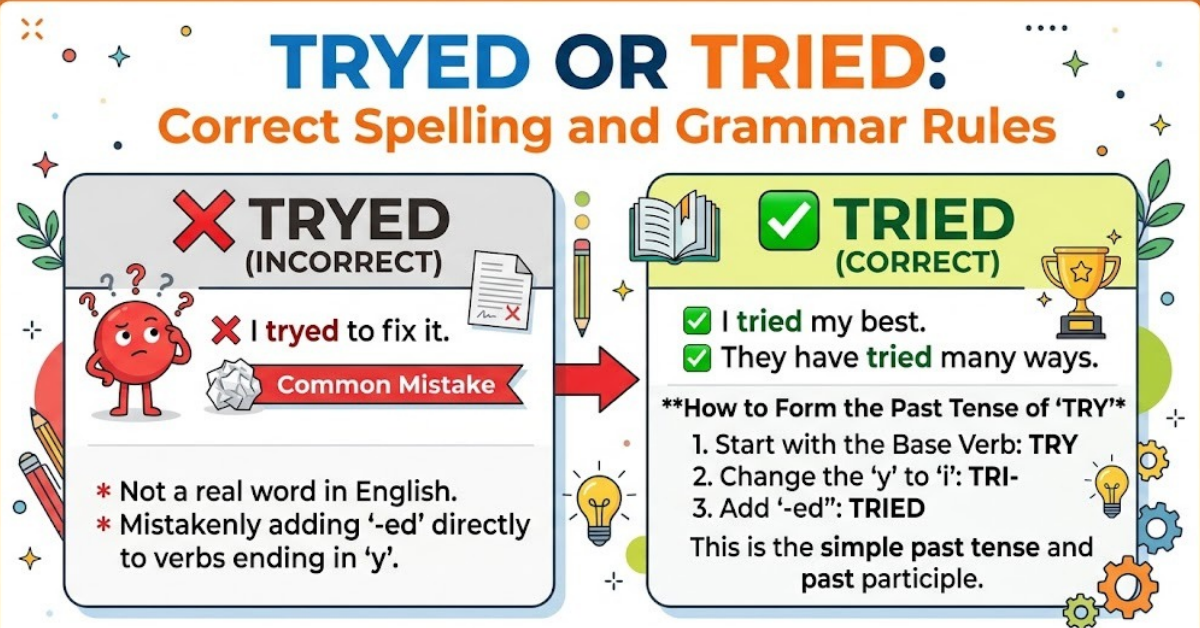
When comparing tryed vs tried, there is only one correct spelling in standard English: tried.
- Tried: Correct spelling and the past tense and past participle of try.
- Tryed: Incorrect spelling in standard English.
For example:
Correct: I tried to call you yesterday.
Incorrect: I tryed to call you yesterday.
The word tried describes an attempt that happened in the past. It can also be used with helping verbs, as in “I have tried everything.”
Why Is Tried the Correct Spelling?
The reason tried is correct comes down to an English spelling rule for verbs ending in a consonant followed by y.
When a verb ends in a consonant plus y, you generally change the y to i before adding -ed to form the past tense.
The rule looks like this:
Consonant + y → change y to i + ed
For example:
- Try → tried
- Cry → cried
- Fry → fried
- Dry → dried
- Carry → carried
- Worry → worried
Because try ends in a consonant (r) followed by y, its past-tense form becomes tried, not tryed.
What Happens When a Verb Ends in a Vowel Plus Y?
There is an important exception to remember. When a verb ends in a vowel followed by y, you usually keep the y and add -ed.
Examples include:
- Play → played
- Enjoy → enjoyed
- Stay → stayed
- Delay → delayed
- Employ → employed
This distinction explains why we write tried but played. In try, the letter before y is a consonant; in play, it is a vowel.
What Does Tried Mean?
Tried is the past tense and past participle of the verb try. It generally means that someone attempted to do something, made an effort, or tested something to see whether it worked or was suitable.
The exact meaning depends on the context.
1. Made an Attempt
Tried can describe an effort to accomplish something.
Example: “She tried to finish the project before the deadline.”
This means she made an effort to complete the project.
2. Tested Something
The word can also mean that someone experienced or tested something.
Example: “I tried the new restaurant last weekend.”
Here, tried means the speaker visited the restaurant and experienced its food or service.
3. Attempted to Solve a Problem
Example: “We tried several solutions before finding the answer.”
In this sentence, tried describes testing different approaches to solve a problem.
4. Made an Effort Despite Difficulty
Example: “He tried his best, even though the task was difficult.”
This usage emphasizes effort rather than whether the person succeeded.
Tried in a Sentence: Examples of Correct Usage
The best way to understand a spelling rule is to see it in everyday writing.
Here are examples of tried used correctly:
- I tried to learn a new language last year.
- She tried calling her friend after work.
- They tried their best to win the competition.
- He tried a different approach to fix the problem.
- We tried the new recipe, and everyone enjoyed it.
- I have tried several methods to improve my writing.
- The teacher tried to explain the concept more clearly.
- She tried on three dresses before choosing one.
- They tried to arrive early but got stuck in traffic.
- I tried again after my first attempt failed.
Notice that tried can appear in several sentence structures, but its spelling remains the same.
Try, Tries, Tried, and Trying: Understanding the Different Forms
The verb try changes its spelling depending on the tense and grammatical structure of the sentence.
| Verb form | Correct spelling | Example |
| Base form | Try | I try to exercise daily. |
| Third-person singular | Tries | She tries to help everyone. |
| Simple past | Tried | He tried to contact me. |
| Past participle | Tried | We have tried that method. |
| Present participle | Trying | They are trying again. |
Understanding these forms helps you avoid spelling mistakes and use the verb correctly.
When Do You Use Try?
Use try for the base form, including after modal verbs such as can, will, and should.
Examples:
- I will try again tomorrow.
- You should try this recipe.
- They can try a different method.
When Do You Use Tries?
Use tries with a third-person singular subject in the simple present tense.
Examples:
- She tries to stay positive.
- He tries to arrive on time.
- My brother tries new foods whenever he travels.
When Do You Use Tried?
Use tried when describing a past attempt or when forming perfect tenses.
Examples:
- I tried to reach you earlier.
- She has tried every available option.
- They had tried to solve the issue before asking for help.
When Do You Use Trying?
Use trying for continuous verb forms or when the word functions as a gerund.
Examples:
- I am trying to improve my English.
- She was trying to open the door.
- Trying again can sometimes lead to better results.
Common Mistakes With Tried and Tryed
Even people who understand English grammar can make spelling errors when writing quickly. Here are some mistakes worth avoiding.
Mistake 1: Adding -ed Without Changing the Y
Incorrect: “I tryed to finish the assignment.”
Correct: “I tried to finish the assignment.”
Remember that verbs ending in a consonant plus y generally change the y to i before -ed.
Mistake 2: Using Tried Instead of Try
Incorrect: “I will tried my best.”
Correct: “I will try my best.”
After will, use the base form of the verb.
Mistake 3: Using Try Instead of Tries
Incorrect: “She try to help her friends.”
Correct: “She tries to help her friends.”
In the simple present tense, a third-person singular subject such as he, she, or it generally takes tries.
Mistake 4: Confusing Tried and Trying
Incorrect: “I am tried to learn English.”
Correct: “I am trying to learn English.”
Use trying after am in this continuous construction. The word tried can also be an adjective meaning exhausted, as in “I feel tired,” but it does not work in the incorrect sentence above.
Tried vs. Attempted: Are They the Same?
Tried and attempted have similar meanings, but they can differ in tone.
Tried is common in everyday conversation and works naturally in both informal and formal writing.
Example: “I tried to repair my bicycle.”
Attempted often sounds more formal and may emphasize the effort to perform a specific action.
Example: “The technician attempted to repair the equipment.”
Depending on the sentence, other alternatives include tested, experimented with, made an effort, and gave it a go.
Synonyms of Tried
If you want to avoid repeating the word tried, you can use a suitable synonym based on your intended meaning.
| Synonym | Example |
| Attempted | She attempted to solve the puzzle. |
| Tested | We tested a different approach. |
| Explored | He explored several possible solutions. |
| Experimented with | They experimented with a new technique. |
| Endeavored | She endeavored to meet the deadline. |
| Made an effort | I made an effort to improve. |
These words are not interchangeable in every situation. Choose one that fits the context and the tone of your writing.
How to Remember the Correct Spelling of Tried
If you frequently confuse tryed and tried, use one of these simple memory tricks.
1. Remember the consonant-plus-y rule.
When a verb ends in a consonant plus y, change the y to i before adding -ed.
Try → Tried
Cry → Cried
Carry → Carried
2. Compare it with familiar words.
Think of cried, fried, and dried. They follow the same spelling pattern as tried.
3. Read your sentence aloud.
Although pronunciation alone will not tell you which spelling is correct, reading your sentence aloud can help you notice other grammatical errors.
4. Use a spellchecker.
Most word processors and modern browsers flag tryed as a spelling error. However, learning the rule helps you recognize the correct form even when a spellchecker is unavailable.
Frequently Asked Questions About Tryed or Tried
Is it tryed or tried?
Tried is correct. Tryed is a misspelling in standard English because verbs ending in a consonant plus y generally change the y to i before adding -ed.
Why is tried spelled with an i instead of a y?
The verb try ends in a consonant followed by y. Under the standard spelling rule, the y changes to i before the -ed ending is added, producing tried.
Is tried a real word?
Yes. Tried is the simple past tense and past participle of try. For example, “I tried to help” uses the simple past, while “I have tried to help” uses the past participle.
What is the past tense of try?
The past tense of try is tried. For example, “I try to exercise every day” becomes “I tried to exercise yesterday.”
Is it tried my best or tryed my best?
The correct expression is “tried my best” when referring to a past effort.
Example: “I tried my best to complete the assignment.”
For a future intention, write “I will try my best.”
Is it tryed again or tried again?
The correct phrase is “tried again.”
Example: “The first attempt did not work, so she tried again.”
What is the difference between tried and trying?
Tried generally refers to a past attempt or appears as a past participle. Trying is the present participle and is used in continuous constructions, such as “I am trying to understand the lesson.”
What is the difference between tried and tested?
Tried can mean that someone attempted an action or experienced something. Tested more specifically suggests checking how something performs or whether it works.
Does tried always mean success?
No. Tried describes an attempt, not necessarily a successful result. For example, “I tried to open the door, but it remained locked” clearly describes an unsuccessful attempt.
Can I use tryed in informal text messages?
People may understand what you mean if you write tryed, but it is still a spelling mistake in standard English. Using tried is the better choice in text messages, emails, schoolwork, and professional communication.
Conclusion: Tryed or Tried?
When deciding between tryed or tried, remember that tried is the correct spelling in standard English. The word is the past tense and past participle of try, and it follows the spelling rule that changes a final consonant-plus-y to i before adding -ed.
Keep this simple pattern in mind: try → tried, just like cry → cried and fry → fried. Once you understand the rule, choosing the correct spelling becomes much easier.
If you’re working on improving your English, learning similar spelling pairs can help you write more clearly and confidently. Practice using try, tries, tried, and trying in your own sentences to make the differences stick.