Have you ever finished an email or message with the words “looking forward to seeing you” and wondered whether you were using the phrase correctly? It’s a common expression in English, used to show excitement, anticipation, or genuine interest in meeting someone.
“Looking forward to seeing you” means that you are happy or excited about the possibility of meeting someone in the future. It works well in professional emails, friendly conversations, invitations, and personal messages. However, knowing when to use it, how to punctuate it, and which alternatives fit different situations can help you communicate more naturally.
In this guide, we’ll explain the meaning of the phrase, explore its grammar, share practical examples, and answer common questions about using it correctly.
What Does “Looking Forward to Seeing You” Mean?
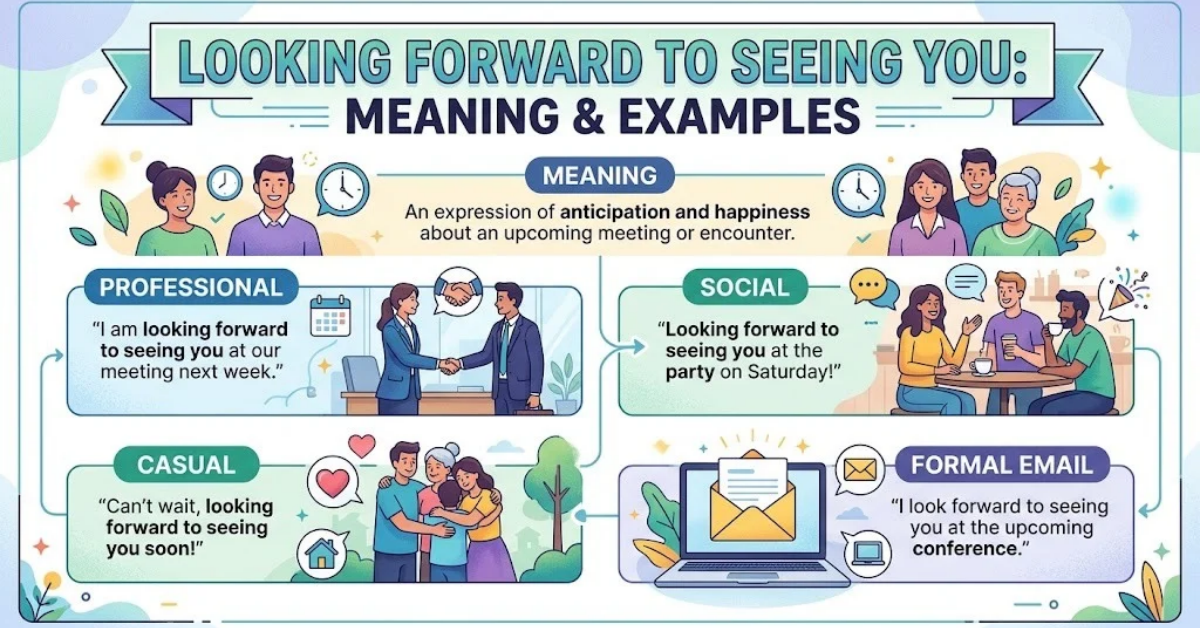
The phrase “looking forward to seeing you” expresses positive anticipation about a future meeting. It tells the other person that you expect to see them and feel happy, interested, or enthusiastic about it.
For example:
“I’m looking forward to seeing you on Saturday.”
This sentence means that you are pleased about the upcoming meeting and are eager for Saturday to arrive.
The expression can be used in several situations, including:
- Meeting a friend after a long time.
- Attending a business meeting.
- Visiting family members.
- Going on a date.
- Meeting a colleague or client.
- Attending an event or social gathering.
The tone is generally warm and polite. Depending on the context, it can sound professional, friendly, affectionate, or simply courteous.
Is “Looking Forward to Seeing You” Grammatically Correct?
Yes. “Looking forward to seeing you” is grammatically correct. It is a shortened form of “I am looking forward to seeing you.”
The complete sentence is often preferable in formal writing, while the shorter version works naturally in email sign-offs and informal messages.
For example:
- Complete: “I am looking forward to seeing you tomorrow.”
- Shortened: “Looking forward to seeing you tomorrow!”
Both are correct in their respective contexts.
Why Is It “Seeing You” Instead of “See You”?
The reason comes down to grammar. In the expression look forward to, the word to is a preposition, not the infinitive marker used in phrases such as to see or to meet.
When a verb follows this preposition, it generally takes the -ing form, also called a gerund.
Therefore:
- Correct: I look forward to seeing you.
- Incorrect: I look forward to see you.
The same pattern appears in other expressions:
- I look forward to meeting you.
- She looks forward to hearing from you.
- We look forward to working together.
- He looks forward to visiting his family.
Remember this simple rule: look forward to + verb ending in -ing.
How to Use “Looking Forward to Seeing You” in a Sentence
The phrase is flexible, but the wording can change slightly depending on the situation.
1. In Everyday Conversations
Use it when you’re talking to friends, relatives, or acquaintances about an upcoming meeting.
Examples:
- “I’m looking forward to seeing you this weekend.”
- “It’s been ages! I’m really looking forward to seeing you.”
- “Looking forward to seeing you at the party tonight.”
- “I’m looking forward to seeing you again soon.”
These examples sound natural because they communicate enthusiasm without being overly formal.
2. In Professional Emails
In business communication, the phrase conveys courtesy and interest in an upcoming meeting.
Examples:
- “I look forward to seeing you at the conference next week.”
- “I’m looking forward to seeing you at our scheduled meeting.”
- “Thank you for confirming the appointment. I look forward to seeing you on Monday.”
- “We look forward to seeing you at the event.”
For formal emails, “I look forward to seeing you” is a particularly useful choice. It is polite, professional, and appropriate for clients, colleagues, managers, and business partners.
3. In Text Messages
Text messages often allow for a more relaxed tone.
Examples:
- “Can’t wait to see you!”
- “Looking forward to seeing you tomorrow”
- “So excited to catch up with you!”
- “See you soon! Really looking forward to it.”
Choose wording that reflects your relationship with the recipient. A close friend might appreciate an enthusiastic message, while a professional contact may prefer a straightforward one.
4. In Invitations and Event Messages
If you’re organizing a gathering, you can use the phrase to welcome guests and create a friendly atmosphere.
Examples:
- “We’re looking forward to seeing you at our wedding.”
- “I look forward to seeing you at the graduation ceremony.”
- “We’re excited to welcome you and look forward to seeing you at the event.”
- “Looking forward to seeing everyone at the reunion!”
It works especially well when the meeting has already been arranged.
“Looking Forward to Seeing You” in Emails
Choosing the right wording for an email depends on the purpose of your message and your relationship with the recipient.
Here are a few examples you can adapt.
Formal Email Example
Subject: Upcoming Meeting Confirmation
Dear Mr. Smith,
Thank you for confirming the meeting scheduled for Thursday. I look forward to seeing you and discussing the project in more detail.
Best regards,
[Your Name]
This version is appropriate for business meetings, client appointments, and formal professional communication.
Friendly Email Example
Hi Sarah,
I’m glad we finally found a date that works for both of us. I’m looking forward to seeing you this weekend and catching up!
Best,
[Your Name]
This message is warm and conversational without sounding overly casual.
Event Confirmation Example
Hello,
Thank you for confirming your attendance. We’re looking forward to seeing you at the event on Friday.
Kind regards,
[Your Name]
This version is suitable for conferences, workshops, networking events, and other organized gatherings.
Looking Forward to Seeing You vs. Looking Forward to Meeting You
These expressions are similar, but they are not always interchangeable.
“Looking forward to seeing you” usually suggests that you will see someone you already know or have met before. It can also refer to someone you have arranged to meet, even if the relationship is professional.
“Looking forward to meeting you” is particularly common when you are going to meet someone for the first time.
Examples:
- “I’m looking forward to seeing you again.” — Often used when you already know the person.
- “I’m looking forward to meeting you.” — Often used before a first meeting.
- “I look forward to meeting you at the interview.” — Appropriate for a candidate or interviewer meeting for the first time.
- “I look forward to seeing you at our next meeting.” — Appropriate when you have met previously.
The distinction isn’t absolute. You can use seeing you for a first meeting when the context makes sense, but meeting you often makes the first introduction clearer.
Looking Forward to Seeing You vs. Looking Forward to Meet You
This is an important grammar distinction.
The correct expression is “looking forward to meeting you,” not “looking forward to meet you.”
Why? Because the preposition to in look forward to must be followed by a noun or gerund in this construction.
Compare these examples:
| Correct expression | Incorrect expression |
| I look forward to seeing you. | I look forward to see you. |
| I look forward to meeting you. | I look forward to meet you. |
| We look forward to hearing from you. | We look forward to hear from you. |
| She looks forward to working with you. | She looks forward to work with you. |
There is nothing wrong with using to see or to meet in other grammatical structures. The issue arises specifically after the expression look forward to.
For instance, “I hope to see you soon” is perfectly correct.
Should You Say “I Look Forward to Seeing You” or “I’m Looking Forward to Seeing You”?
Both expressions are correct, but they can carry slightly different tones.
“I Look Forward to Seeing You”
This version is often used in professional emails and formal communication. It sounds composed, courteous, and businesslike.
Example:
“Thank you for arranging the appointment. I look forward to seeing you next week.”
“I’m Looking Forward to Seeing You”
This version emphasizes your current anticipation and can sound slightly more conversational or personal.
Example:
“I’m looking forward to seeing you this weekend!”
Neither form is universally better. Choose the one that suits the situation, your personal writing style, and the level of formality you want.
Best Alternatives to “Looking Forward to Seeing You”
Sometimes, repeating the same expression in every message can make your writing feel predictable. Fortunately, several alternatives communicate similar feelings.
Professional Alternatives
Use these in work emails, meeting confirmations, and business correspondence:
- I look forward to our meeting.
- I look forward to meeting with you.
- I look forward to our discussion.
- I look forward to speaking with you.
- I look forward to connecting with you.
- I look forward to seeing you at the conference.
Friendly Alternatives
These work well in texts, personal emails, and everyday conversations:
- Can’t wait to see you!
- Excited to see you soon!
- Looking forward to catching up.
- It will be great to see you again.
- Hope to see you soon!
- I’m excited that we’ll get to spend time together.
Warm and Affectionate Alternatives
When speaking to a partner, close friend, or family member, you might prefer something more personal:
- I can’t wait to be with you.
- Counting down the days until I see you.
- I’m so happy we’ll get to spend time together.
- I miss you and can’t wait to see you.
- It’s going to be wonderful seeing you again.
Choose an alternative that reflects the relationship rather than relying on a phrase simply because it sounds polished.
How to Reply to “Looking Forward to Seeing You”
If someone sends you this message, you don’t need a complicated response. A simple acknowledgment is usually enough.
Here are some natural replies.
Polite replies:
- “Likewise! Looking forward to it.”
- “Thank you! I look forward to seeing you too.”
- “Same here. See you soon!”
Friendly replies:
- “Me too! It’s going to be great catching up.”
- “Can’t wait!”
- “Same here! It’s been too long.”
Professional replies:
- “Thank you. I look forward to our meeting as well.”
- “Likewise. See you on Thursday.”
- “Thank you for confirming. I look forward to speaking with you.”
Affectionate replies:
- “I can’t wait to see you either!”
- “Me too! I’ve missed you.”
- “Counting down the days!”
The best reply depends on who sent the message and how formal or personal your relationship is.
Common Mistakes to Avoid
Although the expression is straightforward, a few common errors are worth watching for.
1. Using the Wrong Verb Form
Incorrect: “I look forward to see you.”
Correct: “I look forward to seeing you.”
2. Forgetting the Subject in a Complete Sentence
In formal writing, a complete sentence usually works best.
Less complete: “Looking forward to seeing you at the meeting.”
More formal: “I am looking forward to seeing you at the meeting.”
The shorter version is perfectly normal in many emails and messages, but the complete sentence is a safer choice when you want a more formal tone.
3. Using It When No Meeting Is Planned
The phrase normally suggests that a meeting or encounter is expected. If no plans have been made, a message such as “I hope we get to see each other soon” may be more accurate.
4. Choosing a Tone That Doesn’t Fit the Situation
“Can’t wait to see you!” may sound natural to a friend but overly casual in certain professional situations. For a client or senior colleague, “I look forward to seeing you at the meeting” is often more suitable.
Frequently Asked Questions
Is “looking forward to seeing you” correct English?
Yes. It is a standard English expression used to communicate anticipation about a future meeting. You can use it in personal messages, invitations, and professional emails.
What does “looking forward to seeing you” mean?
It means that you feel happy, interested, or excited about meeting someone in the future. It usually communicates a positive expectation about an upcoming encounter.
Is it correct to say “looking forward to see you”?
No, not after the expression look forward to. The correct form is “looking forward to seeing you” because to functions as a preposition and is followed by the -ing form of the verb.
Is “looking forward to seeing you” formal or informal?
It works in both formal and informal situations. The version “I look forward to seeing you” is especially common in professional emails, while “I’m looking forward to seeing you” often sounds more conversational.
What is the difference between “see you” and “seeing you”?
“See you” is used in expressions such as “Hope to see you soon.” “Seeing you” is the gerund form needed after the preposition in “I look forward to seeing you.”
Can I end an email with “looking forward to seeing you”?
Yes, especially when you have already discussed an upcoming meeting or event. For example, “I look forward to seeing you on Friday” is a suitable closing sentence before “Best regards” or “Kind regards.”
What is another way to say “looking forward to seeing you”?
Alternatives include “I can’t wait to see you,” “I look forward to our meeting,” “I’m excited to see you,” and “It will be great to see you again.” Choose one based on the level of formality and your relationship with the recipient.
Should I use “look forward” or “looking forward”?
Both can be correct. “I look forward to seeing you” is a complete sentence, while “Looking forward to seeing you” is a common shortened expression in messages and email sign-offs.
Is “looking forward to meeting you” better than “looking forward to seeing you”?
Neither is always better. Meeting you is especially useful when you are going to meet someone for the first time, while seeing you often suggests a planned encounter with someone you already know.
Conclusion
“Looking forward to seeing you” is a correct, natural, and versatile English expression that communicates excitement or positive anticipation about a future meeting. It works in professional emails, friendly text messages, invitations, and personal conversations.
The key grammar rule is simple: after look forward to, use a noun or the -ing form of a verb. That’s why “I look forward to seeing you” is correct, while “I look forward to see you” is not.
When writing your next email or message, choose the version that fits your audience. Whether you prefer a professional “I look forward to seeing you” or a friendly “Can’t wait to see you,” a little attention to wording can make your communication clearer, warmer, and more effective.