Have you ever wondered whether to write stare or stair? These two words sound exactly alike, but their meanings and uses are completely different. Choosing the wrong one can change the meaning of a sentence, even though the pronunciation remains the same.
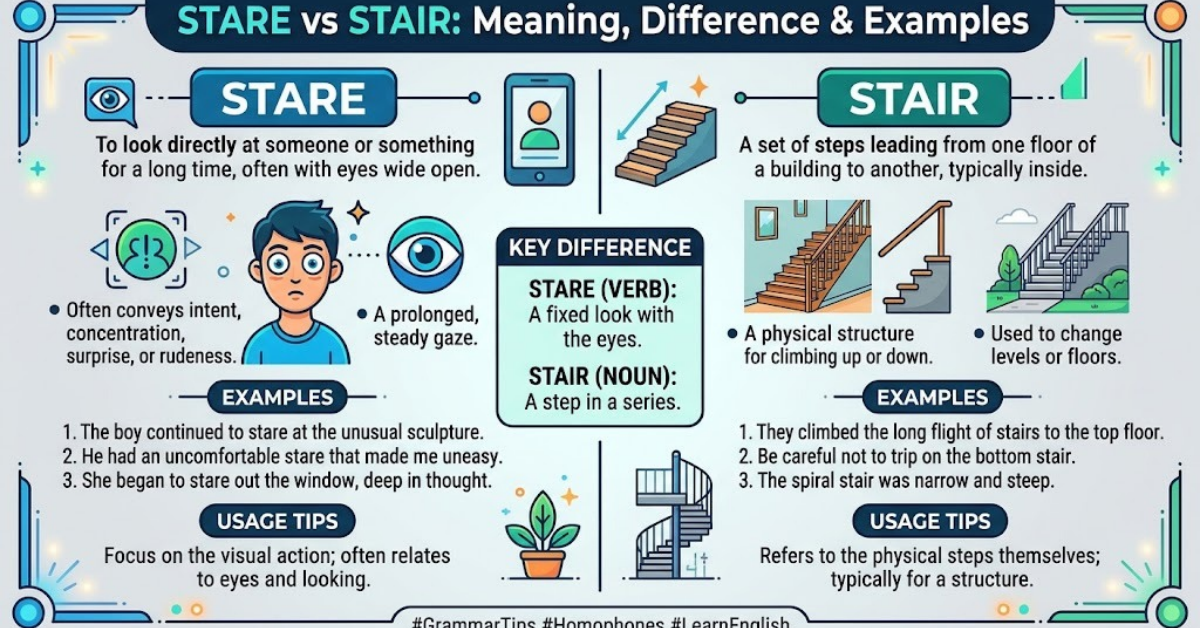
When comparing stare vs stair, the main difference is simple: stare means to look at someone or something for a long time, while stair refers to one of the steps used to move between different levels of a building.
Both words are common in everyday English, making it useful to understand when and how to use each one. In this guide, we’ll explore their definitions, grammatical functions, sentence examples, and easy tricks to remember the difference.
Stare vs Stair: What Is the Difference?
The words stare and stair are homophones. This means they have the same pronunciation but different spellings and meanings.
Here’s a quick comparison:
| Word | Meaning | Part of Speech | Example |
| Stare | To look at something or someone for a long time | Verb or noun | Don’t stare at strangers. |
| Stair | A single step in a staircase | Noun | She missed a stair. |
The easiest way to distinguish them is to remember what each word describes:
- Stare: Something related to looking or watching.
- Stair: Something related to walking up or down between floors.
Although they sound identical, they cannot be used interchangeably.
What Does Stare Mean?
The word stare means to look at someone or something with your eyes fixed on it for an extended period. It can describe looking because of curiosity, surprise, confusion, admiration, or even anger.
Staring is generally more intense or prolonged than simply glancing or looking at something.
For example, if someone sees an unexpected event and continues watching it without looking away, they might be described as staring.
Stare as a Verb
As a verb, stare describes the action of looking at something continuously or intensely.
Examples:
- “Why are you staring at me?”
- “The children stared at the magician in amazement.”
- “She stared at the computer screen for several minutes.”
- “He couldn’t stop staring at the beautiful painting.”
- “Everyone stared when the unexpected announcement was made.”
In these examples, stare describes an action involving the eyes.
Stare as a Noun
Although less common, stare can also function as a noun. It refers to a long, fixed, or intense look.
Examples:
- “He gave me an angry stare.”
- “Her surprised stare made everyone laugh.”
- “I could feel his stare from across the room.”
The word can therefore describe both the act of looking and the look itself.
What Does Stair Mean?
The word stair refers to one of the individual steps that form a staircase. Stairs are used to move between different floors or levels of a building.
For example, when you walk up a staircase, each separate horizontal surface you step on is called a stair.
A stair is a physical structure, unlike stare, which describes looking.
Stair in Everyday Sentences
Here are some examples showing how to use stair correctly:
- “Be careful when walking down the last stair.”
- “The child sat on the bottom stair.”
- “He slipped on a wet stair.”
- “She decorated each stair with colorful lights.”
- “The broken stair needs to be repaired.”
In each sentence, stair refers to an individual step.
What Is the Difference Between Stair and Stairs?
Although closely related, stair and stairs are used slightly differently.
- Stair: Refers to one individual step.
- Stairs: Commonly refers to a complete set of steps used to move between floors.
For example:
- Singular: “The first stair is damaged.”
- Plural: “The stairs lead to the second floor.”
In everyday English, people often use stairs when referring to an entire staircase rather than using the word staircase.
Stare vs Stair: Pronunciation Explained
One reason people confuse these words is that they sound identical when spoken.
Both stare and stair are generally pronounced /ster/ in many English accents, although vowel pronunciation can vary slightly between regional varieties.
They are examples of homophones, just like:
- Their and there
- Sea and see
- Right and write
- Pair and pear
- Break and brake
Because pronunciation cannot help distinguish these words, you need to pay attention to their meanings and spelling when writing.
Easy Tricks to Remember Stare vs Stair
If you frequently mix up these words, a few simple memory tricks can make the difference easier to remember.
1. Associate Stare With Eyes
The word stare is related to looking. Think about your eyes whenever you see this word.
For example: “I stare at the stars.”
Both the word and the sentence relate to seeing something.
2. Associate Stair With Steps
Remember that a stair is something you step on.
You can connect the word with familiar expressions such as:
- Staircase
- Stairway
- Stair rail
- Stair landing
These words all relate to steps or structures used to move between floors.
3. Remember the Difference Through Simple Sentences
Try memorizing these two sentences:
- “Don’t stare at people.”
- “Walk carefully on the stairs.”
The first describes an action involving your eyes, while the second describes something you walk on.
This simple association can help you choose the correct spelling without hesitation.
Common Expressions Using Stare and Stair
Both words appear in everyday conversations and written English. Understanding their common expressions can help you use them naturally.
Common Expressions With Stare
| Expression | Meaning |
| Stare at | Look at something continuously |
| Stare into space | Look without focusing on anything specific |
| Give someone a stare | Look at someone intensely |
| Stare in disbelief | Look because something is difficult to believe |
| Blank stare | An expressionless or unfocused look |
Examples:
- “He stared into space while thinking.”
- “She gave him a cold stare.”
- “I stared in disbelief when I heard the news.”
Common Expressions With Stair
| Expression | Meaning |
| Staircase | A complete structure containing steps |
| Stairway | A passage or structure with stairs |
| Stair rail | A railing alongside stairs |
| Stair landing | A flat platform between sections of stairs |
| Stairwell | An enclosed area containing stairs |
Examples:
- “The staircase leads to the upper floor.”
- “Hold the stair rail while walking.”
- “They stopped at the stair landing.”
Stare vs Stair: Common Mistakes to Avoid
Even experienced English speakers sometimes confuse homophones when writing quickly. Here are a few mistakes worth avoiding.
Incorrect: “He continued to stair at the television.”
Correct: “He continued to stare at the television.”
The sentence describes looking, so stare is the right choice.
Incorrect: “She walked up the stare.”
Correct: “She walked up the stair.”
The sentence refers to a physical step, so stair is correct.
Incorrect: “Don’t stair at me like that.”
Correct: “Don’t stare at me like that.”
The correct spelling depends on the intended meaning, not how the word sounds.
Stare vs Stair vs Stare Down: Understanding Related Terms
Another expression worth understanding is stare down. It means to look directly and intensely at someone, often to intimidate them or demonstrate confidence.
For example:
“She managed to stare down her opponent without looking away.”
This expression is different from stair, which always relates to steps or staircases.
Understanding related expressions can expand your vocabulary and help you recognize how the word stare is used in different situations.
Frequently Asked Questions (FAQs)
1. Is it stare or stair?
Both spellings are correct English words, but they have different meanings. Stare means to look at someone or something for a prolonged period, while stair means an individual step in a staircase.
2. What is the difference between stare and stair?
The main difference is their meaning and grammatical use. Stare is generally a verb describing an intense look, while stair is a noun referring to a physical step.
3. Are stare and stair homophones?
Yes, stare and stair are homophones. They are pronounced the same way in many English accents but have different spellings and meanings.
4. Is stair singular or plural?
Stair is the singular form, referring to one individual step. Stairs is the plural form and commonly refers to a series of steps connecting different levels.
5. What is an example sentence using stare?
An example is: “The little boy continued to stare at the colorful balloons.” In this sentence, stare describes looking at something for an extended period.
6. What is an example sentence using stair?
An example is: “She carefully climbed the final stair before reaching the second floor.” Here, stair refers to one physical step in a staircase.
7. Can stare and stair be used interchangeably?
No. Although they sound alike, their meanings are completely different. Using one instead of the other can make a sentence grammatically incorrect or change its intended meaning.
8. What is another word for stare?
Depending on the context, synonyms for stare include gaze, gaze fixedly, gawk, peer, look intently, and glance. However, these words have slightly different meanings and aren’t always interchangeable.
Conclusion
Understanding stare vs stair is easy once you remember what each word represents. Stare describes looking at someone or something for an extended period, whereas stair refers to an individual step in a staircase.
Both words are pronounced alike, but their meanings, spellings, and grammatical functions are different. Remember the simple trick: you use your eyes to stare, and your feet to climb a stair.
With a little practice, you’ll be able to recognize the difference and use both words confidently in everyday conversations, emails, school assignments, and professional writing. For more helpful explanations, explore other commonly confused English words and improve your spelling one comparison at a time.