Have you ever typed a word, looked at it twice, and wondered whether it actually looks right? The spelling confusion between comming vs coming is a common example. Both forms may look familiar, but only one is accepted in standard English.
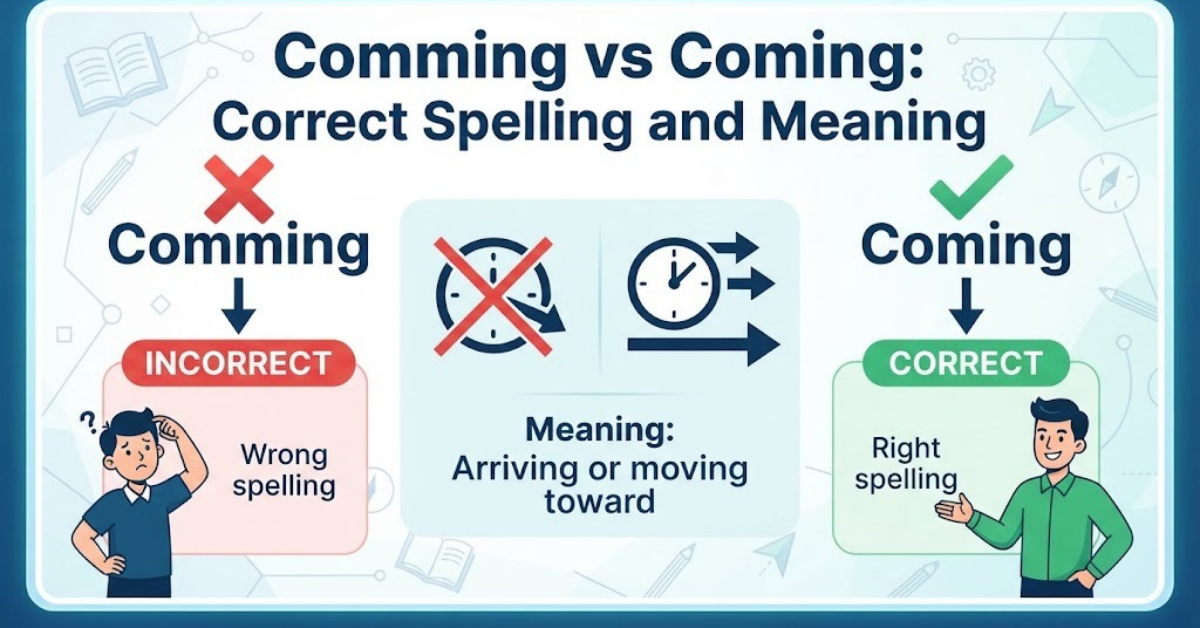
The correct spelling is coming, with a single m. The word comming is a misspelling and should not be used in formal writing, emails, school assignments, or professional communication.
Although the difference is just one letter, understanding the correct spelling can help improve your vocabulary, writing accuracy, and confidence. Let’s explore the meaning of coming, why comming is incorrect, and how to remember the right spelling.
Comming or Coming: Which One Is Correct?
The correct spelling is coming.
The word coming is formed by adding the suffix -ing to the verb come. When this suffix is added, the final silent e is dropped, leaving the spelling coming.
Here is a quick comparison:
| Word | Correct or Incorrect? | Explanation |
| Coming | Correct | Standard English spelling |
| Comming | Incorrect | Contains an unnecessary extra m |
| Come | Correct | Base form of the verb |
| Comes | Correct | Third-person singular form |
| Came | Correct | Simple past tense |
| Come | Correct | Past participle |
| Coming | Correct | Present participle or gerund |
Remember: When choosing between comming and coming, always use coming.
What Does Coming Mean?
The word coming has several meanings depending on how it is used in a sentence. Most commonly, it refers to moving toward a person or place, approaching a particular time, or something that is expected to happen.
It is the present participle of the verb come and can also function as an adjective or a gerund.
For example:
- “She is coming to the party tonight.”
- “The weekend is coming soon.”
- “A new movie is coming to theaters next month.”
- “Thank you for coming to my birthday celebration.”
In each sentence, coming communicates movement, arrival, or an approaching event.
Coming as a Verb
When used as a verb, coming describes the action of moving toward a destination or person.
Examples:
- “I am coming home.”
- “They are coming to visit us tomorrow.”
- “The bus is coming down the road.”
In these sentences, coming is part of the present continuous tense.
Coming as an Adjective
The word coming can also describe something that is approaching or expected in the near future.
Examples:
- “The coming year will bring new opportunities.”
- “We need to prepare for the coming storm.”
- “She is excited about the coming holidays.”
Here, the word describes an upcoming event, period, or situation.
Why Is Comming Incorrect?
The spelling comming is incorrect because it adds an extra m that does not belong in the standard spelling of the word.
The confusion often happens because English spelling rules can be inconsistent. Some words double their final consonant when adding -ing, while others simply drop a silent e.
For example:
- Run → Running
- Swim → Swimming
- Sit → Sitting
- Come → Coming
- Make → Making
- Write → Writing
The words running, swimming, and sitting double their final consonants. However, coming follows a different spelling pattern because the base word already ends in a silent e.
Understanding this distinction makes it easier to avoid spelling mistakes.
How to Remember the Correct Spelling of Coming
If you frequently confuse comming with coming, a simple spelling trick can help.
1. Remember the Base Word Come
Start with the original word:
Come + ing = Coming
The final e is removed before adding -ing. The m stays exactly as it is.
This simple formula helps you remember why the correct spelling contains only one m.
2. Compare It With Similar Words
Think about other English words that follow the same spelling pattern:
| Base Word | Correct -ing Form |
| Make | Making |
| Take | Taking |
| Give | Giving |
| Write | Writing |
| Come | Coming |
| Hope | Hoping |
These words all drop the final silent e before adding the suffix.
3. Use the Word in a Sentence
Practicing the word in a meaningful sentence can help reinforce its correct spelling.
For example:
“I am coming to your house after work.”
Write the sentence a few times while paying attention to the single m in coming. This can help you recognize the correct form more easily when writing.
Comming vs Coming: Examples in Everyday Writing
The easiest way to understand a spelling difference is to see how the correct word works in real sentences.
Here are some common examples of coming:
- “Are you coming with us?”
- “Winter is coming.”
- “My friends are coming over this evening.”
- “The train is coming in five minutes.”
- “I look forward to coming back next year.”
- “The coming weeks will be busy.”
- “She is coming to the office tomorrow.”
Notice that the word remains coming in every example, regardless of the sentence structure.
Incorrect vs Correct Sentences
| Incorrect Sentence | Correct Sentence |
| “I am comming home.” | “I am coming home.” |
| “Are you comming tomorrow?” | “Are you coming tomorrow?” |
| “The weekend is comming.” | “The weekend is coming.” |
| “She is comming to school.” | “She is coming to school.” |
| “Winter is comming soon.” | “Winter is coming soon.” |
These examples show why checking the spelling matters, especially in everyday messages and professional writing.
Is Coming a Verb or a Noun?
The word coming can function as a verb, a noun-like gerund, or an adjective depending on its context.
Coming as a Verb
In the sentence “He is coming home,” the word describes an action.
Coming as a Gerund
In the sentence “Coming here was a great decision,” the word functions as a noun-like form of the verb.
Coming as an Adjective
In the sentence “The coming months will be exciting,” the word describes a period that is approaching.
The grammatical role changes depending on how the word is used, but the spelling remains the same.
Common Spelling Mistakes Similar to Comming
The confusion between comming and coming is part of a larger pattern in English spelling. Many people struggle with words that change when the suffix -ing is added.
Here are a few examples:
| Incorrect Spelling | Correct Spelling |
| Makeing | Making |
| Takeing | Taking |
| Runing | Running |
| Swimmming | Swimming |
| Writting | Writing |
| Comming | Coming |
A useful rule is to check the final letters of the base word before adding a suffix.
For verbs ending in a silent e, the e is usually dropped before adding -ing. For some short verbs ending in a consonant-vowel-consonant pattern, the final consonant is doubled.
There are exceptions, but understanding these common patterns can make English spelling much easier.
Frequently Asked Questions
1. Is it comming or coming?
The correct spelling is coming. The word comming is incorrect because it contains an extra m.
2. Why is coming spelled with one m?
The word comes from the base verb come. When the suffix -ing is added, the final silent e is dropped, producing coming. The m is not doubled.
3. What is the meaning of coming?
Coming generally means moving toward a destination, approaching a particular time, or something expected to happen. For example, “The bus is coming” means the bus is approaching.
4. Is coming a present tense word?
Coming is the present participle of the verb come. It is commonly used in the present continuous tense, as in “I am coming home.”
5. What is the past tense of coming?
The simple past tense of come is came. For example, “She came to the office yesterday.” The past participle is come, as in “She has come home.”
6. Is coming a real English word?
Yes, coming is a standard English word. It can function as a verb form, gerund, or adjective depending on the context.
7. How do you remember the spelling of coming?
Remember the base word come. Drop the final e and add -ing: come → coming. This helps you avoid adding an unnecessary second m.
Conclusion
When deciding between comming vs coming, the correct spelling is always coming. The word is formed from come by dropping the final silent e and adding -ing, which leaves a single m.
Although comming may look familiar, it is a spelling error that should be avoided in formal and informal writing. Remember the simple rule, practice using the word in sentences, and check your spelling when necessary.
Learning small spelling differences like this can make a noticeable improvement in your English writing. Explore more commonly confused English words to build your vocabulary and communicate with greater confidence.