Have you ever typed a word, looked at it twice, and wondered whether you’ve spelled it correctly? The confusion between business or buisness is more common than you might think, especially because the pronunciation of the word doesn’t clearly reveal how it should be written.
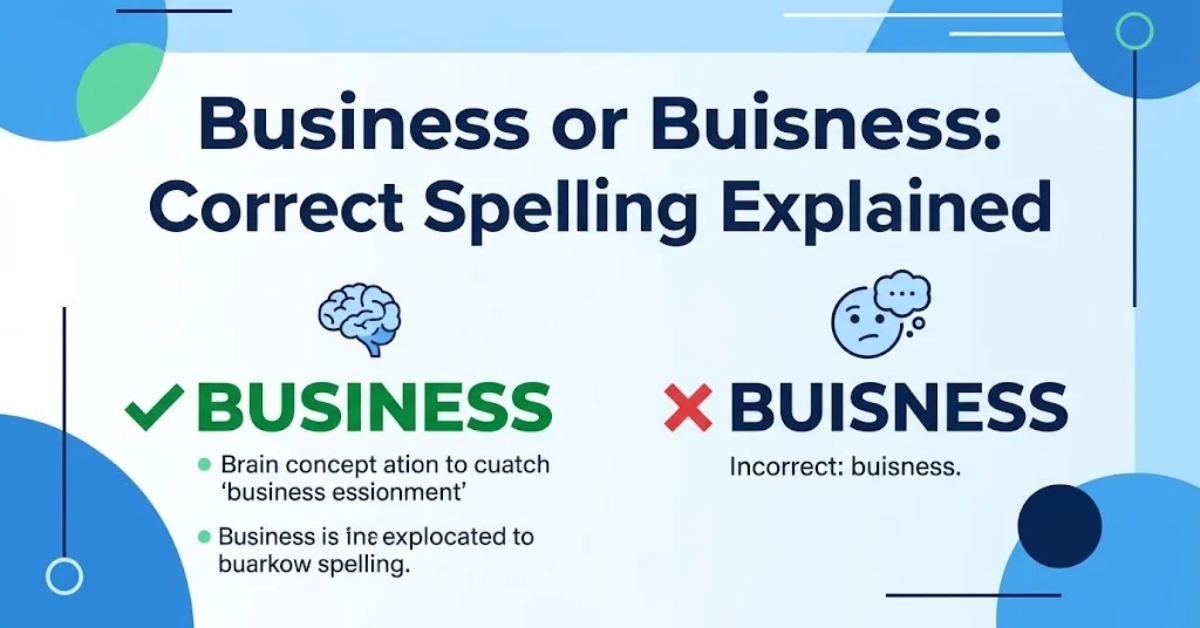
The correct spelling is business, with the letters u and s appearing in that order after the initial b. The spelling buisness is incorrect and should be avoided in formal writing, emails, school assignments, and professional documents.
In this guide, we’ll explain the correct spelling, explore the meaning of business, provide practical examples, and share simple techniques to help you remember the word confidently.
Business or Buisness: Which Spelling Is Correct?
Business is the correct spelling. Buisness is a common spelling mistake caused by switching the positions of the letters u and s.
Here’s a quick comparison:
| Spelling | Correct or Incorrect? | Explanation |
| Business | Correct | Standard English spelling |
| Buisness | Incorrect | The letters u and s are misplaced |
| Businesses | Correct | Plural form of business |
| Businessman | Correct | A man engaged in business |
| Businesswoman | Correct | A woman engaged in business |
| Businesslike | Correct | Practical, efficient, and professional in manner |
Whether you’re writing about a small company, a large corporation, or a personal project, always use business.
What Does Business Mean?
The word business has several related meanings. Most commonly, it refers to an organization or activity involved in providing goods or services in exchange for money.
For example, a bakery sells bread and cakes, a software company develops digital products, and a cleaning service helps customers maintain their homes or workplaces. All three can be described as businesses.
The word can also refer to commercial activity more generally, a person’s work or responsibilities, or a matter that needs attention.
Consider these examples:
- “She started a small business selling handmade jewelry.”
- “Our business has grown significantly over the past year.”
- “He travels frequently for business.”
- “It’s none of your business.”
- “We need to discuss an important business matter.”
These examples show that business is used in both professional settings and everyday conversations.
Why Is Business Often Misspelled as Buisness?
The confusion usually comes from the unusual relationship between the word’s spelling and pronunciation. In everyday speech, business is commonly pronounced BIZ-niss, which sounds quite different from how the word looks when written.
Here are three reasons people make this mistake.
1. The Letters Are Easy to Mix Up
When typing quickly, it’s easy to place the u before the s, producing buisness instead of business. This is a simple letter-order error rather than a misunderstanding of the word’s meaning.
2. Pronunciation Can Be Misleading
English spelling doesn’t always follow predictable sound patterns. Because the first syllable of business sounds like “biz,” learners may struggle to connect its pronunciation with the written form.
3. Typing Habits Reinforce Errors
If someone repeatedly types a misspelled word, the incorrect version can begin to look familiar. This is why proofreading and spelling practice are useful, even for words you use frequently.
How to Remember the Correct Spelling of Business
The easiest way to avoid writing buisness is to memorize the letter sequence in business and practice using it in context.
Use the “Bus-i-ness” Memory Trick
Break the word into three visual parts:
BUS + I + NESS = BUSINESS
Think of the word bus at the beginning, followed by i and ness. Although this is a memory aid rather than a formal linguistic breakdown, it helps you remember that the u comes before the s.
You can reinforce the spelling with a few simple steps:
- Write business correctly five times.
- Say the letters aloud as you write them.
- Use the word in a sentence, such as “My business serves local customers.”
- Check the spelling whenever you prepare an important document.
Regular practice makes the correct letter sequence easier to recall.
Business vs. Businesses: Understanding the Difference
Another common question is whether to write business or businesses. Both are correct, but they serve different grammatical purposes.
| Word | Usage | Example |
| Business | Singular noun or uncountable noun, depending on context | “Her business is expanding.” |
| Businesses | Plural noun referring to multiple companies or commercial operations | “Several businesses operate in this area.” |
Use business when discussing one company or commercial activity in general. Use businesses when referring to two or more separate companies or commercial organizations.
For example, “The city supports small businesses” is correct because the sentence refers to multiple organizations.
Is Business a Noun or a Verb?
In standard modern English, business is primarily a noun, not a verb.
It can describe:
- A company or commercial organization.
- The activity of buying and selling goods or services.
- Work-related responsibilities.
- A matter or concern that needs attention.
For example, in the sentence “They run a successful business,” the word identifies the company they operate.
The related word busy is an adjective, while businesslike is another adjective. Although these words are related historically, they have different grammatical functions.
Common Phrases That Use the Word Business
Understanding familiar expressions can help you use the word naturally in writing and conversation.
Mind Your Own Business
This expression means that someone should avoid interfering in matters that don’t concern them.
Example: “I appreciate your concern, but please mind your own business.”
Business as Usual
This phrase means that normal activities are continuing despite a change, problem, or unusual event.
Example: “After the short power outage, it was business as usual at the office.”
Get Down to Business
This means starting to focus on the important or practical parts of a task.
Example: “We’ve discussed our plans, so let’s get down to business.”
Do Business With Someone
This means buying from, selling to, or working commercially with another person or organization.
Example: “Our company hopes to do business with international clients.”
Learning these expressions can improve your vocabulary and help you understand the word in different contexts.
Why Correct Spelling Matters in Business Writing
Spelling mistakes may seem minor, but they can affect how readers perceive your communication. This is particularly important when writing emails, proposals, reports, résumés, or marketing materials.
Using business correctly helps you:
- Maintain professionalism: Accurate spelling makes documents look polished.
- Communicate clearly: Readers can focus on your message rather than errors.
- Build credibility: Careful writing helps establish trust with customers and colleagues.
- Improve readability: Consistent spelling makes content easier to understand.
Spell-checking tools can identify many mistakes, but it’s still helpful to understand common errors yourself. A quick review before sending a professional message can prevent avoidable problems.
Frequently Asked Questions
1. Is it business or buisness?
Business is the correct spelling. Buisness is incorrect because the letters u and s appear in the wrong order.
2. Why do people spell business incorrectly?
People often misspell business because its pronunciation, commonly “BIZ-niss,” doesn’t clearly indicate its written form. Typing quickly and confusing the order of letters can also cause the mistake.
3. How do you spell business correctly?
The correct spelling is B-U-S-I-N-E-S-S. A helpful memory trick is to think of the word as “BUS + I + NESS.”
4. What is the plural of business?
The plural is businesses. For example, “Many small businesses operate in the local market.”
5. What does business mean in simple words?
A business is an organization or activity that provides goods or services, usually in exchange for money. The word can also refer to work, commercial activity, or a matter that needs attention.
6. Is business spelled with one s or two s’s at the end?
Business ends with two s’s. The complete spelling is business, with a single s after the initial bu and a double ss at the end.
7. Is business a difficult word to spell?
It can be confusing because its pronunciation differs from its spelling. However, remembering the sequence B-U-S-I-N-E-S-S and practicing it regularly makes the word easier to spell correctly.
8. How can I check whether I’ve spelled business correctly?
Use a trusted dictionary or a spell-checking tool. You can also remember the correct form by writing the word slowly and checking that the u comes before the s near the beginning.
Conclusion
When choosing between business or buisness, the correct spelling is always business. The incorrect version, buisness, results from mixing up the order of two letters, a mistake that’s easy to prevent with a little practice.
Remember the spelling B-U-S-I-N-E-S-S, use the word in everyday sentences, and proofread your writing before submitting or publishing it. Whether you’re discussing a company, professional responsibilities, or commercial activities, correct spelling helps your message appear clear and credible.
If you’re interested in improving your English, explore more spelling guides covering commonly confused words, pronunciation differences, and practical vocabulary tips to make your writing more accurate and confident.