Have you ever looked at a messy desk, a cluttered room, or a poorly planned schedule and wondered whether to call it unorganized or disorganized? Both words describe situations where things lack order, but they aren’t always interchangeable.
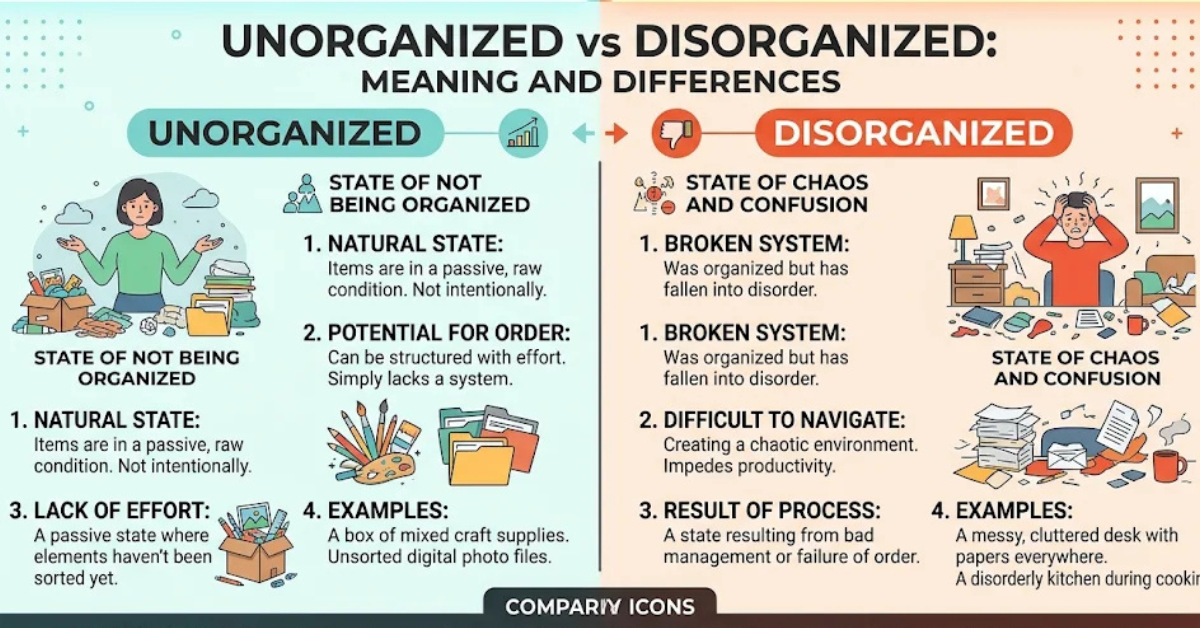
The difference between unorganized vs disorganized is subtle. Although both terms can describe a lack of structure, unorganized generally refers to something that has not been arranged or organized, while disorganized often suggests that something lacks order, coordination, or an effective system.
Understanding this distinction can help you choose the right word in conversations, professional emails, academic assignments, and everyday writing. Let’s look at their meanings, examples, similarities, and differences.
Unorganized vs Disorganized: Which Word Is Correct?
Both unorganized and disorganized are correct English words. Neither is a spelling mistake, and both can describe people, places, activities, and situations that lack organization.
However, their meanings have slightly different shades.
- Unorganized: Something that has not been arranged, structured, or put into an organized system.
- Disorganized: Something that is poorly arranged, disorderly, confused, or lacking proper coordination.
For example:
- “The documents are unorganized.” This suggests that the documents have not been sorted or arranged properly.
- “The documents are disorganized.” This suggests that the documents are in a disorderly state, making them difficult to manage or find.
The distinction isn’t absolute. In many everyday situations, the two words can be used interchangeably without changing the basic meaning.
What Does Unorganized Mean?
Unorganized is an adjective that describes something that has not been arranged, planned, or structured in an orderly way.
It often refers to the absence of a clear system or formal organization. Something unorganized may simply need sorting, planning, or grouping to become easier to manage.
Examples of Unorganized in Sentences
Here are some everyday examples:
- “My computer files are unorganized because I haven’t created separate folders.”
- “The students submitted their unorganized notes before the examination.”
- “We have an unorganized collection of photographs from our vacation.”
- “The event planning process is still unorganized.”
- “Her wardrobe is unorganized, with clothes scattered across different shelves.”
In these examples, the word describes something that lacks a proper arrangement or structure.
When Should You Use Unorganized?
Use unorganized when you want to emphasize that something has not been properly arranged or established.
Common situations include:
- Documents that haven’t been sorted into categories.
- Files without a proper naming or folder system.
- Events that haven’t been planned.
- Information that hasn’t been grouped logically.
- Personal belongings that haven’t been arranged.
For example, if you have hundreds of photographs stored in one folder without categories, calling them unorganized is appropriate.
What Does Disorganized Mean?
Disorganized is an adjective that describes something or someone lacking order, structure, coordination, or effective management.
It can suggest confusion, disorder, or a breakdown in an existing organizational system.
For instance, a disorganized office may have misplaced documents, cluttered workspaces, and employees who struggle to coordinate their responsibilities.
The word can also describe a person’s habits or working style. Someone who frequently forgets appointments, loses important items, or struggles to manage deadlines might be described as disorganized.
Examples of Disorganized in Sentences
Consider these examples:
- “The meeting became disorganized because nobody knew who was responsible for each task.”
- “His disorganized desk makes it difficult to find important documents.”
- “The company experienced delays because of its disorganized management.”
- “She felt disorganized after managing several projects at the same time.”
- “The presentation was disorganized, and the audience struggled to follow the main points.”
These sentences show how disorganized can describe confusion, poor coordination, and a lack of order.
When Should You Use Disorganized?
Use disorganized when something is in a disorderly condition or lacks effective coordination.
Common examples include:
- A workplace with unclear responsibilities.
- A person who regularly forgets important tasks.
- A meeting without a clear agenda.
- A business with inefficient management.
- A room where belongings are scattered everywhere.
For example, if a team has an established project plan but members fail to communicate and complete their responsibilities in the right order, the project may be described as disorganized.
Unorganized vs Disorganized: Key Differences
Although the two words overlap, understanding their emphasis makes it easier to select the right one.
| Comparison | Unorganized | Disorganized |
|---|---|---|
| Basic meaning | Not arranged or structured | Lacking order or coordination |
| Main emphasis | Absence of organization | Disorder or poor organization |
| Common usage | Files, collections, information, events | People, workplaces, systems, activities |
| Typical situation | Something hasn’t been sorted | Something is confusing or disorderly |
| Tone | Generally neutral | Often suggests a problem |
| Example | Unorganized documents | Disorganized office |
The easiest way to remember the difference: Unorganized often emphasizes the absence of a proper arrangement, while disorganized often emphasizes a disorderly or poorly coordinated condition.
However, context matters, and native English speakers frequently use both terms for similar situations.
Unorganized vs Disorganized Examples in Everyday Situations
Sometimes, the easiest way to understand two similar words is to see how they work in different contexts.
1. Unorganized vs Disorganized Room
Imagine walking into a bedroom where clothes, books, and personal belongings are scattered around.
You could describe it as an unorganized room because the belongings haven’t been arranged properly.
You could also call it a disorganized room because everything appears messy and out of place.
Both expressions are acceptable, although disorganized may emphasize the disorder more strongly.
2. Unorganized vs Disorganized Person
These words can also describe someone’s habits or personality.
- Unorganized person: Someone who doesn’t have an established system for managing tasks, belongings, or responsibilities.
- Disorganized person: Someone who struggles to maintain order, manage priorities, or coordinate daily activities.
For example:
“John is unorganized because he never plans his daily schedule.”
“John is disorganized because he frequently misses appointments and loses important documents.”
The second example emphasizes the consequences of poor organization.
3. Unorganized vs Disorganized Workplace
In a professional environment, both words can describe problems with workplace management.
An unorganized workplace might lack clear filing systems, documented procedures, or structured workflows.
A disorganized workplace might experience missed deadlines, communication problems, misplaced resources, and confusion among employees.
The second term often communicates a more noticeable breakdown in daily operations.
4. Unorganized vs Disorganized Information
Information can also be described using either adjective.
- Unorganized information: Details that haven’t been categorized or arranged logically.
- Disorganized information: Details presented in a confusing or disorderly manner.
For example, a research document containing facts without headings or categories could be described as unorganized. If the information jumps between unrelated subjects and becomes difficult to understand, disorganized may be more appropriate.
Is Unorganized or Disorganized More Common?
Both words are widely recognized in modern English, but their frequency and usage can vary depending on context, region, and writing style.
Disorganized is particularly common when describing people, workplaces, schedules, and situations involving disorder or confusion.
Unorganized is also common, especially when describing things that lack a formal arrangement or system.
There isn’t a universal rule that makes one word better than the other. The best choice depends on what you want to communicate.
For formal writing, focus on clarity rather than trying to use one word everywhere.
Synonyms of Unorganized and Disorganized
Learning synonyms can help expand your vocabulary and prevent repetitive writing.
Synonyms for Unorganized
Depending on the context, you can use:
- Unstructured
- Unsorted
- Unarranged
- Unsystematic
- Unplanned
- Unclassified
- Uncoordinated
Example: “The information is unstructured and needs to be divided into categories.”
Synonyms for Disorganized
Common alternatives include:
- Chaotic
- Disorderly
- Messy
- Confused
- Haphazard
- Untidy
- Unsystematic
- Uncoordinated
Example: “The office became chaotic after several employees started working on the same project without clear instructions.”
Remember that synonyms aren’t always exact replacements. For example, chaotic generally suggests a greater degree of disorder than unorganized.
How to Become More Organized and Avoid Disorganization
Whether you’re managing your home, workplace, or personal schedule, developing simple organizational habits can make everyday activities easier.
Here are some practical ways to improve organization:
- Create a daily plan: Write down your most important tasks and decide when to complete them.
- Organize your belongings: Keep frequently used items in designated places.
- Use digital folders: Sort documents, photographs, and other files into clearly labeled categories.
- Prioritize responsibilities: Complete important or time-sensitive tasks first.
- Avoid unnecessary clutter: Regularly remove items and information you no longer need.
- Review your progress: Spend a few minutes at the end of each day checking what needs attention.
These habits can help prevent small organizational problems from turning into larger issues.
Frequently Asked Questions (FAQs)
1. Is unorganized a real word?
Yes. Unorganized is a legitimate English adjective. It describes something that hasn’t been arranged, structured, or organized properly.
2. Is disorganized a real word?
Yes. Disorganized is also a correct English word. It describes something or someone lacking order, coordination, or effective organization.
3. Are unorganized and disorganized interchangeable?
In many situations, yes. Both words can describe messy rooms, poorly arranged documents, and inefficient systems. However, unorganized often emphasizes the absence of an arrangement, while disorganized can suggest confusion or disorder.
4. Is it better to say unorganized or disorganized?
Neither word is universally better. Use unorganized when something hasn’t been properly arranged or structured. Choose disorganized when something is disorderly, confusing, or poorly coordinated.
5. What is the opposite of unorganized?
Common opposites include organized, structured, systematic, and orderly. The best choice depends on the sentence.
6. What is the opposite of disorganized?
The most direct opposite is organized. Other alternatives include orderly, well-structured, systematic, and coordinated.
7. Can a person be both unorganized and disorganized?
Yes. A person can lack a consistent organizational system and also struggle to maintain order in everyday activities. For example, someone who doesn’t plan their schedule and regularly loses important documents could be described using both words.
8. Is disorganized a negative word?
It generally carries a negative meaning because it suggests disorder, confusion, or poor organization. However, it isn’t necessarily an insult. It can simply describe someone’s habits, a workplace, or a situation.
9. Is unorganized grammatically correct?
Yes. Unorganized is grammatically correct and can be used as an adjective before a noun or after a linking verb.
Examples:
- “The unorganized files need attention.”
- “The files are unorganized.”
10. Which word should I use in professional writing?
Both are suitable for professional writing. Use unorganized to describe missing structure or arrangement and disorganized to describe disorder, confusion, or ineffective coordination.
Conclusion
Understanding unorganized vs disorganized becomes much easier when you focus on the difference in emphasis. Both words describe a lack of organization, but unorganized generally refers to something that hasn’t been arranged or structured, whereas disorganized often describes a disorderly or poorly coordinated condition.
For example, unorganized files may simply need sorting, while a disorganized workplace may have deeper problems involving communication, management, and daily operations.
Both terms are correct, so you don’t need to worry about choosing the wrong spelling. Simply consider the situation and select the word that communicates your intended meaning most clearly.
If you’re interested in improving your English vocabulary, explore more guides about commonly confused words, spelling differences, and everyday grammar to make your communication more effective.