Have you ever started writing a sentence and paused to wonder whether it’s beginning or begining? It’s an easy mistake to make, especially when typing quickly or relying on how a word sounds. However, only one of these spellings is correct in standard English.
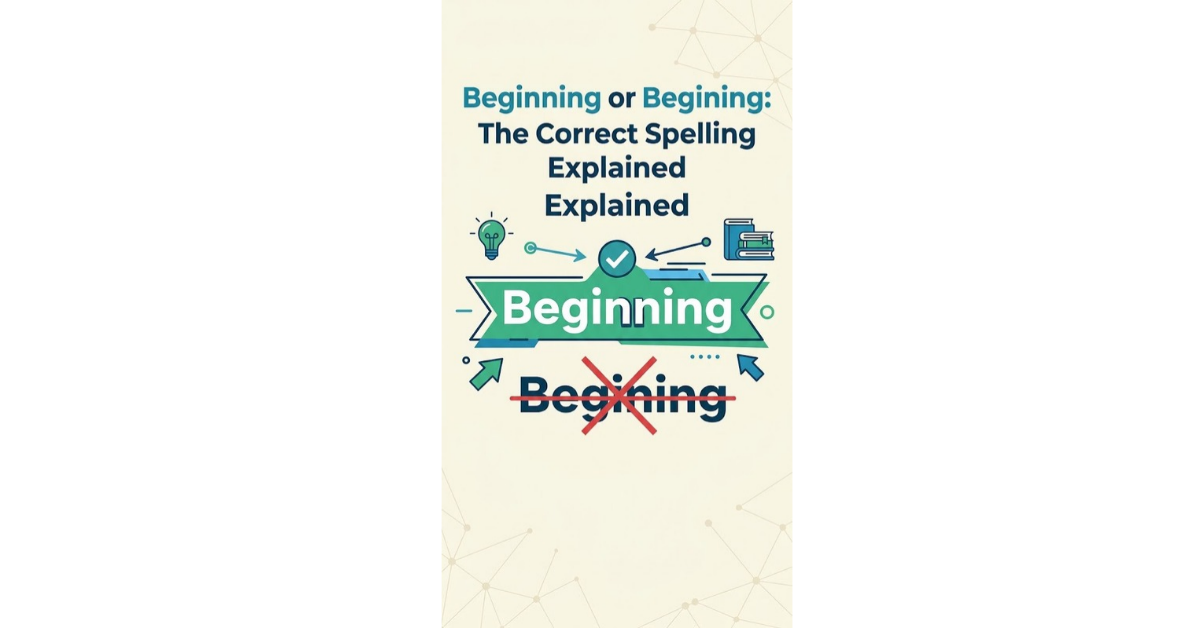
The correct spelling is beginning, with a double n at the end of the word’s root and before the -ing ending. Begining is incorrect because it leaves out one of those letters.
Whether you’re writing an essay, composing a professional email, or creating online content, knowing the difference will help you avoid a common spelling error. Let’s look at the spelling rule, the meaning of the word, examples, and a simple trick to remember it.
Beginning or Begining: Which Is Correct?
Beginning is the correct spelling. It is the form used in standard English dictionaries and in both American and British English.
The incorrect spelling, begining, contains only one n before the ending. The mistake usually happens because writers forget to double the final consonant when adding -ing to the verb begin.
Here’s a quick comparison:
| Spelling | Correct or Incorrect? | Explanation |
| Beginning | Correct | The final n is doubled before adding -ing |
| Begining | Incorrect | Missing one n |
| Begin | Correct | The original verb |
| Began | Correct | Simple past tense |
| Begun | Correct | Past participle |
| Beginner | Correct | A person who is starting to learn something |
Easy rule to remember: When you add -ing to begin, double the final n to make beginning.
Why Is Beginning Spelled With Two Ns?
The spelling of beginning follows a common English spelling rule involving short verbs and suffixes.
The base verb is begin. When you add the suffix -ing, you double the final consonant because the word ends in a consonant-vowel-consonant pattern, with the stress on the final syllable.
The transformation looks like this:
- Begin + ing = Beginning
- Run + ing = Running
- Sit + ing = Sitting
- Stop + ing = Stopping
In each example, the final consonant is doubled before adding the suffix.
This rule helps preserve the pronunciation of the original short vowel. Without the doubled consonant, the spelling may look inconsistent with standard English spelling conventions.
The Consonant-Doubling Rule Explained
The consonant-doubling rule commonly applies when a one-syllable verb ends in a single consonant preceded by a single vowel. It also applies to many multisyllabic verbs when the final syllable is stressed.
For example:
- Admit → Admitting: The final syllable is stressed.
- Prefer → Preferring: The final syllable is stressed.
- Begin → Beginning: The final syllable is stressed.
However, the rule doesn’t apply to every verb. For example, open becomes opening, not openning, because its final syllable isn’t stressed.
Understanding this distinction can help you spell many other English words correctly, not just beginning.
What Does Beginning Mean?
The word beginning can function as a noun or as the present participle of the verb begin. Its meaning depends on how it is used in a sentence.
As a noun, beginning refers to the start or initial stage of something. It can describe the first part of a story, the opening of an event, or the early stage of a process.
As a verb form, it describes the action of starting something.
Here are a few examples:
- “The beginning of the movie was exciting.”
- “I’m beginning to understand the lesson.”
- “Every successful journey has a beginning.”
- “The company is beginning a new project next month.”
In each sentence, the spelling remains beginning, with two n’s.
Beginning vs. Begining: Examples in Sentences
One of the easiest ways to learn the correct spelling is to see it used naturally.
Here are several examples of beginning in everyday writing:
- “The beginning of the school year is always busy.”
- “She is beginning to feel more confident.”
- “We met at the beginning of the summer.”
- “The book has an interesting beginning.”
- “I’m beginning to think we should leave early.”
- “At the beginning of the meeting, everyone introduced themselves.”
- “Learning a new language can feel difficult in the beginning.”
Notice that every example uses the double-n spelling. Writing begining in any of these sentences would be a spelling mistake.
Common Incorrect and Correct Examples
| Incorrect Sentence | Correct Sentence |
| “The begining of the story was confusing.” | “The beginning of the story was confusing.” |
| “I’m begining to understand.” | “I’m beginning to understand.” |
| “At the begining of the year, we moved.” | “At the beginning of the year, we moved.” |
| “She is begining a new job.” | “She is beginning a new job.” |
Reading the correct versions aloud and paying attention to the spelling can help reinforce the double-n pattern.
How to Remember the Spelling of Beginning
If you often confuse beginning and begining, a simple memory trick can make the correct version easier to recall.
1. Remember the Original Word
Start with the verb begin. When you add -ing, don’t simply attach the suffix; double the final n first.
Think of the word as:
Begin + n + ing = Beginning
This visual breakdown makes the spelling rule easier to remember.
2. Connect It With Running
The word running follows the same consonant-doubling rule.
Compare the two:
- Run → Running
- Begin → Beginning
Both words double their final consonant before adding -ing. If you already know how to spell running, you can use it as a reminder for beginning.
3. Practice Writing the Word
Write beginning several times and use it in a sentence. For example: “I’m beginning to improve my spelling.”
Practicing the word in context helps you recognize its correct form when writing naturally.
4. Use Spell-Checking Tools
Most word processors and browsers identify begining as a misspelling. Spell-checking tools can catch these errors, but learning the rule helps prevent them in the first place.
Beginning vs. Other Related Words
Understanding related words can make it easier to distinguish between different grammatical forms.
| Word | Meaning | Example |
| Begin | To start something | “We begin at nine.” |
| Beginning | The start or the act of starting | “The beginning was difficult.” |
| Began | Past tense of begin | “The class began yesterday.” |
| Begun | Past participle of begin | “The show has begun.” |
| Beginner | Someone new to an activity | “I’m a beginner at tennis.” |
These words are related, but they aren’t interchangeable in every sentence.
For example, you would say “The meeting began at noon,” not “The meeting beginning at noon,” unless the sentence structure specifically calls for a participle.
Is Beginning One Word or Two?
Beginning is one word. It doesn’t require a hyphen or a space when used as a noun or verb form.
Correct examples include:
- “The beginning of the book”
- “Beginning a new chapter”
- “At the beginning of the week”
The phrase in the beginning is written as three separate words, but beginning itself remains a single word.
The expression in the beginning often refers to an initial period or the earliest stage of an event. For example, “In the beginning, learning to drive felt intimidating.”
American English vs. British English: Is There a Difference?
No. The spelling of beginning is the same in American English and British English.
Unlike some words that have different regional spellings, such as color and colour, this word follows the same spelling convention in both varieties.
Use beginning regardless of whether you’re writing for an American, British, Australian, Canadian, or other English-speaking audience.
Frequently Asked Questions
1. Is it beginning or begining?
Beginning is correct. It has two n’s before the -ing ending, while begining is a misspelling.
2. Why does beginning have two n’s?
The final consonant of begin is doubled before adding -ing. This follows the English consonant-doubling rule, which applies to many short verbs and verbs with a stressed final syllable.
3. How do you spell beginning correctly?
Spell it B-E-G-I-N-N-I-N-G. Remember that the base word begin gains an additional n before the -ing suffix.
4. What is the plural of beginning?
The noun beginning can have the plural form beginnings. For example, “The beginnings of their friendship were unusual.” The double n remains in the plural form.
5. Is beginning a noun or a verb?
It can be both. As a noun, it means the start of something. As a verb form, it describes the action of starting, as in “She is beginning her homework.”
6. What is the difference between begin and beginning?
Begin is the base form of the verb, meaning to start. Beginning can refer to the initial stage of something or describe an action that is currently starting.
7. Is beginning spelled the same in British and American English?
Yes. Both British and American English use beginning. There is no regional spelling difference for this word.
8. What is the past tense of begin?
The simple past tense is began, while the past participle is begun. For example, “The event began early” and “The event has begun.”
Conclusion
When choosing between beginning or begining, always use beginning. The correct spelling contains two n’s because the final consonant of begin is doubled before adding the -ing suffix.
Remember the simple pattern: begin + n + ing = beginning. This rule also helps with words such as running, sitting, and stopping, making it useful beyond this single spelling question.
Whether you’re writing an assignment, a business email, or a blog post, using the correct spelling makes your writing clearer and more professional. Keep practicing, proofread your work, and explore other commonly confused English words to strengthen your spelling and vocabulary.