Have you ever paused while writing because you weren’t sure whether to use bale or bail? These two words sound exactly alike in most English accents, but their meanings are completely different. Understanding bale vs bail can help you avoid spelling mistakes in everyday writing, business communication, and legal discussions.
The simplest distinction is this: bale usually refers to a large bundle of material, such as hay, cotton, or paper, while bail commonly refers to money or conditions associated with releasing someone from custody before trial. Bail also has several other meanings, including removing water from a boat and leaving a situation unexpectedly.
Let’s explore how these words differ, when to use each one, and how to remember their correct spelling.
Bale vs Bail: What’s the Difference?
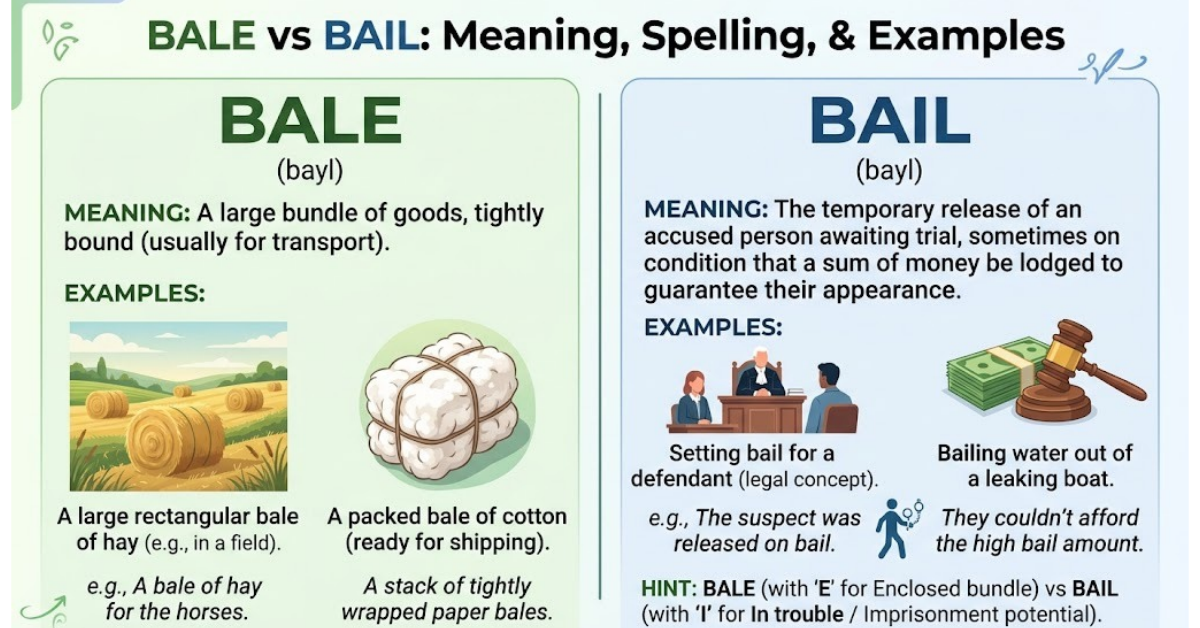
Although bale and bail are homophones, meaning they sound alike but have different meanings and spellings, they aren’t interchangeable.
- Bale: A large, tightly bound bundle of material, such as hay, straw, cotton, or recycled paper.
- Bail: Money or a legal arrangement that allows an accused person to be released from custody under specified conditions. It can also mean removing water from a boat or, informally, abandoning a situation.
Bale vs Bail at a Glance
| Feature | Bale | Bail |
| Pronunciation | Usually /beɪl/ | Usually /beɪl/ |
| Main meaning | A compact bundle of material | Conditional release from custody |
| Common use | Agriculture, recycling, textiles | Law, everyday expressions |
| Example | The farmer stacked a bale of hay. | The judge granted bail. |
| Verb form | To bale hay or paper | To bail someone out or bail water |
The key is context. If the sentence concerns hay, cotton, or compressed materials, bale is probably correct. If it concerns a court case, financial assistance, water removal, or escaping a situation, bail is generally the word you need.
What Does Bale Mean?
Bale is a noun or verb associated primarily with bundling materials into compact packages.
As a noun, a bale is a large quantity of material tied, wrapped, or compressed together for convenient storage, transportation, or handling.
As a verb, to bale means to make material into bales.
Examples of Bale in a Sentence
Here are several examples showing how to use bale correctly:
- The farmer loaded a bale of hay onto the truck.
- The warehouse stores cotton in large bales.
- Workers collected old newspapers and compressed them into a bale.
- The farmer used a machine to bale the straw after harvesting the crop.
- The recycling center prepares cardboard bales for transportation.
In each example, the word refers to bundling or a bundle of material.
Common Types of Bales
The word bale appears in several industries.
1. Hay bales: Farmers compress dried grass into bales to make animal feed easier to store and transport.
2. Cotton bales: Cotton fibers are compressed into large bundles before being transported to textile manufacturers.
3. Straw bales: Straw is often baled after harvesting grain and may be used for animal bedding, construction, or other agricultural purposes.
4. Paper and cardboard bales: Recycling facilities compress waste paper and cardboard into dense bundles for easier handling and processing.
What Does “Bale of Hay” Mean?
A bale of hay is a compact bundle of dried grass or other forage used mainly to feed livestock.
For example:
“The farmer placed three bales of hay inside the barn.”
This is one of the most familiar uses of the word bale, making it a helpful example to remember when distinguishing bale from bail.
What Does Bail Mean?
Bail has several meanings, but it is especially common in legal language and everyday expressions.
As a noun, bail generally refers to a legal arrangement that permits someone accused of a crime to be released from custody while their case proceeds, subject to applicable rules and conditions. Depending on the jurisdiction and circumstances, bail may involve a financial deposit, a guarantee, or other requirements.
As a verb, to bail can mean arranging someone’s release, removing water from a boat, or leaving a situation suddenly.
1. Bail in Legal Terms
In criminal justice, bail is associated with the release of an accused person from custody while awaiting further court proceedings.
For example:
- The judge granted bail after reviewing the case.
- Her family helped arrange bail.
- The defendant was released on bail under specific conditions.
- The court denied bail because of concerns about the circumstances of the case.
Bail procedures differ by jurisdiction. In some places, release may involve a financial payment, while other systems rely on different forms of supervision or conditions. Bail does not mean that a person has been found innocent or guilty.
2. Bail as Financial Assistance
The expression bail someone out means helping someone escape a difficult situation, often by providing money or practical assistance.
For example:
- Her parents bailed her out when she couldn’t pay the bill.
- A friend helped bail him out of a financial problem.
- The company needed emergency funding to avoid running out of cash.
This expression can be used literally in a legal context or figuratively when someone needs help.
3. Bail Meaning to Leave a Situation
In informal English, bail can mean to leave a place, activity, or commitment, sometimes unexpectedly.
Examples include:
- We decided to bail when the weather turned bad.
- He bailed on our plans at the last minute.
- She wanted to bail out of the meeting early.
The expression bail on someone often suggests abandoning plans or failing to follow through on a commitment.
4. Bail Water From a Boat
The verb bail can also mean removing water from a boat, usually with a container or another tool.
For example:
“The passengers used buckets to bail water out of the small boat.”
In this context, bail has nothing to do with courts or money. It describes removing water to prevent the boat from filling up.
Bale vs Bail in Sentences
One of the easiest ways to understand the difference is to compare the words in everyday situations.
Examples Using Bale
- The farmer purchased a new bale of hay.
- The workers stacked the cotton bales in the storage area.
- The recycling plant compressed plastic into a bale.
- We needed a machine to bale the remaining straw.
- A bale of fabric was delivered to the factory.
Examples Using Bail
- The court allowed the defendant to remain free on bail.
- She helped her brother pay for bail.
- We decided to bail on the trip because of the storm.
- The sailors worked quickly to bail water from the boat.
- He needed someone to bail him out of a difficult financial situation.
Notice how the surrounding words provide clues. Words such as hay, cotton, straw, and recycling commonly point to bale. Words such as court, release, water, and out of trouble often point to bail.
Bale vs Bail: How to Remember the Correct Spelling
If you frequently confuse these words, a simple memory trick can make the distinction easier.
Remember “Bale” for Bundles
Think of a bale of hay.
Both bale and hay are associated with farming and agricultural materials. When you picture a tightly packed bundle of hay or cotton, remember that the word is spelled with an e.
Remember “Bail” for Being Released
Think of bail out of jail.
Both bail and jail contain the letter combination ail. This association can help you remember that bail is the word used in legal release situations.
You can also remember that bail out is a common expression for receiving help or escaping trouble.
Use the Context Test
Before choosing a spelling, ask yourself:
- Am I talking about a bundle of material? Use bale.
- Am I talking about legal release, financial help, leaving a situation, or removing water? Use bail.
- Does neither meaning fit? Review the sentence to see whether another word is needed.
This quick check is often enough to prevent the mistake.
Is Bale or Bail Ever Used as a Verb?
Yes. Both words can function as verbs, although their meanings differ.
Bale as a verb: To compress or package material into a bale.
Example: “The workers will bale the hay tomorrow.”
Bail as a verb: To arrange someone’s release, remove water from a boat, or leave a situation.
Examples:
- “The family worked to bail him out.”
- “We had to bail water out of the boat.”
- “She decided to bail on the event.”
The grammatical role alone does not determine which spelling is correct. The intended meaning does.
Common Expressions With Bale and Bail
Certain phrases can help you recognize the right word immediately.
Expressions With Bale
- Bale of hay
- Bale of cotton
- Bale of straw
- Bale of recycled paper
- Bale press
- Hay baler
These expressions usually relate to agriculture, materials, storage, or recycling.
Expressions With Bail
- Post bail
- Released on bail
- Bail someone out
- Bail out of a situation
- Bail on plans
- Bail water from a boat
These phrases cover legal, financial, social, and practical situations.
Bale vs Bail: Common Mistakes to Avoid
Because the words sound alike, spelling errors can happen even when the intended meaning is clear.
Mistake 1: Using Bale in a Legal Sentence
Incorrect: “The judge granted bale to the defendant.”
Correct: “The judge granted bail to the defendant.”
The sentence concerns legal release, so bail is the appropriate spelling.
Mistake 2: Using Bail for Agricultural Materials
Incorrect: “The farmer loaded a bail of hay.”
Correct: “The farmer loaded a bale of hay.”
The sentence describes a bundle of hay, so bale is correct.
Mistake 3: Confusing “Bail Out” With “Bale Out”
Incorrect: “My friend helped bale me out of debt.”
Correct: “My friend helped bail me out of debt.”
The expression bail someone out means helping them escape a difficult situation.
Mistake 4: Assuming the Words Have the Same Meaning Because They Sound Alike
Homophones often cause confusion because pronunciation alone cannot reveal the correct spelling. Words such as their, there, and they’re create a similar challenge.
The solution is to focus on meaning and sentence context rather than sound.
Frequently Asked Questions About Bale vs Bail
Is it bale or bail?
Both are correct English words, but they have different meanings. Bale generally refers to a bundle of material, while bail commonly refers to legal release, financial assistance, leaving a situation, or removing water from a boat.
What is the difference between bale and bail?
The main difference is their meaning. A bale is a compact bundle of material such as hay or cotton. Bail can refer to a legal release arrangement or appear in expressions such as bail out and bail on someone.
Is it a bale of hay or a bail of hay?
The correct expression is a bale of hay. A bale is a compact bundle of hay prepared for storage, transportation, or animal feed.
Is it bail or bale someone out?
The correct phrase is bail someone out. It means helping someone out of trouble, often through financial assistance, or arranging their release from custody.
Are bale and bail pronounced the same?
Yes. In most English accents, bale and bail are pronounced the same way, usually /beɪl/. They are homophones, which means they sound alike but have different spellings and meanings.
Can bail mean leaving a place?
Yes. In informal English, bail can mean leaving a place or abandoning a plan, often unexpectedly. For example, “We decided to bail when the party became too crowded.”
What does bail mean in court?
In legal contexts, bail refers to an arrangement that allows an accused person to be released from custody while awaiting further proceedings, subject to the applicable rules and conditions. The exact process varies by jurisdiction.
Is “bale” a verb?
Yes. Bale can be a verb meaning to compress material into a bundle. For example, “The farmer will bale the straw after harvesting the field.”
What is the difference between bail and bond?
In some legal systems, bail refers to the release arrangement or amount set for release, while a bond may be a financial guarantee or instrument used to satisfy the bail requirement. The precise distinction depends on local law and legal practice.
Conclusion: Bale vs Bail Made Simple
The difference between bale vs bail comes down to meaning and context. Use bale when referring to a bundle of hay, cotton, straw, or another material. Use bail when discussing legal release, helping someone out of trouble, leaving a situation, or removing water from a boat.
Remember these two simple associations:
- Bale = a bundle.
- Bail = release, assistance, or escape.
Although the words sound alike, they are not interchangeable. Learning their meanings and common expressions will help you choose the right spelling in emails, schoolwork, professional documents, and everyday conversations.