Have you ever come across the words tacet and tacit and wondered whether they mean the same thing? They look almost identical, differ by just one letter, and both have a connection to silence. However, when comparing tacet vs tacit, the two words have distinct meanings and are used in very different contexts.
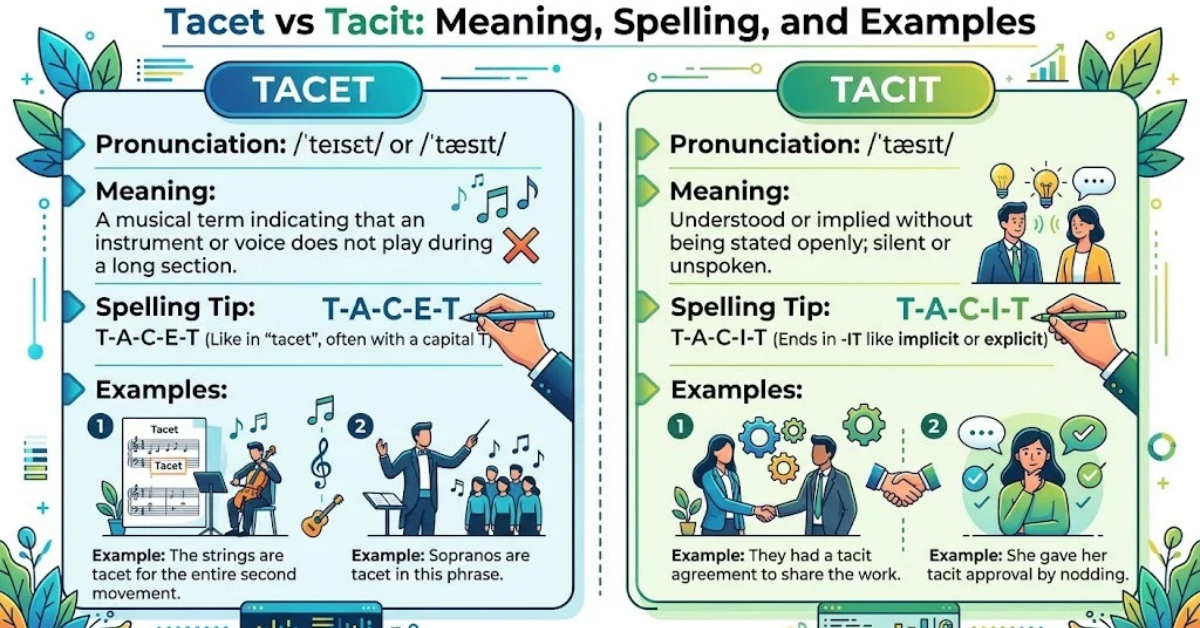
Tacet is a musical term that instructs a performer to remain silent during a particular section of music. Tacit, on the other hand, describes something understood, accepted, or communicated without being expressed directly in words.
Understanding this difference can help you avoid spelling mistakes, improve your vocabulary, and choose the right word in academic, professional, and everyday writing.
Tacet vs Tacit: Which Word Is Correct?
Both tacet and tacit are correct English words. The right choice depends on what you want to communicate.
- Tacet: A musical instruction indicating that an instrument or voice should remain silent for a specified section or movement.
- Tacit: Something understood, implied, or accepted without being explicitly stated.
Consider these examples:
- The conductor marked the trumpet part tacet for the entire movement.
- Their continued cooperation suggested a tacit agreement.
In the first sentence, tacet tells a musician not to play. In the second, tacit describes an understanding that exists without a direct verbal agreement.
The key distinction is simple: tacet concerns musical silence, while tacit concerns an unspoken understanding.
What Does Tacet Mean?
Tacet is a musical term derived from Latin, meaning “it is silent” or “it is silent” in the sense of a part not sounding.
In musical notation, the word tells a performer that their instrument or voice is not required to play or sing during a designated section. Rather than filling the page with rests, a composer or arranger may use tacet to indicate that a part remains silent for a longer passage.
For example, if a piece contains a long orchestral section without a flute part, the flute player may see a tacet instruction for that movement.
How Is Tacet Used in Music?
The term commonly appears in orchestral scores, concert band arrangements, chamber music, and other written musical parts.
Here are some examples:
- The flute is tacet during the second movement. The flute player does not perform in that movement.
- The percussion section is tacet until the final passage. The percussionists remain silent until their part begins.
- The singer is tacet throughout the instrumental introduction. The vocalist does not sing during the introduction.
A tacet instruction does not necessarily mean that the musician is silent for the entire composition. Its scope depends on the notation and the section to which the instruction applies.
Tacet Pronunciation
Tacet is commonly pronounced TAY-set in English, although pronunciation may vary by musical tradition and language.
The word is associated with the Latin verb tacere, meaning “to be silent.”
What Does Tacit Mean?
Tacit is an adjective that describes something understood or accepted without being openly expressed.
It is often used when people share an understanding even though they have not discussed it directly or formally agreed to it.
For example:
There was a tacit agreement that nobody would discuss the matter outside the meeting.
The participants may never have stated this rule aloud, but their behavior indicates that they understand and accept it.
How Is Tacit Used in Everyday English?
Tacit is especially common in discussions about relationships, communication, social expectations, business, politics, and agreements.
Here are several examples:
- Tacit agreement: They reached a tacit agreement to divide the responsibilities equally.
- Tacit approval: Her silence was interpreted as tacit approval, although she never explicitly agreed.
- Tacit understanding: The two colleagues had a tacit understanding about how to handle difficult customers.
- Tacit consent: The proposal proceeded on the assumption of tacit consent, though silence alone does not necessarily establish consent.
- Tacit knowledge: An experienced chef may possess tacit knowledge of how to judge a dish by its texture and aroma.
In each case, the word describes something implied, understood, or assumed rather than directly communicated.
Importantly, tacit does not automatically mean that everyone agrees. It describes an unspoken or implicit understanding, which may be inferred from circumstances and can sometimes be misunderstood.
Tacit Pronunciation
Tacit is generally pronounced TASS-it.
The first syllable sounds like “tass,” and the second resembles “it.” The final letter is a t, not an e.
Tacet vs Tacit: Key Differences at a Glance
| Feature | Tacet | Tacit |
| Part of speech | Musical term, commonly used as an instruction | Adjective |
| Main meaning | A musical part remains silent | Understood without being directly expressed |
| Common context | Music and musical notation | Communication, agreements, social expectations |
| Example | The violin is tacet in this movement. | They had a tacit understanding. |
| Related idea | Silence in performance | Implicit or unspoken meaning |
| Origin | Latin tacere, to be silent | Latin tacitus, silent or unspoken |
Although both words are connected to silence through their Latin origins, their modern meanings have developed in different directions.
Tacet vs Tacit: Examples in Sentences
One of the easiest ways to remember the difference is to compare the words in realistic situations.
Examples of Tacet
- The composer instructed the oboe to remain tacet during the opening movement.
- The trumpet part is marked tacet for the first half of the performance.
- Because the guitar is tacet in this section, the guitarist waits for the next entrance.
- The conductor checked the score to confirm that the horns were tacet during the quiet passage.
- The choir’s soprano section is tacet until the final verse.
Each example involves a performer or musical part that does not sound during a specified section.
Examples of Tacit
- Their actions showed tacit support for the new policy.
- The team operated under a tacit understanding about who would lead each project.
- His silence was taken as tacit approval, but his actual opinion remained unclear.
- The neighbors had a tacit agreement to keep the shared garden tidy.
- Much of her professional expertise came from tacit knowledge gained through years of experience.
Each sentence refers to something implied, understood, or accepted without being stated directly.
Tacit vs Explicit: Understanding the Opposite
To understand tacit, it helps to compare it with explicit.
- Tacit: Communicated or understood indirectly, without being openly stated.
- Explicit: Expressed clearly and directly.
For example:
Tacit agreement: The employees understood that they should keep the discussion private, even though nobody stated the rule.
Explicit agreement: The employees signed a written policy requiring them to keep the discussion private.
The distinction is useful in business communication, contracts, workplace policies, and discussions about consent.
However, an important qualification applies: an implied understanding is not necessarily a legally binding agreement, and silence does not automatically establish consent. The relevant facts, circumstances, and applicable law matter.
Tacet vs Tacit vs Tact
Another word that sometimes causes confusion is tact.
Although tacet, tacit, and tact look similar, they have different meanings.
- Tacet: A musical instruction to remain silent.
- Tacit: Understood or implied without being directly stated.
- Tact: The ability to communicate or handle sensitive situations without offending others.
Examples:
- The clarinet is tacet during the introduction.
- The manager had a tacit understanding with the team.
- She handled the difficult conversation with tact.
A useful way to remember tact is to associate it with diplomacy, sensitivity, and careful communication.
Why Are Tacet and Tacit So Often Confused?
There are several reasons these words can be difficult to distinguish.
1. Their Spellings Are Nearly Identical
Both words contain five letters and share the first four letters in a different final arrangement. A quick glance may not be enough to tell them apart.
2. Both Have a Connection to Silence
Their Latin roots help explain the similarity. Tacet comes from a form of tacere, meaning “to be silent,” while tacit comes from tacitus, meaning “silent” or “unspoken.”
Over time, however, their English uses became distinct.
3. They Are Used in Different Contexts
Tacet is mainly relevant to music. Tacit is used in everyday language, professional communication, social relationships, and academic writing.
Remembering the context often makes the correct choice obvious.
How to Remember the Difference Between Tacet and Tacit
If you frequently confuse these words, try these simple memory techniques.
For tacet, think of a musician waiting silently.
Imagine a conductor pointing to a score where the word tacet appears. The musician knows not to play during that section.
For tacit, think of an unspoken thought.
Imagine two colleagues exchanging a look and understanding what needs to happen without saying a word. That is a tacit understanding.
You can also remember these quick associations:
- Tacet = music and silence
- Tacit = implied and unspoken
- Tact = diplomacy and sensitivity
The more you connect each word with a specific situation, the easier it becomes to use it correctly.
Frequently Asked Questions About Tacet vs Tacit
Is tacet the same as tacit?
No. Tacet is a musical instruction indicating that a performer or musical part remains silent during a specified section. Tacit describes something understood or accepted without being directly expressed.
What does tacet mean in music?
In music, tacet instructs a musician not to play or sing during a designated section or movement. It is commonly used in orchestral scores and other musical arrangements.
What does tacit mean in simple terms?
Tacit means understood without being said aloud. For example, if two people know they will share a task without discussing the arrangement, they may have a tacit understanding.
How do you pronounce tacet and tacit?
Tacet is commonly pronounced TAY-set, while tacit is generally pronounced TASS-it. Pronunciation can vary slightly depending on accent and language.
What is a tacit agreement?
A tacit agreement is an understanding inferred from circumstances, behavior, or established expectations rather than explicitly stated. Whether it has legal significance depends on the relevant circumstances and applicable law.
Is tacit a positive or negative word?
Tacit is neutral. It can describe a positive understanding, such as tacit support, or a potentially problematic assumption, such as interpreting silence as tacit approval.
What is the opposite of tacit?
Depending on the context, explicit, express, or clearly stated can serve as opposites of tacit. Each describes something communicated directly rather than merely implied.
Can tacit be used in a sentence?
Yes. For example: “The two business partners had a tacit understanding about how profits would be divided.” The sentence indicates that their understanding existed without necessarily being stated explicitly.
Is tacet used outside music?
Tacet is primarily a musical term. In ordinary conversation and writing, it is uncommon outside discussions of musical scores or performance instructions.
Conclusion: Tacet vs Tacit Explained
The difference between tacet vs tacit becomes easy to remember once you focus on how each word is used.
Tacet is a musical instruction that tells a performer to remain silent during a particular section. Tacit is an adjective describing an understanding, agreement, or assumption that exists without being directly expressed.
When writing about music, choose tacet. When discussing unspoken agreements, implied meanings, or shared understanding, choose tacit. If you remember these two contexts, you’ll be able to distinguish the words confidently in everyday writing, professional communication, and academic work.