Have you ever wondered whether to write “worse case” or “worst case” when describing a difficult situation? These expressions sound similar, and both contain words associated with something bad. However, only one is the standard expression when you want to describe the most unfavorable possible outcome.
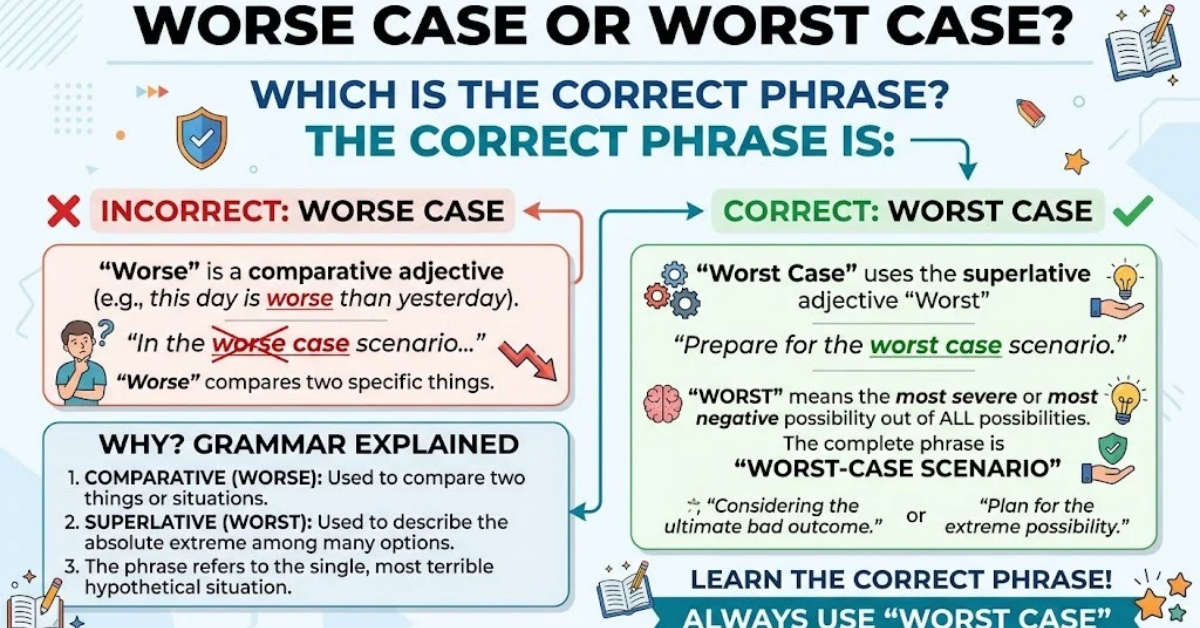
When comparing worse case or worst case, the correct phrase is worst case. The expression refers to the most negative outcome that could reasonably happen in a particular situation. Although “worse” is a perfectly valid English word, it serves a different purpose.
Understanding the difference between worse and worst will help you avoid common grammar mistakes and communicate more clearly in everyday conversations, professional emails, academic writing, and business documents.
Worse Case or Worst Case: Which Is Correct?
“Worst case” is the correct phrase when referring to the most unfavorable possible outcome.
- Worst case: Correct when describing the most negative or unfavorable possibility.
- Worse case: Generally incorrect when intended to mean the most unfavorable possibility, although it can occur in a sentence comparing two specific cases.
For example:
Correct: In the worst case, we might have to cancel the trip.
Incorrect in the intended meaning: In the worse case, we might have to cancel the trip.
The first sentence works because worst describes the most unfavorable outcome under consideration.
Remember this simple rule: use worse to compare two things and worst to identify the most unfavorable thing in a group or range of possibilities.
What Does “Worst Case” Mean?
The phrase worst case refers to the most unfavorable outcome or situation that might occur.
People commonly use it when discussing risks, planning for unexpected problems, considering possible consequences, or preparing for something that may not go according to plan.
For example:
- Travel: In the worst case, we will have to stay overnight at the airport.
- Business: The worst-case scenario would involve losing our biggest client.
- Technology: In the worst case, you may need to reinstall the operating system.
- Education: In the worst case, I might have to retake the examination.
- Personal life: In the worst case, we can postpone the event until next month.
In each example, worst case identifies the least desirable outcome being considered.
What Does “Worst-Case Scenario” Mean?
A worst-case scenario is a possible situation in which things turn out as badly as reasonably anticipated.
The expression is especially common in business planning, finance, emergency preparation, project management, and everyday decision-making.
For example:
We should prepare for the worst-case scenario in case the supplier fails to deliver the materials.
Here, the speaker is recommending preparation for a particularly unfavorable possibility.
It is worth remembering that a worst-case scenario is not necessarily the outcome that will happen. It is one possibility that people consider when evaluating risks.
What Does “Worse” Mean?
Worse is the comparative form of bad. It is used when comparing two things, situations, experiences, or outcomes.
For example:
- This weather is worse than yesterday’s weather.
- My headache feels worse than it did this morning.
- The second proposal is worse than the first.
- Missing one deadline is bad, but missing three deadlines could be worse.
In these sentences, worse compares one thing with another.
You can often recognize the correct use of worse by looking for words such as than, which frequently introduces a comparison.
For example:
The traffic was worse than we expected.
The sentence compares the actual traffic conditions with what the speaker expected.
Worse vs. Worst: Understanding the Grammar
The difference becomes easier to remember when you understand the grammatical relationship between the two words.
| Word | Grammatical form | Meaning | Example |
| Bad | Positive form | Of poor quality or unfavorable | The situation is bad. |
| Worse | Comparative form | More unfavorable than another | The situation is worse today. |
| Worst | Superlative form | The most unfavorable | This is the worst day of the week. |
English commonly uses comparative adjectives to compare two things and superlative adjectives to identify the highest or lowest degree within a group.
Consider these examples:
Bad: The first result was bad.
Worse: The second result was worse than the first.
Worst: The third result was the worst of all three.
The same pattern applies when describing a difficult outcome. Because worst case refers to the most unfavorable possibility, worst is the appropriate word.
Worst Case vs. Worst-Case: Should You Use a Hyphen?
Another common question concerns whether to write worst case or worst-case.
Both forms are correct, but their use depends on the sentence.
Use “Worst Case” as a Noun Phrase
When the expression functions as a noun phrase, it is generally written without a hyphen.
Examples:
- In the worst case, we will need additional funding.
- Let’s consider the worst case before making a decision.
- The worst case is unlikely, but we should prepare for it.
Use “Worst-Case” Before a Noun
When the expression acts as a compound adjective directly modifying a noun, a hyphen is commonly used.
Examples:
- We developed a worst-case scenario.
- The engineer calculated the worst-case outcome.
- The company created a worst-case estimate for its budget.
A useful rule is to write worst case when referring to the situation itself and worst-case when the phrase directly modifies another noun.
Style guides can vary in their treatment of some compound modifiers, but this distinction is a reliable general guideline.
Worse Case or Worst Case in Everyday Sentences
Let’s examine more examples to see how the expressions work in context.
Example 1: Planning a Trip
Incorrect: In the worse case, we will miss our connecting flight.
Correct: In the worst case, we will miss our connecting flight.
The sentence describes the most unfavorable possibility, so worst is appropriate.
Example 2: Comparing Two Outcomes
Correct: The second outcome is worse than the first.
Here, worse is correct because the sentence compares two outcomes rather than identifying the most unfavorable one among several possibilities.
Example 3: Preparing for a Business Problem
Correct: Our worst-case scenario involves a significant decline in sales.
The phrase worst-case scenario describes the most unfavorable situation being considered.
Example 4: Discussing Health
Correct: My symptoms are worse today than they were yesterday.
The word worse compares the symptoms across two points in time.
Example 5: Discussing a Competition
Correct: That was the worst performance of the entire tournament.
The sentence identifies one performance as the most unfavorable among all the performances in the tournament.
These examples show why choosing between worse and worst depends on the meaning of the sentence, not simply on which word sounds more natural.
Is “Worse Case” Ever Grammatically Correct?
Yes, but only when the sentence genuinely calls for a comparison between cases.
For example:
Case A is bad, but Case B is the worse case of the two.
Here, worse is grammatically possible because the sentence compares two specific cases. However, the wording may sound less natural than alternatives such as:
Case B is worse than Case A.
Or:
Case B is the worse of the two cases.
If you are referring to the most unfavorable possible outcome in a general expression, use worst case, not worse case.
This distinction matters because the phrase worse case is not inherently impossible in every grammatical context. It is simply not the standard expression for describing the most unfavorable outcome.
Common Expressions With “Worst Case”
The phrase appears in many familiar expressions. Learning these combinations can help you use the correct wording naturally.
In the Worst Case
This expression introduces the most unfavorable possibility.
Example:
In the worst case, the project will be delayed by two weeks.
Worst-Case Scenario
This expression describes a particularly unfavorable possible situation.
Example:
The team discussed the worst-case scenario before launching the product.
Worst-Case Outcome
This phrase identifies the least desirable result under consideration.
Example:
The worst-case outcome would be a complete loss of the initial investment.
Worst-Case Estimate
This phrase describes an estimate based on particularly unfavorable assumptions.
Example:
The contractor provided a worst-case estimate for the renovation.
Prepare for the Worst
Although this expression does not contain the word case, it follows the same principle.
Example:
We hope everything goes smoothly, but we should prepare for the worst.
Why Do People Confuse Worse Case and Worst Case?
There are several reasons this mistake occurs.
1. Both words describe negative situations. Because worse and worst are associated with something bad, writers sometimes use them interchangeably.
2. Everyday speech can blur grammatical distinctions. In casual conversation, people may use an expression without stopping to consider whether they are making a comparison or describing the most extreme possibility.
3. The difference is easy to overlook when typing. Someone writing quickly may choose the familiar word worse without noticing that worst is needed.
4. English has irregular comparative forms. Unlike many adjectives that form comparisons by adding -er and -est, bad changes to worse and worst. These forms must be learned.
The easiest solution is to focus on what the sentence means. If you’re comparing two things, use worse. If you’re identifying the most unfavorable possibility, use worst.
How to Remember the Difference Between Worse and Worst
If you frequently confuse these words, try these simple memory tricks.
1. Remember “Worse Than”
The word worse commonly appears in comparisons using than.
For example:
This option is worse than the alternative.
If you are comparing one situation with another, worse may be the correct choice.
2. Remember “The Worst of All”
The word worst identifies the most unfavorable option among several possibilities.
For example:
This is the worst outcome of all the possibilities.
The phrase worst of all can help you remember the superlative form.
3. Use the Three-Word Sequence
Memorize the progression:
Bad → Worse → Worst
- Bad describes an unfavorable situation.
- Worse describes something more unfavorable than another.
- Worst describes the most unfavorable option.
4. Test Your Sentence
Before using worse case, ask yourself:
“Am I comparing two cases, or am I describing the most unfavorable possible outcome?”
If you’re describing the most unfavorable outcome, worst case is the phrase you want.
Frequently Asked Questions
Is it worse case or worst case?
Worst case is the correct expression when referring to the most unfavorable possible outcome. Worse is used for comparisons, while worst identifies the most unfavorable option.
Is “worse case scenario” grammatically correct?
When you mean the most unfavorable possible situation, the standard phrase is worst-case scenario. The word worse is comparative and does not normally convey the superlative meaning intended in this expression.
Should I write “in the worst case” or “in the worst-case”?
Write in the worst case when the phrase refers to the situation itself. Use a hyphen in a compound modifier before a noun, as in a worst-case scenario.
What is the difference between worse and worst?
Worse is the comparative form of bad, meaning more unfavorable than something else. Worst is the superlative form, meaning the most unfavorable among the options being considered.
Can I say “the worse of the two”?
Yes. The worse of the two is grammatically correct because it compares two options. For example, “Of the two proposals, this is the worse one.”
What is an example of “worst case” in a sentence?
“In the worst case, we may need to postpone the event.” The phrase identifies the most unfavorable possibility being considered.
Is “worst-case scenario” hyphenated?
Yes, worst-case scenario is commonly hyphenated because worst-case acts as a compound adjective modifying scenario. When used as a noun phrase, it is generally written as the worst case.
Is “worst case” one word or two?
Worst case is written as two words when used as a noun phrase. It is commonly hyphenated as worst-case when it functions as a compound adjective before a noun.
Conclusion: Worse Case or Worst Case?
When deciding between worse case or worst case, remember that the correct expression for the most unfavorable possible outcome is worst case.
Use worse when comparing two things, such as saying one situation is worse than another. Use worst when describing the most unfavorable option, as in “the worst case” or “the worst-case scenario.”
The rule is simple: bad, worse, worst. Keep that sequence in mind, and you’ll find it much easier to choose the right word in emails, articles, reports, and everyday conversations.
If you enjoy learning practical English grammar and commonly confused words, explore more guides on spelling, word usage, and everyday expressions to make your writing clearer and more confident.