Have you ever typed a word, looked at it twice, and wondered whether it actually looks right? The spelling of vacuum often causes that kind of confusion. If you’re unsure whether to write vacuum or vaccum, you’re not alone. This word is frequently misspelled because its vowel sequence is unusual and its pronunciation doesn’t always make the spelling obvious.
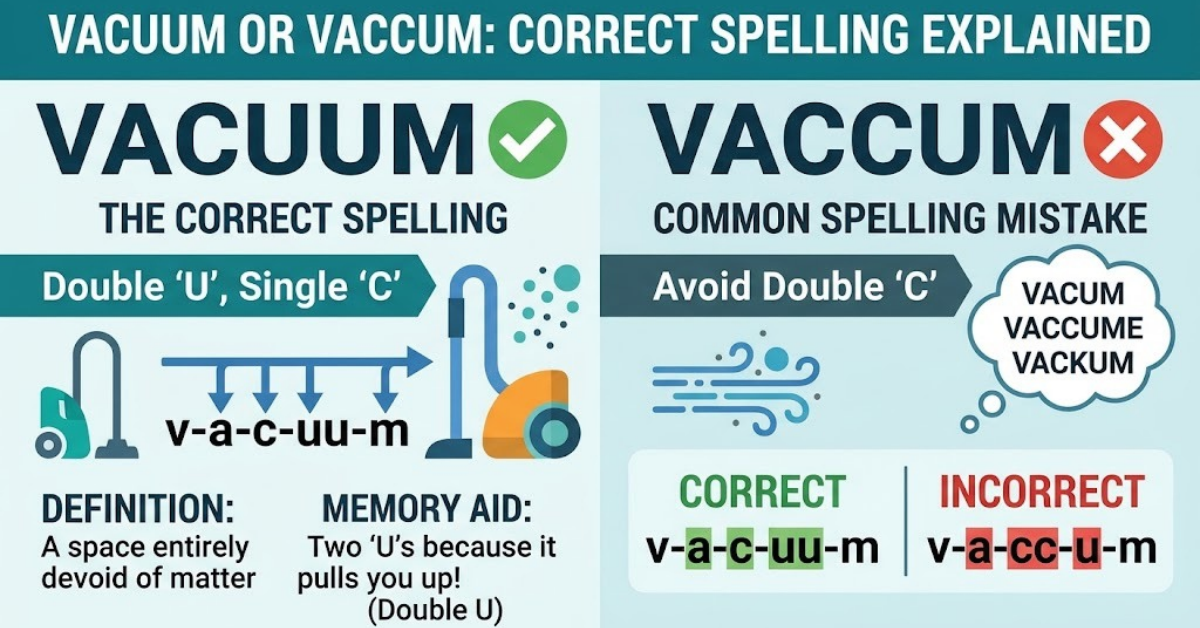
The correct spelling is vacuum, with two u’s and two consecutive letters u in the middle. Vaccum is incorrect because it replaces the second u with a c.
Whether you’re writing about a household cleaning appliance, discussing a scientific concept, or completing an assignment, knowing the correct spelling will help you write with confidence. Let’s look at the meaning, pronunciation, common mistakes, and simple ways to remember the right spelling.
Vacuum or Vaccum: Which One Is Correct?
Vacuum is the correct spelling in standard English. The word contains two consecutive u’s, which is the main detail to remember when writing it.
Vaccum is a misspelling. Although readers can usually understand what the writer intends, the incorrect version should be avoided in schoolwork, professional documents, articles, and everyday communication.
Here’s a quick comparison:
| Spelling | Correct or Incorrect? | Explanation |
| Vacuum | Correct | Standard English spelling |
| Vaccum | Incorrect | The second u is replaced with a c |
| Vacuums | Correct | Plural noun or third-person verb |
| Vacuumed | Correct | Past tense of the verb |
| Vacuuming | Correct | Present participle or gerund |
| Vacuum cleaner | Correct | A machine used to remove dust and dirt |
Easy rule: When choosing between vacuum and vaccum, remember that the correct word has two u’s together: vac-u-um.
What Does Vacuum Mean?
The word vacuum has several meanings, depending on the context. In everyday conversation, it most commonly refers to a cleaning machine that removes dust, dirt, and debris by drawing air through a suction system.
In science, a vacuum is a space containing very little matter compared with ordinary atmospheric conditions. The term is also used figuratively to describe an empty space or a situation in which something important is missing.
Here are the three main uses of the word:
1. Vacuum as a Cleaning Appliance
A vacuum cleaner is a household or commercial appliance used to clean floors, carpets, furniture, and other surfaces. It draws air into the machine, allowing dust and debris to be collected in a bag, container, or filtration system.
Example: “I need to vacuum the living room before the guests arrive.”
2. Vacuum in Science
In physics, a vacuum refers to a region with extremely low pressure and very few particles. A perfect vacuum, containing no matter at all, is an idealization; practical vacuums generally contain some residual particles.
Example: “Scientists use vacuum chambers to conduct experiments under low-pressure conditions.”
3. Vacuum in Figurative Language
The word can also describe an absence of something, such as leadership, information, or authority.
Example: “The sudden resignation created a leadership vacuum in the organization.”
Although these meanings differ, they all use the same spelling: vacuum.
Why Is Vacuum Often Misspelled as Vaccum?
The confusion between vacuum and vaccum is understandable. English spelling contains many words that don’t follow the patterns people expect, and the unusual sequence of vowels in vacuum can make it difficult to remember.
Several factors contribute to this mistake.
1. The Double U Is Unusual
Many English words contain doubled consonants, such as letter, coffee, and running. However, two consecutive u’s are less common, so writers may accidentally substitute another letter when spelling the word from memory.
2. Pronunciation Can Be Misleading
The word vacuum is commonly pronounced approximately VAK-yoom, with variations across accents. Because the two u’s don’t necessarily sound like two separate vowel sounds, the spelling may not be immediately obvious.
3. Typing Errors Become Habits
When someone repeatedly types vaccum, the incorrect version may start to look familiar. This is one reason proofreading and spell-checking can be helpful, particularly when writing quickly.
4. People Rely on How a Word Looks
Sometimes, a misspelled word appears correct simply because the writer has seen it many times. Familiarity, however, doesn’t make a spelling accurate.
The best approach is to learn the correct spelling and use it consistently until it becomes automatic.
How to Remember the Correct Spelling of Vacuum
If you frequently confuse vacuum and vaccum, a simple memory trick can help.
Use the Double-U Rule
Remember this pattern:
VA + CC? No. VAC + UUM = VACUUM
The key is the ending: UUM. The correct word contains two u’s after the c.
You can also break it into smaller sections:
VAC + UUM = VACUUM
This makes the unusual vowel sequence easier to recognize.
Practice With Simple Sentences
Writing the word in context can reinforce the correct spelling. Try these examples:
- “The vacuum needs a new filter.”
- “Please vacuum the carpet before dinner.”
- “The scientist placed the sample inside a vacuum chamber.”
- “The sudden departure left a vacuum in the leadership team.”
Write each sentence once or twice, paying special attention to the two consecutive u’s.
Use a Quick Proofreading Checklist
Before submitting or publishing your writing, check the following:
- Does the word contain two u’s together?
- Have you accidentally replaced the second u with a c?
- Does your spell-checker flag the word?
- Is the word being used as a noun or a verb correctly?
A quick review can prevent a small spelling error from appearing in otherwise polished writing.
Vacuum vs. Vacuums vs. Vacuumed vs. Vacuuming
The word vacuum can take several forms, depending on how it’s used in a sentence. Fortunately, its basic spelling remains consistent.
| Word | Grammatical Use | Example |
| Vacuum | Singular noun or base-form verb | “The vacuum is in the closet.” |
| Vacuums | Plural noun or third-person singular verb | “She vacuums every Saturday.” |
| Vacuumed | Past-tense verb or past participle | “He vacuumed the bedroom yesterday.” |
| Vacuuming | Present participle or gerund | “Vacuuming removes loose dirt from the carpet.” |
Notice that all these forms begin with vacuum. The two u’s remain in place when the word changes form.
Is Vacuum a Noun or a Verb?
It can be both.
As a noun, vacuum can refer to a cleaning appliance or a space containing very little matter. As a verb, it means to clean an area using a vacuum cleaner.
For example:
- Noun: “Our vacuum is powerful enough to clean the rug.”
- Verb: “I vacuum the rug every weekend.”
The context of the sentence tells you which meaning is intended.
What Is the Difference Between Vacuum and Vacuum Cleaner?
Although people sometimes use the terms interchangeably, they are not always identical.
A vacuum cleaner is the appliance used for cleaning. The word vacuum can refer to that appliance in everyday conversation, but it also has broader scientific and figurative meanings.
For example, “I bought a new vacuum” usually means a vacuum cleaner. By contrast, “Light can travel through a vacuum” refers to a region containing very little matter.
Understanding the context helps you identify the intended meaning without changing the spelling.
Common Mistakes to Avoid When Using Vacuum
Correct spelling is only one part of using a word effectively. It’s also useful to understand its different forms and meanings.
Avoid these common errors:
- Writing “vaccum”: The correct spelling is vacuum, with two consecutive u’s.
- Writing “vaccuum”: This version adds an unnecessary c and contains too many letters.
- Using the wrong verb form: Write “She vacuums daily,” not “She vacuum daily,” when describing a third-person singular subject in the present tense.
- Confusing the appliance with the scientific meaning: Use context to make the intended meaning clear.
- Forgetting the double u in longer words: Remember that vacuumed and vacuuming retain the original spelling.
These small details can make your writing more accurate and professional.
Frequently Asked Questions
1. Is it vacuum or vaccum?
Vacuum is the correct spelling. Vaccum is incorrect because it replaces the second u with a c.
2. Why does vacuum have two u’s?
The standard English spelling of vacuum includes two consecutive u’s. Although this letter combination is unusual, it is part of the established spelling and must be learned.
3. How do you spell vacuum correctly?
The word is spelled V-A-C-U-U-M. A useful memory trick is to focus on the final sequence, UUM, and remember that the two u’s appear together.
4. Is vaccum a real word?
No. Vaccum is a common misspelling of vacuum, not an accepted standard spelling in English.
5. What is the plural of vacuum?
The plural is vacuums. For example: “The store sells several types of vacuums.”
6. What is the past tense of vacuum?
The past tense is vacuumed. For example: “I vacuumed the carpet before the visitors arrived.”
7. How do you spell vacuuming?
The correct spelling is vacuuming. The word retains the two u’s in the middle and adds the suffix -ing.
8. Is vacuum spelled the same in British and American English?
Yes. Vacuum is the standard spelling in both British and American English. Unlike words such as colour and color, this word does not have a different standard spelling between the two varieties.
9. What does vacuum mean in science?
In science, a vacuum is a region with very low pressure and relatively few particles. An ideal perfect vacuum contains no matter, although real-world vacuum systems cannot generally eliminate every particle.
Conclusion
When deciding between vacuum or vaccum, always choose vacuum. The correct spelling contains two consecutive u’s, while vaccum is a common spelling mistake.
The word can describe a cleaning appliance, a low-pressure region in science, or an absence of something in a figurative sense. Its related forms, including vacuums, vacuumed, and vacuuming, retain the same basic spelling.
To remember the correct version, focus on the unusual UUM sequence, practice the word in everyday sentences, and proofread your writing when necessary. If you want to improve your English further, explore more spelling guides covering commonly confused words and everyday grammar mistakes.