Have you ever typed a word, looked at it twice, and wondered whether you’ve spelled it correctly? The choice between recomend or recommend is a common source of confusion, especially when writing emails, school assignments, reviews, or professional messages.
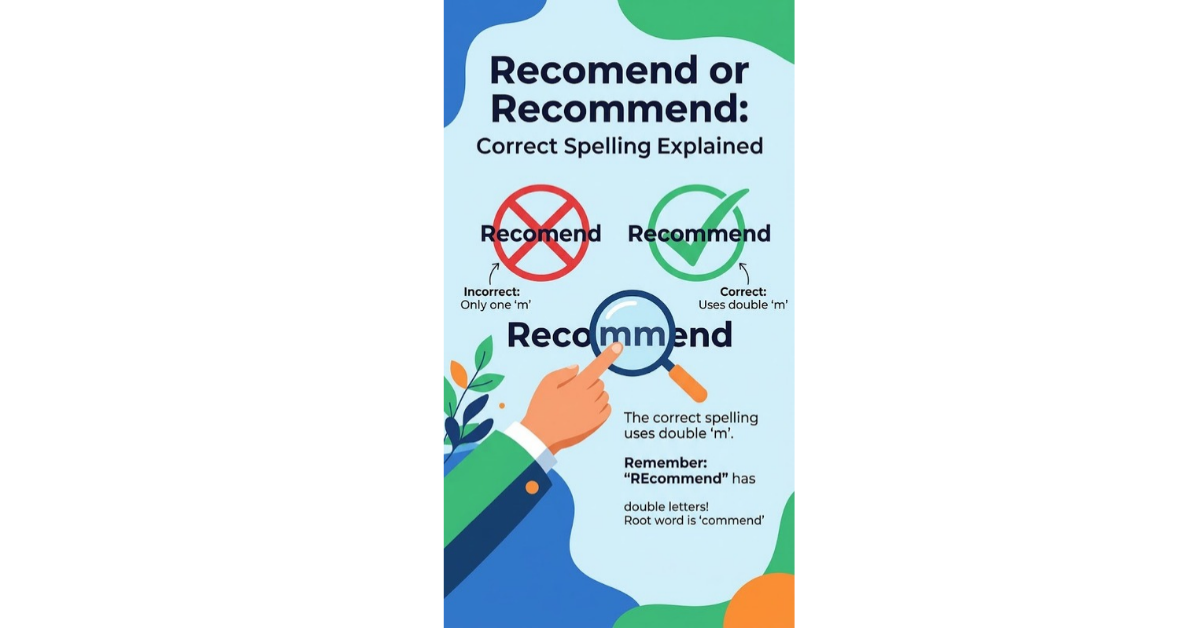
The correct spelling is recommend, with two c’s and two m’s. Recomend is a misspelling because it leaves out one m. Although people can often understand the intended meaning, using the standard spelling helps make your writing clearer and more professional.
In this guide, we’ll explain the meaning of recommend, show you how to use it in everyday sentences, and share simple tricks to remember its spelling.
Recomend or Recommend: Which One Is Correct?
Recommend is the correct spelling in standard English. It contains one c followed by two m’s: r-e-c-o-m-m-e-n-d.
The spelling recomend is incorrect because it contains only one m. This mistake often occurs because the word’s pronunciation doesn’t make the double m particularly noticeable.
Here’s a quick comparison:
| Spelling | Correct or Incorrect? | Explanation |
| Recommend | Correct | Standard English spelling |
| Recomend | Incorrect | Missing one m |
| Recommended | Correct | Past tense and past participle |
| Recommending | Correct | Present participle or gerund |
| Recommendation | Correct | Noun form |
| Recommends | Correct | Third-person singular verb form |
Easy rule: Whenever you write recommend, remember the double c? No—the word has one c and two m’s. That distinction is the key to spelling it correctly.
What Does Recommend Mean?
The verb recommend means to suggest something as a good choice, suitable option, or worthwhile action. You might recommend a restaurant to a friend, a book to a student, or a particular approach to someone facing a problem.
A recommendation usually comes from personal experience, knowledge, professional judgment, or an assessment of someone’s needs. However, recommending something doesn’t necessarily mean it’s the only good option or that everyone will agree with your choice.
For example:
- “I recommend this book to anyone learning English.”
- “The doctor recommended getting more rest.”
- “Can you recommend a good restaurant nearby?”
- “My teacher recommended that I practice writing every day.”
- “The company recommends updating the software regularly.”
In each sentence, recommend expresses a suggestion or endorsement rather than a command.
Why Is Recommend Often Misspelled as Recomend?
There are several reasons people confuse these spellings, even when they know the word well.
1. The Double M Is Easy to Overlook
When writing quickly, it’s easy to type one m instead of two. Because the word remains recognizable without the second m, the mistake can go unnoticed during proofreading.
2. Pronunciation Doesn’t Clearly Show the Spelling
In everyday speech, recommend is generally pronounced ri-kuh-MEND or reh-kuh-MEND, depending on accent. The double m doesn’t create a clearly separate sound, so hearing the word may not help you remember how many letters it contains.
3. Familiarity Can Make Errors Look Correct
If you repeatedly see or type recomend, your brain may begin to recognize it as familiar. Familiarity, however, doesn’t make a spelling correct.
Reading the word in context and using spell-checking tools can help you catch this type of mistake before publishing or sending your writing.
How to Remember the Correct Spelling of Recommend
The easiest way to avoid the recomend versus recommend mistake is to focus on the two m’s in the middle of the word.
Use the Double-M Memory Trick
Break the word into smaller sections:
Re + co + mmend = Recommend
Pay special attention to the letters mm. You can also connect the spelling to the idea that a strong recommendation often comes with a message worth remembering: recommend has two m’s in the middle.
Try practicing it with a few short sentences:
- I recommend this restaurant.
- She recommended a helpful website.
- He is recommending a new book.
- Thank you for your recommendation.
Writing the word in different grammatical forms reinforces the spelling pattern and helps you remember it naturally.
Recommend vs. Recommended vs. Recommendation
These related words share the same root, but each has a different grammatical role.
| Word | Part of Speech | Meaning | Example |
| Recommend | Verb | To suggest a suitable choice | “I recommend this course.” |
| Recommends | Verb | Suggests something | “She recommends this app.” |
| Recommended | Verb or adjective | Suggested or endorsed | “He recommended the book.” |
| Recommending | Verb form or gerund | The act of suggesting | “I’m recommending this service.” |
| Recommendation | Noun | A suggestion or endorsement | “Your recommendation helped me.” |
Notice that all these forms retain the double m. Learning them together makes it easier to recognize the correct spelling in different contexts.
How to Use Recommend Correctly in a Sentence
Although recommend is easy to understand, its grammatical structure can sometimes be confusing. Here are some common patterns.
Recommend Something to Someone
Use this structure when suggesting an item, service, or experience to another person.
Examples:
- “I recommend this movie to my friends.”
- “The teacher recommended the book to her students.”
- “Can you recommend a reliable laptop to me?”
Recommend Doing Something
When suggesting an action, recommend can be followed by a verb ending in -ing.
Examples:
- “I recommend reading the instructions first.”
- “She recommends exercising regularly.”
- “We recommend booking your tickets early.”
Recommend That Someone Do Something
In formal English, recommend can be followed by a that-clause using the base form of the verb.
Examples:
- “I recommend that he review the document.”
- “The doctor recommended that she get more rest.”
- “They recommend that every applicant submit the form online.”
You may also encounter the passive construction “It is recommended that…” in instructions, policies, and professional writing.
What Is the Difference Between Recommend and Suggest?
Recommend and suggest have similar meanings, but they are not always interchangeable.
Recommend often implies that the speaker considers an option particularly suitable or worthwhile. Suggest can be more neutral and simply introduce an idea for consideration.
Compare these examples:
- Recommend: “I recommend this laptop because it offers good performance for the price.”
- Suggest: “I suggest comparing a few laptops before making a decision.”
Both sentences offer guidance, but the first expresses a more direct endorsement, while the second proposes an action.
Other related words include advise, endorse, and propose. The best choice depends on the context and the strength of the message you want to communicate.
Is Recommend a Formal or Informal Word?
Recommend works in both formal and informal English, making it useful in a wide range of situations.
You can use it when talking with friends, writing a customer review, sending a business email, or preparing an academic report.
For example:
- Informal: “Can you recommend a good show to watch?”
- Professional: “I recommend reviewing the proposal before the meeting.”
- Academic: “The findings recommend further investigation.”
The final example is less natural in many academic contexts; writers would usually say that the findings suggest further investigation or that the authors recommend it. Choosing a suitable sentence structure matters just as much as spelling the word correctly.
Common Mistakes to Avoid When Using Recommend
Correct spelling is important, but clear and natural usage also makes a difference.
Watch out for these common mistakes:
- Writing “recomend”: Always include both m’s.
- Confusing the verb and noun: Use recommend for the action and recommendation for the suggestion itself.
- Using an awkward sentence structure: Say “I recommend trying this” or “I recommend that you try this.”
- Making unsupported recommendations: When recommending a product, service, or solution, explain why it may be suitable.
- Forgetting related forms: Recommended, recommending, and recommends all retain the double m.
A quick proofreading check can help you catch errors, especially in longer articles, business communications, and online content.
Frequently Asked Questions
1. Is it recomend or recommend?
Recommend is the correct spelling. Recomend is incorrect because it leaves out one of the two m’s in the word.
2. How do you spell recommend correctly?
The correct spelling is R-E-C-O-M-M-E-N-D. Remember that the word has one c and two consecutive m’s.
3. Why does recommend have two m’s?
The double m is part of the standard English spelling of recommend. Pronunciation doesn’t always reveal the number of letters in a word, so remembering its written form is helpful.
4. What does recommend mean?
To recommend means to suggest something as a good or suitable choice. For example, you might recommend a restaurant because you enjoyed the food or recommend a book because you found it useful.
5. What is the past tense of recommend?
The past tense is recommended. For example: “My colleague recommended a useful online course.”
6. What is the noun form of recommend?
The noun form is recommendation. It refers to a suggestion, endorsement, or piece of advice, as in “Thank you for your recommendation.”
7. Is recommend spelled with one c or two?
Recommend is spelled with one c and two m’s. A common mistake is to focus on the double m and accidentally write two c’s, but the correct spelling is r-e-c-o-m-m-e-n-d.
8. Which is correct: recommend me or recommend to me?
Both constructions can be correct, depending on what you mean. “Can you recommend a book to me?” asks someone to suggest a book, while “Can you recommend me for the position?” asks someone to endorse you as a candidate.
Conclusion
When choosing between recomend or recommend, the correct answer is always recommend. The standard spelling contains one c and two consecutive m’s, and the same double-m pattern appears in recommended, recommending, and recommendation.
To remember the spelling, practice using the word in everyday sentences and pay attention to its middle letters when proofreading. Understanding its meaning and grammatical forms will also help you use it naturally in both casual conversations and professional writing.
If you’re working to improve your English spelling and vocabulary, explore more guides covering commonly confused words, correct spelling, and everyday grammar. A few small improvements can make your writing clearer, more accurate, and more confident.