Have you ever paused while writing a sentence and wondered whether the correct spelling is privilege or priviledge? You’re not alone. This is a common spelling confusion because the word’s pronunciation can make it seem as though there should be an extra letter in the middle.
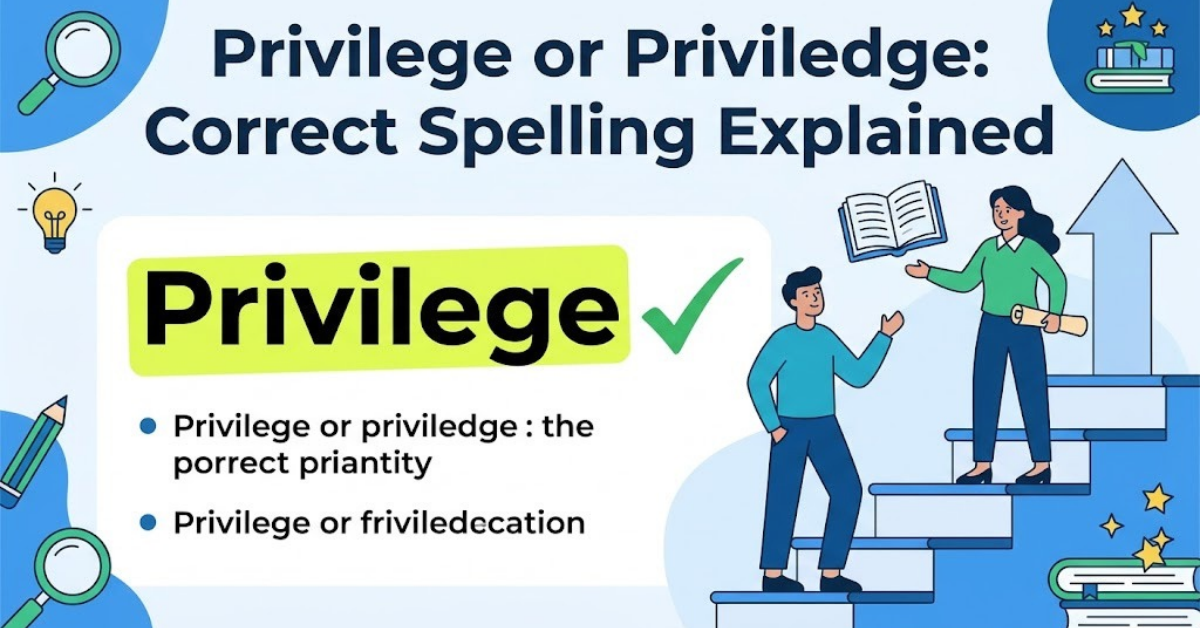
The correct spelling is privilege. The word priviledge is a misspelling and should not be used in formal writing, school assignments, professional emails, or published content. Although both versions may look similar at first glance, only one is accepted in standard English.
In this guide, you’ll learn how to spell privilege correctly, understand its meaning, see practical examples, and discover an easy way to remember the spelling.
Privilege or Priviledge: Which Is Correct?
Privilege is the correct spelling, while priviledge is incorrect.
The word privilege refers to a special right, advantage, benefit, or opportunity available to a particular person or group. It can describe an official right, a personal advantage, or something someone feels fortunate to experience.
Here is a quick comparison:
| Spelling | Correct or Incorrect? | Explanation |
| Privilege | Correct | The standard English spelling |
| Priviledge | Incorrect | A common spelling mistake |
For example:
- Correct: It was a privilege to meet the author.
- Incorrect: It was a priviledge to meet the author.
If you’re unsure which spelling to choose, remember that privilege contains no letter d before the final ge.
What Does Privilege Mean?
The word privilege has several related meanings, depending on the context in which it is used.
1. A Special Right or Benefit
A privilege can be a special right or benefit granted to a person or group. It may come from a position, membership, legal status, or particular circumstances.
Example: Members of the organization have the privilege of using its private facilities.
In this sentence, privilege refers to a benefit that is not necessarily available to everyone.
2. An Advantage in Life
Privilege can also describe advantages that help someone succeed or make life easier. These advantages may involve financial resources, education, social connections, or access to opportunities.
Example: Growing up in a supportive environment gave her certain privileges.
In discussions about society, the word often refers to benefits that people receive because of their background or circumstances, sometimes without realizing it.
3. An Honor or Special Opportunity
People frequently use privilege to express gratitude for an opportunity or experience.
Example: It was a privilege to work with such a talented team.
Here, the word conveys appreciation and respect rather than a formal right.
Why Is Priviledge a Common Spelling Mistake?
There are several reasons people mistakenly write priviledge instead of privilege.
Pronunciation Can Be Misleading
English spelling does not always match pronunciation perfectly. When people say privilege, the middle sounds can make the word seem as though it contains an extra consonant.
As a result, some writers accidentally insert a d, producing the incorrect spelling priviledge.
Confusion With Similar Words
Some English words contain a similar letter pattern, including knowledge, acknowledge, and college. Seeing familiar combinations of letters may lead people to assume that priviledge follows a similar spelling pattern.
However, English spelling often includes exceptions, so familiar patterns are not always reliable guides.
Typing Too Quickly
Another common reason is simply typing without checking. Because priviledge looks close to the correct word, the error can go unnoticed during a quick read.
Spell-checking tools may identify this mistake, but learning the correct spelling yourself is more reliable than depending entirely on software.
How to Remember the Correct Spelling of Privilege
If you regularly confuse privilege and priviledge, a few simple techniques can help.
1. Remember That There Is No D
The easiest trick is to focus on the missing letter.
Write the word as:
P-R-I-V-I-L-E-G-E
Notice that there is no d anywhere in the word.
Whenever you’re tempted to write priviledge, pause and check whether you have accidentally inserted that extra letter.
2. Break the Word Into Smaller Parts
You can practice the word by dividing it into manageable sections:
PRIV-I-LEGE
Say each part slowly as you write it. Repeating the correct spelling several times can help you recognize the word more quickly in the future.
This is a memory aid rather than an official linguistic division, but it can still be useful for spelling practice.
3. Practice With Complete Sentences
Learning a word in context is often more effective than memorizing individual letters.
Try writing these sentences:
- It is a privilege to help others.
- She appreciated the privilege of receiving an education.
- Having supportive friends is a privilege I value.
- He considered it a privilege to represent his school.
Writing these examples reinforces both the spelling and the meaning.
4. Use a Quick Proofreading Check
Before submitting an assignment, publishing an article, or sending a professional message, search your text for priviledge.
If you find it, replace it with privilege. This small proofreading habit can help you avoid a mistake that might otherwise affect the professionalism of your writing.
Examples of Privilege in Everyday Sentences
Understanding how the word works in context makes it easier to use correctly.
Here are some examples from everyday English:
- Professional: It was a privilege to collaborate with experienced professionals.
- Education: Every student should have access to educational opportunities, regardless of their background or privilege.
- Personal: Spending time with my grandparents is a privilege I never take for granted.
- Social: The discussion explored how privilege can influence access to healthcare and education.
- Formal: The committee granted her the privilege of addressing the audience.
- Gratitude: I feel privileged to be part of such a supportive community.
Notice that privilege can be used in positive personal statements as well as serious discussions about social and economic differences.
Privilege vs. Privileged: What’s the Difference?
Another common question concerns the difference between privilege and privileged. Both are correct words, but they serve different grammatical purposes.
| Word | Meaning | Example |
| Privilege | A special right, benefit, or advantage | Education is a privilege worth appreciating. |
| Privileged | Having or receiving a privilege | She felt privileged to attend the event. |
| Privileges | More than one right or benefit | The membership includes several privileges. |
| Privileging | Giving preference or priority to something or someone | The policy is accused of privileging certain groups. |
The word privileged is especially useful when describing someone who has access to particular advantages or when expressing gratitude for an opportunity.
For example, you might say, “I feel privileged to be here,” rather than “I feel privilege to be here.”
Is Privilege the Same in American and British English?
Yes. Privilege is the standard spelling in both American and British English.
Unlike words such as color and colour or organize and organise, this word does not have a commonly accepted American-versus-British spelling difference.
The following spellings are therefore correct in both varieties:
- American English: privilege
- British English: privilege
The spelling priviledge is incorrect in both.
Common Synonyms for Privilege
Depending on the sentence, several words may communicate a similar idea. However, they are not always interchangeable because each has its own shades of meaning.
| Synonym | Meaning | Example |
| Advantage | Something that puts someone in a favorable position | Her experience gave her an advantage. |
| Benefit | Something helpful or valuable | The program offers several benefits. |
| Right | Something a person is entitled to have or do | Everyone has the right to express an opinion. |
| Honor | Something that brings respect or pride | It was an honor to receive the award. |
| Opportunity | A chance to do or experience something | He welcomed the opportunity to learn. |
| Perk | An additional benefit, often informal | Free meals are a workplace perk. |
When choosing a synonym, consider what you want to emphasize. For example, honor works well when expressing respect, while advantage is more appropriate when discussing unequal opportunities.
Frequently Asked Questions
1. Is it privilege or priviledge?
Privilege is correct. Priviledge is a misspelling and should be avoided in formal and informal writing.
2. Why do people spell privilege incorrectly?
People often add an unnecessary d because of the way the word sounds or because they are unfamiliar with its spelling. Typing quickly and relying on pronunciation rather than memorized spelling can also contribute to the mistake.
3. How do you spell privilege correctly?
The correct spelling is P-R-I-V-I-L-E-G-E. A useful reminder is that the word contains no letter d.
4. What is the plural of privilege?
The plural is privileges. For example, “The position comes with several privileges.”
5. Is privilege a noun or a verb?
Privilege is primarily used as a noun, meaning a special right, advantage, or benefit. It can also be used as a verb meaning to give someone or something special treatment or priority, as in “The policy may privilege one group over another.”
6. Is privilege spelled differently in British English?
No. The spelling privilege is standard in both British and American English. The alternative spelling priviledge is incorrect in both varieties.
7. What is the difference between privilege and privileged?
Privilege is usually a noun referring to a right, benefit, or advantage. Privileged is an adjective describing someone who has such an advantage, or someone who feels fortunate to have a particular opportunity.
8. What is an example of privilege in a sentence?
“It was a privilege to represent my school at the national competition.” In this sentence, privilege expresses that the speaker considers the opportunity an honor.
Conclusion
When deciding between privilege or priviledge, the answer is straightforward: privilege is the only correct spelling in standard English. The alternative spelling, priviledge, contains an unnecessary d and should be corrected whenever it appears.
Remember the spelling P-R-I-V-I-L-E-G-E, practice using the word in everyday sentences, and proofread your writing when accuracy matters. These small habits can help you avoid a common English spelling mistake.
If you’re working on improving your vocabulary and writing skills, explore more spelling comparisons and grammar guides to become a more confident writer.