Have you ever wondered whether to use exception or exemption when describing something that doesn’t follow a general rule? Although these two words look similar and are sometimes used in related situations, they have different meanings. Choosing the right one can make a significant difference in everyday conversations, professional writing, legal documents, and academic work.
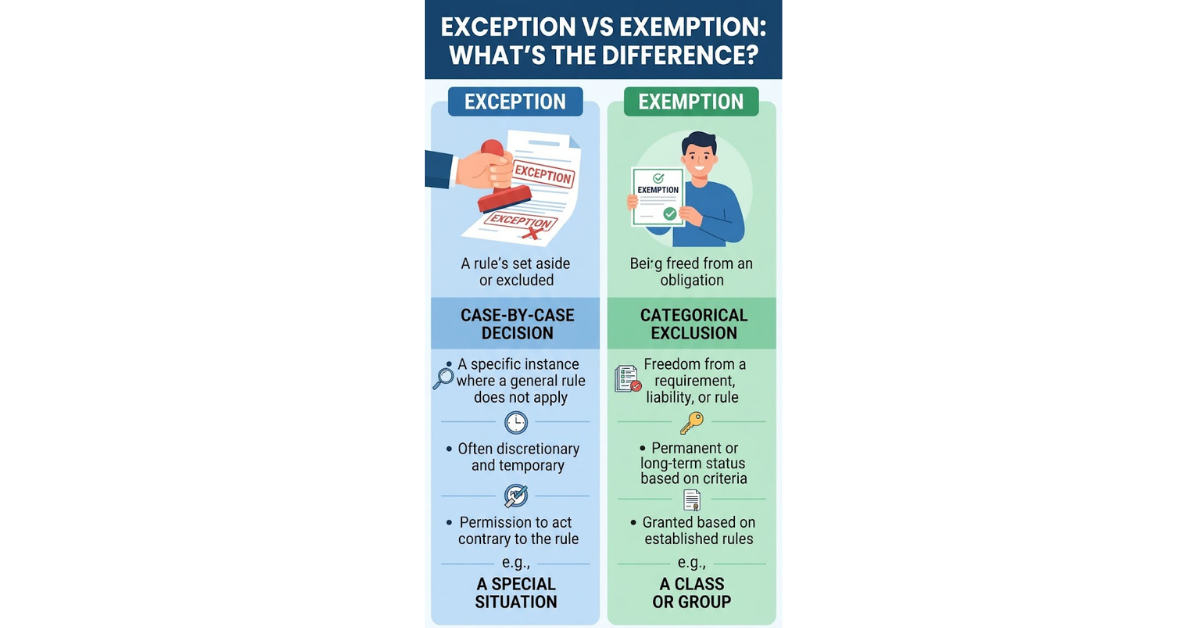
When comparing exception vs exemption, the main distinction is that an exception refers to someone or something that does not follow a general rule, while an exemption refers to official permission or freedom from a requirement, obligation, or rule.
For example, a student who receives special permission not to take an examination has an exemption. However, a student whose performance is different from the usual pattern may be described as an exception. Understanding this distinction will help you use both words accurately.
Exception vs Exemption: What’s the Main Difference?
The simplest way to understand the difference between exception and exemption is to look at what each word describes.
- Exception: A person, situation, or thing that does not follow a general rule or pattern.
- Exemption: Permission or a special status that frees someone from a particular rule, duty, requirement, or obligation.
An exception highlights a difference from what is normally expected. An exemption focuses on being released from something that would otherwise apply.
Consider these examples:
- “Everyone must attend the meeting, with one exception.” This means one person or situation is treated differently from the general rule.
- “The employee received an exemption from attending the meeting.” This means the employee was officially excused from the attendance requirement.
Both words involve situations outside a general requirement, but they communicate different ideas.
What Does Exception Mean?
An exception is a person, thing, or situation that does not follow a general rule, standard, statement, or expectation.
It is commonly used when something differs from what normally happens. An exception can be positive, negative, or simply unusual, depending on the context.
For example, imagine a store that closes at 9 p.m. every day but stays open until midnight on New Year’s Eve. That special opening time is an exception to its normal schedule.
Examples of Exception in Sentences
Here are some everyday examples that demonstrate how to use exception correctly:
- “All employees must wear uniforms, without exception.”
- “Everyone enjoyed the movie, with the exception of my brother.”
- “This restaurant is usually expensive, but today’s lunch menu is an exception.”
- “There is an exception to every general rule.”
- “She rarely misses a deadline, and this situation was no exception.”
- “The school allows no exceptions to its safety policy.”
In each sentence, exception identifies something that differs from a general rule or expected pattern.
Common Types of Exceptions
The word exception appears in several areas of life, including:
- Everyday situations: Something unusual compared with normal circumstances.
- Business: A transaction or situation that does not follow standard procedures.
- Law: A particular exclusion, objection, or qualification within a legal rule or proceeding.
- Education: A special case that differs from an established academic policy.
- Technology: An event or error that interrupts the normal execution of a computer program.
The exact meaning depends on the subject, but the central idea remains the same: something differs from the usual rule or situation.
What Does Exemption Mean?
An exemption is an official or recognized release from a particular requirement, obligation, rule, payment, or responsibility.
Unlike an exception, which describes a departure from a general rule, an exemption generally means someone is not required to comply with a particular obligation.
For example, a qualifying organization may receive a tax exemption that removes its obligation to pay certain taxes. Similarly, a student may receive an exemption from a physical education requirement because of an approved medical condition.
Examples of Exemption in Sentences
The following examples show how exemption is used in different situations:
- “The organization received a tax exemption because it met the legal requirements.”
- “Students with an approved medical condition may qualify for an exemption from certain physical activities.”
- “The company requested an exemption from the new reporting requirement.”
- “Some employees are eligible for an exemption from overtime rules.”
- “The government introduced an exemption for qualifying small businesses.”
- “She received an exemption from the mandatory training program.”
In these examples, exemption refers to being released from an obligation that would otherwise apply.
Common Types of Exemptions
Exemptions are especially common in legal, financial, educational, and administrative settings.
1. Tax exemption
A tax exemption reduces or removes a particular tax obligation for an eligible person, organization, or transaction. The conditions depend on the applicable tax laws.
2. Medical exemption
A medical exemption allows someone to avoid a particular requirement for health-related reasons when the relevant rules permit it.
3. Educational exemption
A school or university may exempt a student from a course, examination, or academic requirement under specific conditions.
4. Legal exemption
Certain laws provide exemptions that release eligible individuals or organizations from specific legal obligations.
5. Religious exemption
Some legal or institutional frameworks recognize religious exemptions from particular requirements, subject to applicable laws and limitations.
Exception vs Exemption: Key Differences Explained
Although the words are related, their grammatical usage and meanings are not interchangeable in every situation.
Here is a side-by-side comparison:
| Comparison | Exception | Exemption |
| Meaning | Something that differs from a general rule | Freedom from a particular requirement |
| Main idea | A departure from the norm | Release from an obligation |
| Focus | Difference or unusual circumstances | Permission or eligibility |
| Common usage | Rules, patterns, situations, and statements | Taxes, laws, duties, and requirements |
| Example | “This case is an exception.” | “She received an exemption.” |
| Related verb | Except | Exempt |
| Related adjective | Exceptional | Exempt |
The easiest way to remember the difference: An exception is something that does not follow the usual pattern, while an exemption is permission not to follow a particular requirement.
When Should You Use Exception vs Exemption?
Choosing between these words becomes easier when you identify what you want to communicate.
Use Exception When Something Is Different From the Rule
Choose exception when you are describing an unusual case, a departure from a normal pattern, or something that does not fit a general statement.
Examples:
- “Every customer received a discount, with one exception.”
- “This winter has been unusually warm, but last year was an exception.”
- “The rule applies to all departments, without exception.”
Here, the word highlights a difference between a particular situation and the general rule.
Use Exemption When Someone Is Released From a Requirement
Choose exemption when a person, business, or organization is formally excused from a particular obligation.
Examples:
- “The charity qualifies for a tax exemption.”
- “He requested an exemption from the attendance requirement.”
- “The government granted the company an exemption from certain regulations.”
In these sentences, exemption communicates freedom from an obligation rather than simply being different from the norm.
Exception vs Exemption in Different Contexts
Understanding how these words work in specific situations can make the distinction even clearer.
1. Exception vs Exemption in Taxation
In taxation, an exemption generally refers to an eligible release from a tax obligation or the exclusion of certain income, property, or transactions from taxation under applicable law.
An exception, on the other hand, refers to a particular case that does not follow a general tax rule.
For example:
- “The organization qualifies for a tax exemption.”
- “The tax rule includes an exception for certain transactions.”
The distinction matters because tax exemptions and exceptions can have different legal requirements and financial consequences.
2. Exception vs Exemption in Education
Schools and universities may use both words when explaining academic policies.
An exception could describe a special situation that differs from a standard school rule. An exemption means a student is released from a specific requirement.
For example:
- “The principal made an exception to the usual enrollment deadline.”
- “The student received an exemption from the physical education requirement.”
The first describes a departure from normal policy, while the second describes permission not to complete a requirement.
3. Exception vs Exemption in Law
In legal writing, these terms can have more specific meanings.
An exception may refer to an exclusion, qualification, or formal objection, depending on the legal context. An exemption generally identifies a person, organization, activity, or situation that is released from a particular legal requirement.
For example:
- “The regulation contains an exception for emergency situations.”
- “The organization applied for an exemption from the licensing requirement.”
Legal meanings can vary by jurisdiction, so the wording of the relevant statute or regulation should always be checked.
4. Exception vs Exemption in Business
Businesses frequently encounter both terms when managing policies, contracts, compliance requirements, and employee responsibilities.
An exception may be approved when a standard business procedure cannot be followed in a particular situation. An exemption may release an eligible employee or organization from a specific obligation.
For example:
- “The manager approved an exception to the company’s refund policy.”
- “The business received an exemption from a particular reporting requirement.”
Using the correct word helps avoid confusion when discussing company policies and compliance matters.
What Are the Synonyms of Exception and Exemption?
Although synonyms can help improve vocabulary, not every alternative has exactly the same meaning.
Synonyms of Exception
Depending on the context, possible synonyms include:
- Anomaly
- Irregularity
- Deviation
- Special case
- Exclusion
- Variation
- Departure
For example, anomaly works when something is unusual, while deviation describes a departure from an established standard.
Synonyms of Exemption
Possible synonyms include:
- Waiver
- Exclusion
- Release
- Dispensation
- Immunity
- Freedom
- Exclusion from an obligation
For instance, waiver is often used when a requirement or right is formally given up or waived. However, a waiver and an exemption are not always legally identical.
Common Mistakes When Using Exception and Exemption
Even experienced English speakers sometimes confuse these words because they appear in similar contexts.
Here are some mistakes worth avoiding:
1. Treating both words as interchangeable
Incorrect: “The employee received an exception from paying taxes.”
Better: “The employee received a tax exemption.”
2. Using exemption when describing an unusual event
Incorrect: “Her excellent performance was an exemption to the team’s usual results.”
Better: “Her excellent performance was an exception to the team’s usual results.”
3. Assuming every exception requires official permission
An exception can simply describe something unusual. It does not necessarily involve formal approval or authorization.
4. Assuming every exemption is automatic
Many exemptions require an application, eligibility assessment, or official approval. The applicable rules determine whether someone qualifies.
5. Ignoring the context
A word that works in everyday conversation may have a more specific meaning in legal or financial writing. Always consider the subject before choosing between exception and exemption.
Frequently Asked Questions (FAQs)
1. What is the main difference between exception and exemption?
An exception is something that differs from a general rule or expected pattern. An exemption is an official or recognized release from a particular obligation, requirement, or responsibility.
2. Is an exception the same as an exemption?
No. Although both words can describe situations outside a general rule, they have different meanings. An exception identifies a special case, while an exemption means someone is excused from a requirement.
3. What is an example of an exception?
“Everyone must submit the assignment by Friday, with the exception of students who received an approved extension.” This identifies a special case that differs from the general deadline.
4. What is an example of an exemption?
“She received an exemption from the mandatory training program.” This means she was officially excused from completing a requirement.
5. Is a tax exemption an exception?
Not exactly. A tax exemption is a specific legal or tax-related status that removes or reduces an applicable tax obligation. An exception is a broader term describing something that differs from a general rule.
6. What is the verb form of exception and exemption?
The verb related to exception is except, meaning to exclude someone or something. The verb related to exemption is exempt, meaning to release someone from an obligation or requirement.
7. Can an exception be an exemption?
An exemption can be treated as a special case under a general rule, but the terms are not automatically interchangeable. An exemption specifically concerns freedom from an obligation, while an exception has a broader meaning.
8. What is the difference between exempt and except?
Exempt means to free someone from a duty or requirement. Except generally means to exclude someone or something from a group or statement.
For example, “Students are exempt from the fee” means they do not have to pay it. “Everyone attended except John” means John was the only person who did not attend.
Conclusion
Understanding exception vs exemption comes down to recognizing the difference between a special case and freedom from an obligation. An exception describes something that does not follow a general rule, while an exemption releases someone from a particular requirement or responsibility.
Use exception when discussing unusual situations, differences, or departures from normal expectations. Choose exemption when referring to an approved release from taxes, duties, regulations, or other requirements.
Once you understand this simple distinction, choosing the correct word becomes much easier. Keep these examples in mind, and explore other commonly confused English words to continue improving your vocabulary and writing skills.