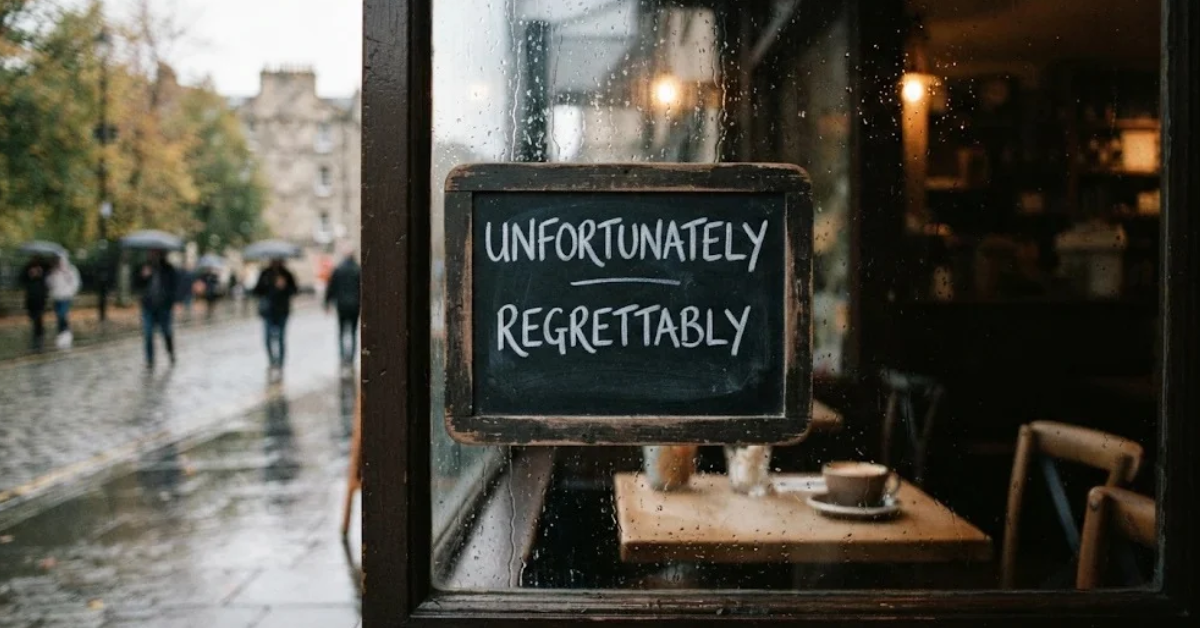
Have you ever found yourself using the word unfortunately repeatedly in emails, essays, conversations, or professional messages? It’s a useful word, but relying on it too often can make your writing sound repetitive. Fortunately, there are plenty of alternatives that can help you express disappointment, regret, or an unpleasant situation more naturally.
Finding the right unfortunately synonym depends on what you want to communicate. Sometimes, you need a formal expression for business correspondence. In other situations, a simple word such as sadly or regrettably works much better.
In this guide, we’ll explore more than 50 alternatives to unfortunately, explain their meanings, provide practical examples, and show you how to choose the best word for different situations.
What Does Unfortunately Mean?
The word unfortunately is an adverb used to introduce information that is disappointing, undesirable, or connected to an unpleasant situation. It often tells the reader that something did not happen as expected or that the speaker wishes circumstances were different.
For example:
-
Unfortunately, the concert was canceled because of bad weather.
-
I wanted to join the meeting, but unfortunately, I was unavailable.
-
Unfortunately, we couldn’t find the information we needed.
In each sentence, the word communicates disappointment or regret without requiring a lengthy explanation.
According to the Oxford Advanced Learner’s Dictionary, unfortunately describes a situation or fact that causes sadness, disappointment, or difficulty. Its direct synonym includes regrettably.
Oxford Learners Dictionaries+1
50+ Unfortunately Synonyms and Alternative Words
There isn’t just one perfect replacement for unfortunately. Different words communicate different degrees of sadness, regret, bad luck, and disappointment.
Here are more than 50 alternatives to consider.
Common Synonyms for Unfortunately
These are some of the most useful alternatives for everyday writing and conversations.
| Synonym | Meaning or Usage |
| Sadly | Expresses sadness or disappointment |
| Regrettably | Indicates that something is unfortunate or undesirable |
| Unluckily | Describes something caused by bad luck |
| Unhappily | Expresses an unpleasant or disappointing situation |
| Alas | Expresses sorrow or disappointment |
| Disappointingly | Highlights an unsatisfactory result |
| Regretfully | Communicates personal regret |
| Lamentably | Describes something deserving regret |
| Sadly enough | Emphasizes an unfortunate situation |
| To our disappointment | Expresses collective disappointment |
| Much to my regret | Shows personal regret |
| Much to our regret | Shows shared regret |
| Badly enough | Informal expression of an undesirable situation |
| To my dismay | Expresses distress or disappointment |
| To our dismay | Communicates shared disappointment |
Formal Synonyms for Unfortunately
When writing business emails, academic papers, reports, or professional messages, a more polished alternative may be appropriate.
Consider these options:
-
Regrettably: A professional way to introduce disappointing information.
-
It is unfortunate that: A formal expression of an undesirable situation.
-
It is regrettable that: Highlights something that deserves regret.
-
To our regret: Expresses disappointment on behalf of a group.
-
With regret: Commonly used when communicating an unpleasant decision.
-
Unhappily: Can introduce an undesirable outcome, although it is less common in modern professional writing.
-
Sadly: A simple alternative that works in both formal and informal contexts.
-
To our disappointment: Suitable for explaining an unsuccessful outcome.
-
It is disappointing that: Directly communicates dissatisfaction.
-
Much to our regret: A more emphatic formal expression.
Example:
Original: Unfortunately, we cannot approve your application.
Alternative: Regrettably, we cannot approve your application at this time.
The second sentence sounds professional while maintaining a respectful tone.
Informal Synonyms for Unfortunately
Sometimes, formal language feels unnecessary. When communicating with friends, family, or colleagues in casual conversations, these alternatives may sound more natural.
-
Sadly enough
-
Bad luck
-
As luck would have it
-
Much to my disappointment
-
I hate to say it
-
It’s a shame
-
Sadly
-
Too bad
-
I’m afraid
-
The unfortunate thing is
-
Not to my liking
-
It didn’t work out
-
Things didn’t go as planned
-
Unfortunately for me
-
What a shame
Examples:
– Unfortunately, I can’t come tonight.
More casually: I’m afraid I can’t make it tonight.
– Unfortunately, we missed the train.
More casually: Bad luck! We missed the train.
– Unfortunately, the restaurant was closed.
More naturally: It’s a shame the restaurant was closed.
Remember that these expressions are alternatives in particular situations, not exact replacements in every sentence.
Best Unfortunately Synonyms for Different Situations
Choosing an alternative becomes easier when you understand the situation and the feeling you want to communicate.
Here is a quick comparison.
| Situation | Best Alternative |
| Professional emails | Regrettably |
| Academic writing | It is unfortunate that |
| Casual conversations | Sadly |
| Expressing personal regret | Regretfully |
| Describing bad luck | Unluckily |
| Showing disappointment | Disappointingly |
| Expressing sympathy | Sadly |
| Dramatic or literary writing | Alas |
| Reporting a serious loss | Tragically |
| Explaining an unsuccessful result | Unfortunately or unsuccessfully, depending on context |
1. Unfortunately Synonym for Professional Emails
Professional communication requires a balance between politeness and clarity. You want to deliver disappointing news without sounding unnecessarily negative.
Good alternatives include:
-
Regrettably
-
With regret
-
I’m afraid
-
To our regret
-
It is unfortunate that
Examples:
-
Regrettably, your requested delivery date cannot be accommodated.
-
I’m afraid we are unable to offer a replacement.
-
With regret, we must inform you that the event has been postponed.
Among these choices, regrettably is particularly useful when you want a direct and professional replacement.
2. Unfortunately Synonym for Academic Writing
Academic writing generally benefits from precise, objective language. Instead of repeating unfortunately, consider expressions that explain the limitation or outcome.
Useful alternatives include:
-
It is unfortunate that
-
Regrettably
-
Disappointingly
-
Sadly
-
A limitation is that
-
The results indicate that
-
The study was unable to
Examples:
– Unfortunately, the research included a relatively small sample.
Better: A limitation of the research is its relatively small sample size.
– Unfortunately, the experiment did not produce the expected results.
Alternative: Regrettably, the experiment did not produce the expected results.
The first alternative is particularly useful because it explains the problem instead of simply expressing disappointment.
3. Unfortunately Synonym for Expressing Disappointment
When something doesn’t go as expected, you may want a word that emphasizes your reaction.
Consider:
-
Sadly
-
Disappointingly
-
To my dismay
-
Much to my disappointment
-
Regrettably
-
To our disappointment
Examples:
-
Disappointingly, the team failed to reach the final.
-
Much to my disappointment, the tickets were already sold out.
-
Sadly, the project was canceled before completion.
4. Unfortunately Synonym for Bad Luck
Sometimes, an unpleasant situation happens because of circumstances beyond someone’s control.
In these cases, the following expressions may work:
-
Unluckily
-
As luck would have it
-
By unfortunate circumstances
-
Through bad luck
-
Against our expectations
Examples:
-
Unluckily, it started raining just before the outdoor event.
-
As luck would have it, we arrived just after the store closed.
-
By unfortunate circumstances, the delivery was delayed.
Unfortunately vs. Its Most Common Synonyms
Although several words can replace unfortunately, their meanings and emotional tones aren’t always identical.
Understanding these differences will help you choose more accurate vocabulary.
Unfortunately vs. Sadly
Both words express disappointment, but sadly often carries a stronger emotional feeling.
-
Unfortunately, the meeting was canceled.
-
Sadly, the community center will close permanently.
The first sentence communicates an inconvenient situation. The second suggests a more emotional loss.
Unfortunately vs. Regrettably
These two words are very close in meaning. However, regrettably often sounds more formal and deliberate.
-
Unfortunately, we cannot process your request.
-
Regrettably, we cannot process your request.
Both are correct, but the second may sound more polished in professional correspondence.
Unfortunately vs. Unluckily
Unluckily specifically emphasizes bad luck rather than general disappointment.
-
Unfortunately, I couldn’t attend the event.
-
Unluckily, I missed the bus by just one minute.
The second sentence clearly connects the situation to bad timing or chance.
Unfortunately vs. Alas
Alas is a more expressive and somewhat old-fashioned alternative. It is commonly found in literary writing, storytelling, and dramatic expressions.
-
Unfortunately, our journey has come to an end.
-
Alas, our journey has come to an end.
The second sentence sounds more dramatic and emotional.
Unfortunately vs. Disappointingly
Disappointingly focuses on an outcome that failed to meet expectations.
-
Unfortunately, the product didn’t arrive on time.
-
Disappointingly, the product didn’t meet our expectations.
The first describes an unpleasant circumstance, while the second emphasizes dissatisfaction.
30 Example Using Unfortunately Synonyms
Seeing alternatives in complete sentences makes it easier to understand how they work in everyday communication.
Here are 30 practical examples:
| Word or Phrase | Example Sentence |
| Sadly | Sadly, the old building was destroyed. |
| Regrettably | Regrettably, we cannot extend the deadline. |
| Unluckily | Unluckily, I left my wallet at home. |
| Unhappily | Unhappily, the arrangement did not last. |
| Alas | Alas, the opportunity has passed. |
| Disappointingly | Disappointingly, the results were below expectations. |
| Regretfully | I must regretfully decline your invitation. |
| Lamentably | Lamentably, the situation has worsened. |
| Sadly enough | Sadly enough, nobody attended the event. |
| To my dismay | To my dismay, the files had disappeared. |
| To our regret | To our regret, the project was unsuccessful. |
| With regret | With regret, we announce the cancellation. |
| It is unfortunate that | It is unfortunate that the system failed. |
| Much to my disappointment | Much to my disappointment, the shop was closed. |
| Much to our regret | Much to our regret, the agreement fell through. |
| I’m afraid | I’m afraid we cannot help with that request. |
| It’s a shame | It’s a shame you couldn’t join us. |
| Too bad | Too bad we missed the opportunity. |
| Bad luck | Bad luck! The tickets sold out. |
| Tragically | Tragically, several homes were destroyed. |
| Woefully | The organization was woefully unprepared. |
| Dismally | The campaign performed dismally. |
| Disastrously | The plan ended disastrously. |
| Adversely | The changes adversely affected production. |
| Inopportunely | The interruption came inopportunely. |
| To our disappointment | To our disappointment, the event was postponed. |
| Sad to say | Sad to say, the business has closed. |
| By bad luck | By bad luck, we arrived after closing time. |
| Through no fault of our own | Through no fault of our own, the shipment was delayed. |
| Against our expectations | Against our expectations, the proposal was rejected. |
Not every expression in this table is interchangeable with unfortunately. Some describe a specific emotion, result, or circumstance, so always consider the meaning of the complete sentence.
How to Choose the Right Unfortunately Synonym
Having a long list of alternatives is helpful, but knowing when to use each one makes an even bigger difference.
Before replacing unfortunately, consider these five factors:
1. Understand the Situation
Think about why you’re using the word in the first place.
-
If something disappointing happened, use sadly.
-
If you’re communicating an unpleasant decision, use regrettably.
-
If something happened because of bad luck, use unluckily.
-
If an outcome failed to meet expectations, use disappointingly.
2. Consider Your Audience
The best vocabulary depends on who will read your message.
For example, alas might work in creative writing, but it may sound unusual in a business email. Similarly, I’m afraid is natural in everyday conversation but may not be suitable for every academic document.
3. Match the Emotional Tone
Not every disappointing situation requires an emotional response.
Compare these sentences:
-
Regrettably, the application was rejected.
-
Sadly, the application was rejected.
The first sounds more formal, while the second sounds more personal.
Choose the expression that reflects the feeling you actually want to communicate.
4. Avoid Repeating the Same Word
Using unfortunately several times in a short paragraph can make writing feel repetitive.
Instead, combine suitable alternatives with sentence restructuring.
For example:
Repetitive version:
Unfortunately, the meeting was canceled. The manager was unavailable. We couldn’t reschedule.
Improved version:
Sadly, the meeting was canceled because the manager was unavailable. We couldn’t find another suitable time, so the discussion will have to wait.
The second version sounds more natural and communicates the same information without unnecessary repetition.
5. Prioritize Clarity Over Vocabulary
A complicated word isn’t automatically better than a simple one.
If sadly communicates your message clearly, there’s no reason to replace it with an unfamiliar expression. Good writing is about choosing words that make your meaning easy to understand.
Words That Are Often Confused With Unfortunately
Some English words appear similar to unfortunately but have different meanings. Understanding these distinctions can prevent awkward sentences.
| Word | Meaning | Example |
| Fortunately | Something good happened | Fortunately, everyone arrived safely. |
| Regrettably | Something deserves regret | Regrettably, the event was canceled. |
| Regretfully | In a manner showing regret | She regretfully declined the invitation. |
| Unluckily | Because of bad luck | Unluckily, we missed the train. |
| Tragically | In a deeply sad or disastrous way | Tragically, the accident claimed lives. |
| Disappointingly | In a way that causes disappointment | Disappointingly, the results were poor. |
One particularly important distinction is between regrettably and regretfully.
Although they are sometimes used interchangeably, regrettably generally describes something that is unfortunate or deserves regret. Regretfully more commonly describes someone expressing or feeling regret.
For example:
-
Regrettably, the event has been canceled.
-
I must regretfully decline your invitation.
Choosing the correct form makes your writing more precise.
Common Mistakes When Using Unfortunately Synonyms
Even experienced writers sometimes choose alternatives that don’t quite fit their intended meaning.
Here are a few mistakes worth avoiding.
Using Tragically for Minor Problems
Tragically suggests serious sadness, loss, or disaster. It would sound exaggerated if you used it to describe something relatively minor.
Incorrect: Tragically, my favorite coffee shop ran out of muffins.
Better: Unfortunately, my favorite coffee shop ran out of muffins.
Using Alas in Professional Communication
Alas is grammatically correct, but it can sound old-fashioned or overly dramatic in modern business writing.
Instead of:
Alas, we cannot approve your request.
Write:
Regrettably, we cannot approve your request.
Confusing Regretfully With Regrettably
These words have overlapping meanings, but they aren’t always interchangeable.
For instance:
-
Regrettably, the shipment was delayed.
-
I regretfully informed the customer about the delay.
The first describes an unfortunate event. The second describes someone communicating with regret.
Replacing Every Instance of Unfortunately
Sometimes, unfortunately is already the most appropriate word. Changing it simply to make your vocabulary sound sophisticated can make sentences harder to read.
Use synonyms when they improve clarity, variety, or tone—not just for the sake of using different words.
Frequently Asked Questions (FAQs)
1. What is the best synonym for unfortunately?
The best general synonyms for unfortunately are sadly, regrettably, unluckily, and unhappily. Regrettably is particularly suitable for formal writing, while sadly works well in everyday conversations.
2. What is a professional way to say unfortunately?
Regrettably is one of the best professional alternatives. Other options include “with regret,” “I’m afraid,” and “it is unfortunate that.”
For example:
“Regrettably, we cannot fulfill your request at this time.”
3. What is a simple word for unfortunately?
Sadly is probably the simplest and most natural alternative. Unluckily is another straightforward choice when describing something caused by bad luck.
4. What is a more polite way to say unfortunately?
“I’m afraid” is a polite and conversational alternative.
For example:
“Unfortunately, we cannot attend the meeting.”
A softer version would be:
“I’m afraid we won’t be able to attend the meeting.”
5. What is the opposite of unfortunately?
The most direct opposite of unfortunately is fortunately.
Other alternatives include:
-
Luckily
-
Happily
-
Thankfully
-
Fortunately
-
By good fortune
Example: Unfortunately, it started raining. Fortunately, we had umbrellas.
6. Can I use sadly instead of unfortunately?
Yes. Sadly can replace unfortunately in many sentences, especially when expressing disappointment or sorrow.
However, sadly often communicates a stronger emotional feeling, so it isn’t always the best replacement for neutral situations.
7. Is regrettably the same as unfortunately?
They have very similar meanings and can often be used interchangeably. However, regrettably generally sounds more formal and is frequently used in professional communication.
8. What is another way to say unfortunately in an email?
Depending on the message, you can use:
-
Regrettably
-
I’m afraid
-
With regret
-
To our disappointment
-
It is unfortunate that
For example: “I’m afraid we need to postpone our scheduled appointment.”
9. What is a good synonym for unfortunately in academic writing?
Regrettably, sadly, and “it is unfortunate that” can work in academic writing. However, expressions such as “a limitation of this study” or “the findings did not demonstrate” may communicate the actual issue more precisely.
10. Is alas a synonym for unfortunately?
Yes. Alas is an established alternative that expresses sorrow, disappointment, or regret. However, it is more literary and dramatic than unfortunately, making it less suitable for everyday professional communication.
Conclusion
Finding the right unfortunately synonym can make your writing clearer, more engaging, and less repetitive. Whether you’re preparing a professional email, writing an academic paper, or having an everyday conversation, there are plenty of alternatives to express disappointment or regret.
Words such as sadly, regrettably, unluckily, disappointingly, and alas each bring a slightly different meaning and tone. The important thing is to understand those differences before using them.
As a quick reminder, choose regrettably for professional situations, sadly for emotional contexts, and unluckily when bad fortune is involved.
The next time you find yourself typing unfortunately, pause for a moment and consider whether another expression communicates your message more naturally. A small vocabulary change can make a noticeable difference in the quality of your writing.