Have you ever wondered whether to write jinks or jinx when talking about bad luck or playfully saying that someone has spoiled a good thing? English has plenty of words that sound similar but have different meanings, and this is one spelling question that can leave writers second-guessing themselves.
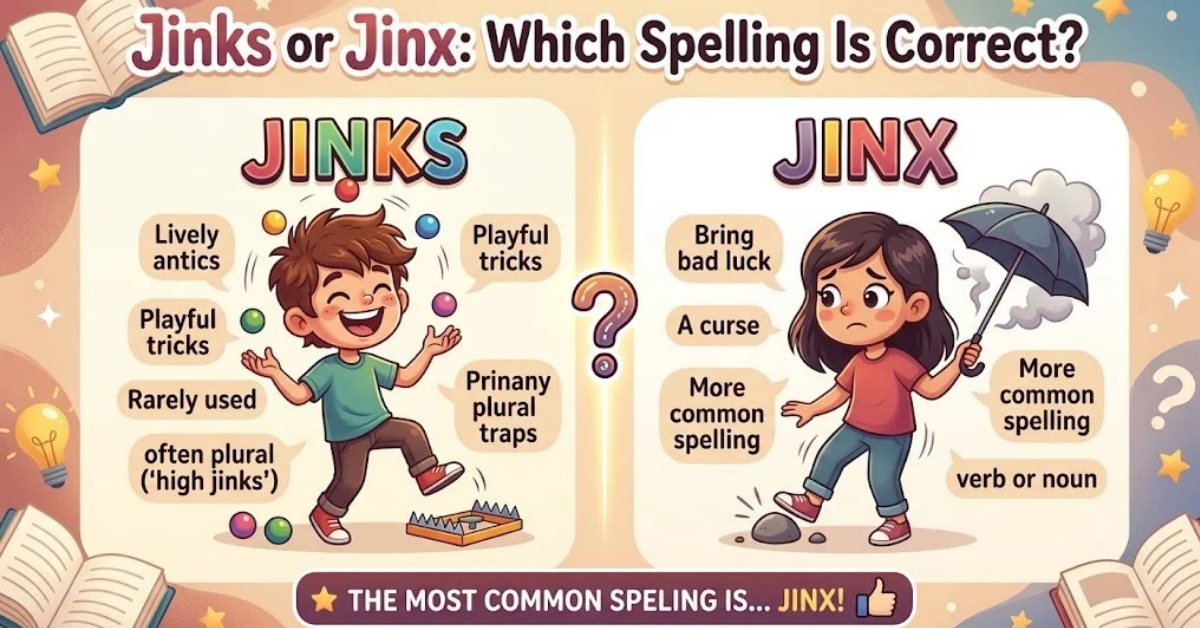
In most situations, jinx is the correct word, especially when referring to bad luck, a supposed curse, or the act of bringing bad luck to someone. Jinks is also a legitimate English word, but it has a different meaning and appears in specific expressions, such as “high jinks.”
Understanding the difference will help you choose the right spelling in everyday conversations, text messages, social media posts, and formal writing.
Jinks or Jinx: Which One Is Correct?
The answer depends on what you want to say. Both jinx and jinks are recognized English words, but they are not interchangeable.
- Jinx: A person, thing, or supposed influence associated with bad luck; also a verb meaning to bring or seem to bring bad luck.
- Jinks: A word most commonly encountered in the expression “high jinks,” meaning playful, noisy, or mischievous behavior.
If you’re talking about bad luck or the familiar game in which two people say the same thing at the same time, use jinx.
If you’re describing lively mischief or playful troublemaking, jinks may be appropriate as part of an established expression.
Examples of Jinx
- Don’t jinx our chances of winning!
- I hope I haven’t jinxed the whole day.
- Everyone thinks that old car is a jinx.
- We said the same thing at the same time. Jinx!
Examples of Jinks
- The children got up to all sorts of high jinks during the party.
- Their weekend was filled with laughter and high jinks.
- The movie features plenty of comic high jinks.
These examples show why the intended meaning matters when choosing between the two spellings.
What Does Jinx Mean?
Jinx is a noun and a verb associated with bad luck or the idea of bringing misfortune.
As a noun, it can refer to a person or thing believed to cause bad luck. As a verb, it means to bring about, or appear to bring about, bad luck.
The word is often used casually rather than literally. People might say someone has jinxed a game simply because that person predicted a victory just before the team started losing.
For example:
We were winning until you said we couldn’t lose. You jinxed us!
The speaker is usually being playful, not claiming that the other person has supernatural powers.
Jinx as a Noun
When used as a noun, jinx identifies the supposed source of bad luck.
Examples:
- That broken watch is my jinx.
- I don’t want to be the jinx of the team.
- She joked that the losing streak was caused by a jinx.
Jinx as a Verb
As a verb, jinx describes the act of supposedly bringing bad luck.
Examples:
- Don’t jinx it!
- I hope I haven’t jinxed our plans.
- He jinxed the match by celebrating too early.
The verb can also appear in different grammatical forms, including jinxed and jinxing.
What Does Jinks Mean?
Jinks is a real English word, although it is much less common as a standalone word than jinx.
Its best-known use is in the expression “high jinks,” which refers to lively, mischievous, or playful behavior. The phrase is often associated with fun, pranks, and lighthearted trouble.
For example:
The friends spent the evening enjoying high jinks at the beach.
This means they were having fun and engaging in playful activities.
You might also see the expression used in stories, entertainment writing, or descriptions of humorous adventures.
What Does “High Jinks” Mean?
“High jinks” means energetic fun, playful mischief, or boisterous behavior.
Examples include:
- The party was full of high jinks and laughter.
- Their holiday adventures involved plenty of high jinks.
- The comedy follows a group of friends and their ridiculous high jinks.
Notice that high jinks does not mean bad luck. That distinction is the easiest way to remember when the spelling jinks is appropriate.
Jinx vs. Jinks: Key Differences
| Feature | Jinx | Jinks |
| Correct English word? | Yes | Yes |
| Main meaning | Bad luck or supposedly causing bad luck | Playful mischief, especially in “high jinks” |
| Part of speech | Noun and verb | Most familiar in a noun expression |
| Common phrase | “Don’t jinx it!” | “High jinks” |
| Everyday usage | Very common | Less common |
| Example | Don’t jinx our chances. | The evening was full of high jinks. |
The main takeaway is simple: use jinx for bad luck and jinks in the expression high jinks.
Why Do People Confuse Jinks and Jinx?
There are several reasons people mix up these words.
1. They Look Almost Identical
The two words differ by only one letter. When typing quickly, it’s easy to substitute one for the other without noticing.
2. They Sound Similar
In many English accents, jinx and jinks sound identical or nearly identical. The final sounds can make it difficult to determine the spelling by listening alone.
3. Both Words Are Real
Unlike many spelling comparisons in which one option is simply incorrect, both words exist in English. This makes context especially important.
4. The Word Is Common in Informal Conversation
People often use jinx jokingly in games, conversations, and social media posts. Since informal speech doesn’t always draw attention to spelling, the confusion can continue when people write the word.
How to Remember the Correct Spelling
If you’re unsure whether to use jinks or jinx, try these simple memory tricks.
For bad luck, use JINX.
Think of the familiar expression:
Don’t jinx it!
If you’re talking about an unlucky situation, a supposed curse, or accidentally spoiling a good outcome, jinx is the word you want.
For mischief, remember HIGH JINKS.
If you’re describing a group of friends laughing, playing pranks, or getting into harmless trouble, remember the expression:
The children were up to high jinks.
Connecting each spelling to a familiar phrase makes it easier to recall the difference.
Is “Jinks” Ever Correct?
Yes. Jinks is not simply a misspelling of jinx. It is a legitimate word, especially in the established expression “high jinks.”
However, if your sentence refers to bad luck, the act of supposedly causing bad luck, or the game played when people say the same word simultaneously, jinx is the appropriate spelling.
Consider these examples:
Incorrect for the intended meaning:
“Don’t jinks our chances of winning!”
Correct:
“Don’t jinx our chances of winning!”
Now compare:
Correct:
“The party was filled with high jinks.”
Replacing jinks with jinx in that expression would change the established spelling of the phrase.
Jinx in Texting and Everyday Conversation
The word jinx is especially common in informal communication.
“Don’t Jinx It!”
This expression means you shouldn’t say something too confidently because you might supposedly bring bad luck or spoil a positive outcome.
Example:
“We’re almost finished with the project!”
“Don’t jinx it. Let’s finish first!”
“Jinx!”
People often say “jinx!” when two people speak the same word or phrase simultaneously. In some versions of the game, the person who says it first wins, and the other person must follow a playful rule.
The rules vary among friends and families, so there is no single universal version.
“I’ve Been Jinxed!”
This expression suggests that a person has experienced a run of bad luck.
For example:
“I’ve missed the bus twice and spilled coffee on my shirt. I’ve been jinxed today!”
In ordinary conversation, the speaker is usually exaggerating for humor.
Is Jinx a Real Curse?
The word jinx is associated with superstition, curses, and bad luck, but saying that someone has jinxed something does not establish that a curse exists.
People often use the word as a figure of speech to describe an unfortunate coincidence or to joke about tempting fate.
For example, someone might avoid saying, “We’re definitely going to win,” because they don’t want to “jinx” the result. This is a familiar social habit, not proof that the words can influence the outcome.
Frequently Asked Questions About Jinks or Jinx
Is it jinks or jinx?
Both are real words, but they have different uses. Jinx refers to bad luck or supposedly causing bad luck, while jinks is most familiar in the expression “high jinks,” meaning playful mischief.
Is “jinks” a misspelling of “jinx”?
Not always. Jinks is a valid word in expressions such as “high jinks.” However, it is a misspelling if you intend to refer to bad luck or use the verb meaning to bring bad luck.
What does jinx mean in slang?
In informal conversation, jinx often means that someone has supposedly brought bad luck by saying something too confidently. It is also used when two people say the same thing simultaneously.
What does high jinks mean?
High jinks refers to lively fun, playful mischief, or boisterous behavior. For example, “The children got into high jinks at the sleepover” means they were having fun and behaving mischievously.
Is it correct to say “Don’t jinx it”?
Yes. “Don’t jinx it” is a common and grammatically correct expression. It means you shouldn’t tempt fate or speak too confidently about a favorable outcome.
How do you spell jinxed?
The correct spelling is jinxed. It is the past-tense and past-participle form of the verb jinx.
Example: “I hope I haven’t jinxed our chances.”
What is the plural of jinx?
The usual plural noun is jinxes.
Example: “They blamed their losing streak on a series of jinxes.”
Are jinx and jinks pronounced the same?
They are pronounced identically or very similarly in many English accents. This is one reason people confuse the spellings, so it’s best to use the meaning and context to choose the correct word.
Conclusion: Jinks or Jinx?
When comparing jinks or jinx, remember that both spellings are valid English words, but they serve different purposes.
Jinx is the correct choice when you’re talking about bad luck, a supposed curse, or the playful expression “Don’t jinx it!” Jinks is most commonly found in “high jinks,” which describes fun, mischief, and playful behavior.
The next time you’re unsure, think about what you mean. If it’s bad luck, choose jinx. If it’s lively mischief, remember high jinks. Understanding this small distinction will help you write more accurately and confidently.