Have you ever wondered whether to write honey or hunny when texting your partner, posting a romantic caption, or giving someone a sweet nickname? Both spellings appear in everyday conversations, especially online, but they aren’t used in exactly the same way.
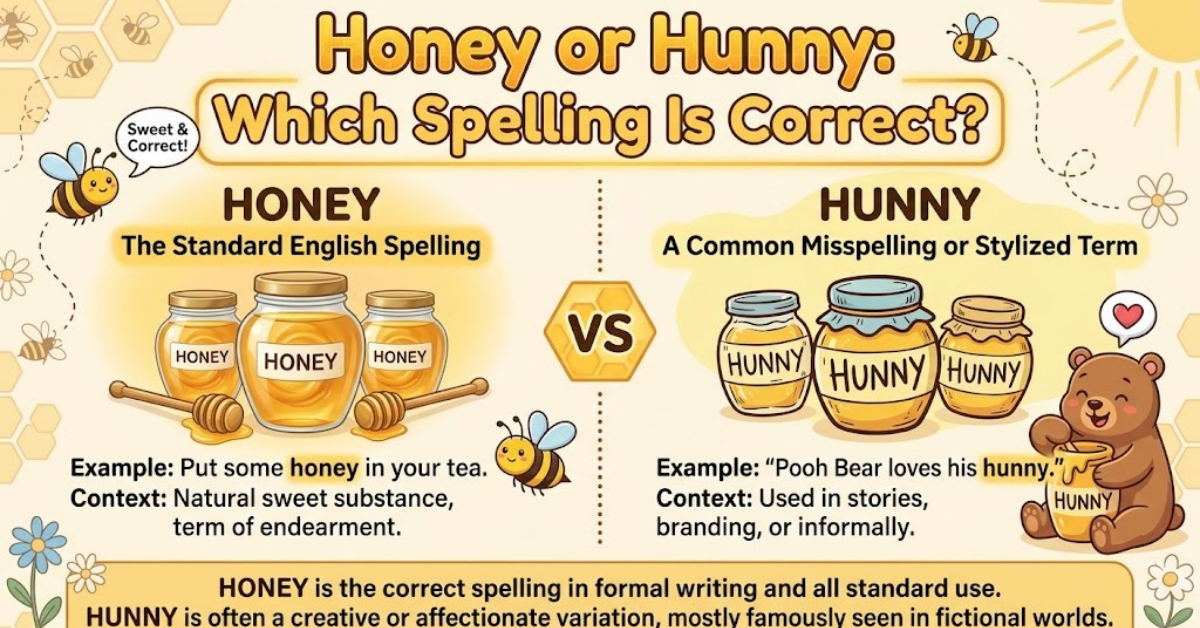
The correct standard English spelling is honey. It refers to the sweet substance made by bees and is also a popular affectionate term for a loved one. Hunny, on the other hand, is an informal, playful spelling often used in text messages, social media posts, and personal nicknames.
So, which one should you choose? It depends on whether you’re writing something formal, expressing affection, or simply adding a playful touch to a message.
Honey or Hunny: Which One Is Correct?
When comparing honey vs. hunny, the main difference is standard spelling versus informal usage.
- Honey: The standard English spelling, appropriate for formal and informal writing.
- Hunny: A nonstandard, playful variant commonly used as an affectionate nickname.
For example:
Correct standard usage: “I added honey to my tea.”
Affectionate usage: “Good morning, honey! I hope you have a wonderful day.”
Playful texting: “I miss you, hunny”
Although hunny is widely understood in casual communication, it isn’t the standard spelling of the word honey. If you’re writing an essay, professional email, recipe, or other formal document, choose honey.
What Does Honey Mean?
The word honey has two common meanings in English.
1. Honey as a Sweet Food
Honey is a naturally sweet substance produced by honeybees from the nectar of flowers. Bees transform and store the nectar in their honeycombs, where it becomes the thick, sweet food people commonly use in cooking and baking.
For example:
- I prefer honey in my tea.
- She drizzled honey over her yogurt.
- This recipe uses honey instead of refined sugar.
In these examples, honey refers to the food.
2. Honey as a Term of Endearment
Honey is also a common term of endearment used to express love, warmth, or affection.
People may call their:
- Romantic partners
- Spouses
- Children
- Close family members
- Friends, depending on the relationship and cultural context
For example:
- “How was your day, honey?”
- “I love you, honey.”
- “Take care of yourself, honey.”
The word can sound romantic, caring, or friendly depending on the speaker, the relationship, and the situation.
What Does Hunny Mean?
Hunny is an informal spelling of honey, most often used as a nickname or affectionate expression.
It generally carries the same meaning as honey, but the altered spelling can make the word feel more playful, cute, personal, or expressive.
For example:
- “Good night, hunny.”
- “You’re my favorite person, hunny.”
- “Happy birthday to my beautiful hunny!”
- “Miss you so much, hunny”
People often choose this spelling because it feels distinctive or suits their texting style. It may also reflect the way they pronounce the word or the personal language they share with someone they love.
However, hunny does not have a separate, universally recognized dictionary meaning that differs from honey in affectionate use.
Why Do People Write Hunny Instead of Honey?
There are several reasons why hunny appears so frequently in digital communication.
1. It Looks Cute and Playful
Changing the spelling of a familiar word can give it a softer or more playful feel. Some people prefer hunny because it looks less formal than honey.
2. It Makes a Nickname Feel Personal
Couples and close friends often develop their own ways of addressing each other. Using hunny can become part of a personal vocabulary that makes their conversations feel special.
3. Social Media Encourages Creative Spelling
On platforms such as Instagram, TikTok, and Facebook, users frequently adjust spellings to create distinctive captions, usernames, and comments.
Words such as luv, bby, and hunny are examples of how informal digital language can differ from standard written English.
4. Popular Culture Has Made It Familiar
The spelling Hunny is also recognizable from Winnie-the-Pooh stories, where the character is famously associated with a sign reading “HUNNY.” This playful spelling has helped make the word familiar to many readers.
Honey vs. Hunny: Key Differences
| Feature | Honey | Hunny |
| Standard English spelling | Yes | No |
| Refers to the sweet food | Yes | Generally no |
| Used as a term of endearment | Yes | Yes |
| Common in text messages | Yes | Yes |
| Suitable for formal writing | Yes | Generally no |
| Playful or personalized style | Sometimes | Often |
The most important distinction is that honey is the standard spelling, while hunny is generally an informal stylistic choice.
Honey or Hunny in Text Messages
When texting someone you care about, either spelling can work. The best option depends on the tone you want to create.
When to Use Honey
Use honey when you want your message to sound natural, familiar, and affectionate without an intentionally playful spelling.
Examples:
- “Good morning, honey. Have a great day!”
- “Thank you for everything, honey.”
- “Are you home yet, honey?”
- “I can’t wait to see you, honey.”
When to Use Hunny
Use hunny when you want a cute, casual, or personalized tone.
Examples:
- “Morning, hunny! Did you sleep well?”
- “You’re my whole world, hunny.”
- “Sweet dreams, my hunny.”
- “Miss you already, hunny”
Neither spelling automatically makes a message more romantic. Your relationship, the words surrounding the nickname, and your usual communication style matter more.
Honey or Hunny for Your Boyfriend or Girlfriend
Both spellings can be used for a romantic partner.
Honey is a familiar, widely accepted term of endearment. It works well in affectionate messages, anniversary cards, love letters, and everyday conversation.
Hunny can feel more playful or personal, especially if your partner already uses that spelling or enjoys cute nicknames.
Here are a few examples:
For your boyfriend:
- “Good morning, honey. I hope your day goes well.”
- “You’re my favorite person, hunny.”
- “Love you more every day, honey.”
For your girlfriend:
- “Good night, my honey. Sweet dreams.”
- “You make every day brighter, hunny.”
- “I’m so lucky to have you, honey.”
There is no universal rule that one spelling is better for a boyfriend or girlfriend. Choose the one that feels natural to both of you.
Is Hunny a Misspelling of Honey?
In standard English, yes. If you are referring to the sweet food produced by bees, the correct spelling is honey, not hunny.
However, language also changes depending on context. In informal messages, nicknames, fictional dialogue, and social media captions, hunny is often an intentional spelling choice rather than an accidental typo.
For example:
Standard usage: “Would you like some honey in your tea?”
Informal nickname: “Thanks for helping me, hunny!”
The first sentence requires the conventional spelling. The second uses a playful variant to communicate affection.
Is Honey More Romantic Than Hunny?
Not necessarily. Both words can communicate affection, warmth, and closeness.
Some people find honey more natural and sincere, while others enjoy the cute, informal feel of hunny. Neither spelling has a universally stronger romantic meaning.
If you’re unsure which one to use, pay attention to how the other person communicates. Matching their preferred nickname or spelling can make your message feel more thoughtful.
It’s also worth remembering that honey can be used in nonromantic situations. Depending on the speaker and context, it may express friendliness, reassurance, or familiarity rather than romantic interest.
Honey, Hunny, or Hun: What’s the Difference?
These three expressions are similar, but their spelling and usage differ.
Honey
The standard spelling and a common affectionate nickname.
Example: “I’ll call you later, honey.”
Hunny
An informal, playful variant of honey, often used in texting.
Example: “You’re the sweetest, hunny.”
Hun
A shorter informal term of address that can be friendly, affectionate, or familiar.
Example: “Thanks for your help, hun.”
The word hun can sometimes sound patronizing or overly familiar, especially when used between strangers. Its meaning depends heavily on the situation, relationship, and tone.
Common Mistakes When Using Honey or Hunny
Here are a few things to keep in mind:
- Using hunny in formal writing: Choose honey in professional documents and standard prose.
- Assuming hunny has a different meaning: It generally conveys the same affectionate meaning as honey when used as a nickname.
- Assuming every use of honey is romantic: The word can also be friendly, familial, or conversational.
- Correcting someone’s personal nickname unnecessarily: If someone intentionally uses Hunny as a nickname or username, the spelling may be part of their personal style.
Understanding the context will help you choose the right form without overthinking it.
Frequently Asked Questions
Is it spelled honey or hunny?
Honey is the correct standard English spelling. Hunny is an informal alternative often used as a playful nickname or affectionate term in texts and social media posts.
Is hunny a real word?
Hunny is a recognizable informal spelling, but it is not the standard spelling of honey. It is commonly used creatively in nicknames, online conversations, and popular culture.
Does hunny mean the same thing as honey?
Usually, yes, when the word is used as a term of endearment. Both can express affection, love, or warmth, although hunny often has a more playful appearance.
Should I call my boyfriend honey or hunny?
Either is fine. Choose honey for a familiar, conventional nickname or hunny if you prefer a cute, informal style. You can also ask your partner which one they like.
Is honey a romantic word?
It can be. Couples frequently use honey as a romantic nickname, but parents, relatives, and friends may also use it affectionately. Context determines the meaning.
Why does Winnie-the-Pooh spell honey as hunny?
In the Winnie-the-Pooh stories, “HUNNY” is associated with Pooh’s playful, childlike way of interacting with the world. The spelling is a memorable fictional detail rather than the standard English spelling.
Is hunny appropriate for professional writing?
Generally, no. In business emails, academic assignments, formal articles, and professional documents, use the standard spelling honey when referring to the food or using the conventional word. Save hunny for contexts where its informal or personalized style is appropriate.
Can I use hunny as an Instagram caption?
Yes. Hunny can work well in casual captions, romantic posts, and affectionate messages. If you want a conventional spelling, use honey instead.
Conclusion: Honey or Hunny?
When deciding between honey or hunny, remember that honey is the correct standard English spelling, while hunny is a playful, informal variation commonly used as an affectionate nickname.
If you’re writing about the sweet food made by bees, preparing a professional document, or aiming for standard English, choose honey. If you’re texting your partner, writing a cute caption, or using a personalized nickname, hunny can be perfectly understandable in that informal context.
Ultimately, the choice comes down to purpose and tone. Use the standard spelling when accuracy matters, and enjoy the flexibility of informal language when expressing affection.
Looking for more explanations of confusing words, texting expressions, and everyday English? Explore related spelling and grammar guides to make your writing clearer and more confident.