Have you ever wanted to describe something perfectly clean, flawless, or beautifully maintained but paused to wonder whether the correct spelling is immaculate or emaculate? You’re not alone. English spelling can be tricky, especially when a word sounds different from the way it looks.
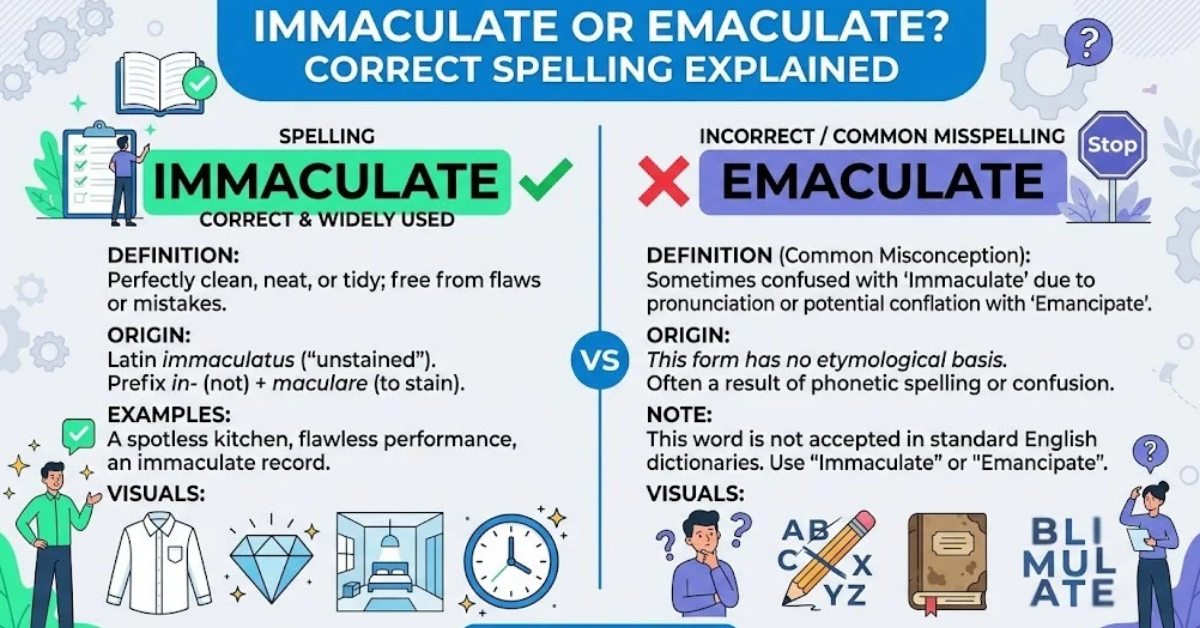
When comparing immaculate or emaculate, the correct spelling is immaculate. The word emaculate is a common misspelling and is not the standard English word used to describe something spotless or without flaws.
Whether you’re writing an email, completing a school assignment, creating website content, or simply improving your vocabulary, knowing the correct spelling will help you communicate more confidently. Let’s explore the meaning of immaculate, how to use it in a sentence, and a few easy ways to remember it.
Immaculate or Emaculate: Which One Is Correct?
Immaculate is the correct spelling. It is an adjective used to describe something that is perfectly clean, exceptionally neat, or free from mistakes and imperfections.
Emaculate, on the other hand, is an incorrect spelling when you intend to use this meaning.
Here is a quick comparison:
- Immaculate: Correct spelling; means spotless, flawless, or exceptionally neat.
- Emaculate: Incorrect spelling of immaculate.
For example:
Correct: Her bedroom was immaculate, with everything neatly arranged.
Incorrect: Her bedroom was emaculate, with everything neatly arranged.
The first sentence uses the standard English spelling. If you want to describe a clean room, a flawless appearance, or carefully maintained surroundings, always choose immaculate.
What Does Immaculate Mean?
The word immaculate means completely clean, spotless, or free from imperfections. Depending on the context, it can describe physical cleanliness, excellent presentation, or something that appears flawless.
For example, an immaculate kitchen has clean surfaces and neatly arranged items. An immaculate suit looks perfectly maintained, while an immaculate performance contains few or no noticeable mistakes.
The word can also have a religious meaning, particularly in Christian traditions, where it is associated with freedom from sin or spiritual purity.
Here are some common uses of immaculate:
- Cleanliness: The hotel room was immaculate.
- Appearance: He arrived wearing an immaculate white shirt.
- Organization: Her notes were immaculate and easy to follow.
- Performance: The goalkeeper delivered an immaculate performance.
- Condition: The classic car remained in immaculate condition.
- Religious context: The Immaculate Conception is a specific Catholic doctrine.
Although these uses share the idea of purity or perfection, the precise meaning depends on the sentence.
Why Do People Confuse Immaculate and Emaculate?
The confusion between immaculate and emaculate often comes from pronunciation, unfamiliarity with the word, and the way people remember spelling patterns.
1. The Beginning of the Word Sounds Unfamiliar
When people hear immaculate in conversation, they may not immediately recognize the first syllable. Some assume the word begins with an e, resulting in the misspelling emaculate.
However, the correct word begins with im-.
2. English Spelling Is Not Always Predictable
English contains many words whose spelling cannot be reliably determined from pronunciation alone. When someone encounters an unfamiliar word, it is easy to substitute a more familiar letter combination.
The best way to avoid this mistake is to learn the word’s standard spelling and see it used in context.
3. Typing Errors Can Become Habits
A person may accidentally type emaculate once and continue using it without realizing the error. Spell-checking tools can help, but they do not always identify every mistake, especially when proper names or unusual terms are involved.
Reading carefully and using a trusted dictionary can prevent these errors from becoming habits.
How to Remember the Correct Spelling of Immaculate
Remembering the spelling becomes easier when you connect the word with its meaning.
Use the “IM” Memory Trick
The correct spelling begins with IM, not EM:
I-M-M-A-C-U-L-A-T-E
A simple memory aid is:
“Immaculate means immaculate perfection.”
Notice the double m near the beginning. Remembering both the initial im- and the double m can help you avoid the common misspelling.
Break the Word Into Parts
You can also practice spelling the word in smaller sections:
Im + mac + u + late = immaculate
Repeat the word aloud while looking at its written form. This helps connect its pronunciation with its spelling.
Use It in a Sentence
Writing the word in context is another effective strategy.
For example:
- The kitchen was immaculate.
- Her handwriting was immaculate.
- The car was kept in immaculate condition.
The more often you encounter and use the correct form, the easier it becomes to remember.
Immaculate in a Sentence: 15 Examples
The following examples demonstrate how immaculate works in everyday English.
- The hotel room was immaculate when we arrived.
- She wore an immaculate dress to the wedding.
- His car is always immaculate, both inside and outside.
- The chef maintained an immaculate kitchen.
- Their garden looked immaculate after hours of careful work.
- The artist’s attention to detail was immaculate.
- She kept her documents in immaculate order.
- The historic building has been preserved in immaculate condition.
- He delivered an immaculate presentation at the conference.
- The restaurant was known for its immaculate service and cleanliness.
- Her handwriting was so immaculate that every word was easy to read.
- The athlete gave an almost immaculate performance.
- The white sneakers looked immaculate despite years of use.
- The house was immaculate before the guests arrived.
- His immaculate appearance made a strong first impression.
These sentences show that immaculate is not limited to cleaning. It can also describe presentation, organization, condition, and performance.
Immaculate vs. Perfect: What’s the Difference?
Immaculate and perfect have similar meanings, but they are not always interchangeable.
Immaculate often emphasizes cleanliness, neatness, precision, or freedom from visible flaws.
Perfect is broader and can describe anything that meets an ideal standard or has no shortcomings.
Compare the following examples:
- The kitchen was immaculate.
This emphasizes that the kitchen was exceptionally clean and tidy. - The solution was perfect.
This suggests that the solution was exactly right or had no flaws. - His suit was immaculate.
This emphasizes its neatness and excellent condition. - It was the perfect day for a picnic.
This means the conditions were ideal for the activity.
In some situations, the words overlap. For instance, an immaculate performance may also be described as a perfect performance.
Immaculate vs. Immaculately
Another common grammar question involves the difference between immaculate and immaculately.
Immaculate is an adjective. It describes a person, place, object, or performance.
Example:
The office was immaculate.
Immaculately is an adverb. It describes how an action is performed or how something appears.
Example:
The office was immaculately maintained.
Here is a quick comparison:
| Word | Part of speech | Example |
| Immaculate | Adjective | She has an immaculate home. |
| Immaculately | Adverb | She keeps her home immaculately clean. |
Use immaculate when describing something directly and immaculately when modifying a verb, adjective, or another adverb.
Synonyms for Immaculate
If you want to expand your vocabulary or avoid repeating immaculate, several alternatives may work depending on the context.
| Synonym | Meaning |
| Spotless | Completely clean |
| Flawless | Without noticeable defects or mistakes |
| Pristine | In an original, fresh, or exceptionally clean condition |
| Impeccable | Without faults, particularly in quality or behavior |
| Unblemished | Free from marks, damage, or imperfections |
| Untarnished | Not damaged or diminished in appearance or reputation |
| Neat | Tidy and well arranged |
| Faultless | Without errors or shortcomings |
| Perfect | Meeting an ideal standard |
| Unspoiled | Not damaged, altered, or degraded |
These words have slightly different meanings, so choose one that matches your intended message.
For example, spotless is especially suitable for cleanliness, impeccable often describes manners or professional standards, and pristine can describe something that appears untouched or exceptionally well preserved.
What Is the Opposite of Immaculate?
The opposite of immaculate depends on the context in which it is used.
When describing cleanliness, suitable antonyms include:
- Dirty
- Messy
- Filthy
- Stained
- Grimy
When describing quality or performance, alternatives include:
- Flawed
- Imperfect
- Faulty
- Defective
- Error-prone
For example, an immaculate room is spotless, while a messy room is disorganized or untidy. Similarly, an immaculate performance may be flawless, while a flawed performance contains mistakes.
Is Immaculate a Formal Word?
Yes. Immaculate is appropriate in both formal and informal English.
In everyday conversation, someone might say, “Your car looks immaculate!” In professional writing, the word can describe a carefully maintained property, a polished presentation, or a high standard of workmanship.
Examples include:
- The property was maintained in immaculate condition.
- The candidate presented an immaculate portfolio.
- The laboratory must remain immaculate to meet cleanliness standards.
Although the word can sound slightly more polished than clean or neat, it is widely understood and does not need to be reserved for formal occasions.
Frequently Asked Questions About Immaculate or Emaculate
Is it immaculate or emaculate?
Immaculate is the correct spelling when describing something spotless, flawless, or exceptionally neat. Emaculate is a misspelling in this context.
What does immaculate mean in simple words?
Immaculate means perfectly clean, tidy, or free from noticeable flaws. For example, an immaculate bedroom is very clean and well organized.
How do you spell immaculate correctly?
The correct spelling is I-M-M-A-C-U-L-A-T-E. Remember that the word starts with im- and contains two consecutive m letters.
Is emaculate a real English word?
Emaculate is not the standard English spelling of the adjective meaning spotless or flawless. If that is the meaning you intend, use immaculate.
What is another word for immaculate?
Common alternatives include spotless, flawless, pristine, and impeccable. The best synonym depends on whether you are describing cleanliness, appearance, performance, or quality.
What is the difference between immaculate and impeccable?
Immaculate often emphasizes cleanliness, neatness, or freedom from imperfections. Impeccable commonly describes something of exceptionally high quality, such as impeccable manners, impeccable service, or impeccable judgment.
Can immaculate describe a person?
Yes. It can describe a person’s exceptionally neat appearance, polished clothing, or carefully maintained presentation. For example, “He looked immaculate in his formal suit.”
What is the opposite of immaculate?
Depending on the context, opposites include dirty, messy, flawed, and imperfect. Use the antonym that best matches the intended meaning.
What does immaculate condition mean?
The phrase immaculate condition describes something that is exceptionally well maintained and shows little or no visible dirt, damage, or wear. It is commonly used when discussing cars, furniture, homes, clothing, and collectibles.
Is immaculate the same as clean?
Not exactly. Clean means free from dirt or unwanted substances, while immaculate usually suggests an especially high standard of cleanliness, neatness, or perfection.
Conclusion: Immaculate or Emaculate?
When choosing between immaculate or emaculate, the correct spelling is immaculate. It means spotless, exceptionally neat, or free from imperfections, and it can describe everything from a clean room to a flawless performance.
The easiest way to remember it is to focus on the opening letters: IM, followed by a double m. With this simple spelling rule and a few examples in mind, you can confidently use immaculate in conversations, schoolwork, professional documents, and online content.
Whenever you are uncertain about a spelling, take a moment to check a reliable dictionary and practice the word in a sentence. Small improvements in spelling and vocabulary can make your writing clearer, more polished, and easier to understand.