Have you ever finished writing a sentence and wondered whether to use afterward or afterwards? Both words look correct, sound almost identical, and appear frequently in everyday English. So, is there actually a difference between them, or is one spelling better than the other?
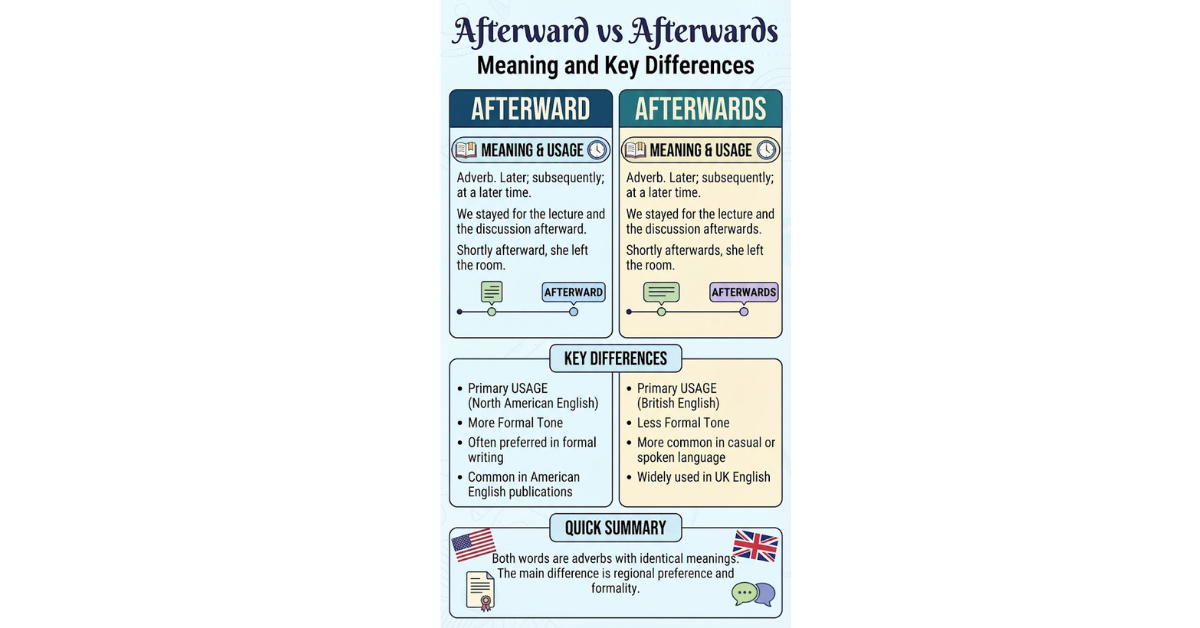
When comparing afterward vs afterwards, the good news is that both are grammatically correct. They have the same meaning and are used to describe something that happens later or following a particular event. The main difference comes down to regional English preferences: afterward is more common in American English, while afterwards is generally preferred in British English.
Understanding this small distinction can help you write more naturally, whether you’re preparing an academic assignment, sending a professional email, or creating everyday content. Let’s look at their meanings, usage, examples, and regional differences.
Afterward vs Afterwards: Which One Is Correct?
Both afterward and afterwards are correct English spellings. Neither is grammatically wrong, and both function as adverbs of time.
The difference is primarily regional rather than grammatical.
- Afterward: More commonly used in American English.
- Afterwards: More commonly used in British English.
For example:
- American English: “We went out for dinner afterward.”
- British English: “We went out for dinner afterwards.”
Both sentences communicate exactly the same thing. The choice depends largely on your preferred English variety and the consistency of your writing.
| Word | Correct Spelling? | Common Usage |
|---|---|---|
| Afterward | Yes | American English |
| Afterwards | Yes | British English |
Quick tip: If you’re writing for an American audience, choose afterward. If you’re following British English conventions, afterwards is usually the more natural choice.
What Does Afterward Mean?
The word afterward means at a later time or following a particular event, action, or situation. It tells readers that something happens after something else.
It is an adverb that helps establish the order of events in a sentence.
For example:
“She completed her homework and watched television afterward.”
In this sentence, afterward indicates that watching television happened after completing the homework.
You can use the word in several everyday situations, including:
- Describing what happens after a meeting.
- Explaining activities following a meal.
- Discussing events that occur after a particular decision.
- Narrating a sequence of events in a story.
- Describing what someone does after completing a task.
Examples of Afterward in Sentences
Here are some examples showing how to use afterward naturally:
- “We visited the museum and went shopping afterward.”
- “He apologized for his behavior afterward.”
- “I had a busy morning, so I took a nap afterward.”
- “The students discussed the assignment afterward.”
- “She felt much better after speaking with her friend afterward.”
The last example can be simplified to avoid repetition: “She felt much better after speaking with her friend.”
These examples demonstrate that afterward refers to an event or action that takes place later.
What Does Afterwards Mean?
Afterwards has exactly the same meaning as afterward. It refers to a time following an event, activity, or situation.
The additional letter s does not change the word’s meaning, pronunciation, or grammatical function.
For example:
“We had lunch and went for a walk afterwards.”
This sentence means that the walk happened after lunch.
The word is especially common in British English and is frequently used in conversations, books, newspapers, and other forms of writing.
Examples of Afterwards in Sentences
Here are some practical examples:
- “We watched a movie and talked about it afterwards.”
- “She finished her presentation and answered questions afterwards.”
- “They went to the beach and had dinner afterwards.”
- “He visited his grandparents and returned home afterwards.”
- “The doctor examined the patient and explained the results afterwards.”
- “I didn’t understand the lesson at first, but everything became clear afterwards.”
Each sentence uses afterwards to indicate that one event follows another.
What Is the Difference Between Afterward and Afterwards?
The most important thing to remember is that there is no difference in meaning between these two words.
Both are adverbs that describe something happening at a later time. The distinction is based mainly on regional spelling preferences.
Here is a closer comparison:
| Feature | Afterward | Afterwards |
| Meaning | At a later time | At a later time |
| Part of speech | Adverb | Adverb |
| Pronunciation | Same | Same |
| American English | More common | Less common |
| British English | Less common | More common |
| Grammatical correctness | Correct | Correct |
American English vs British English
Regional language conventions explain why both spellings exist.
In American English:
Writers generally prefer afterward. It follows the common American preference for the shorter forms of certain words ending in -ward.
Examples include:
- Toward
- Forward
- Backward
- Upward
- Downward
In British English:
Writers commonly use afterwards. The longer -wards forms are generally more established in British usage.
Examples include:
- Towards
- Forwards
- Backwards
- Upwards
- Downwards
These are preferences rather than strict rules. American writers can use afterwards, and British writers can use afterward without making a grammatical mistake.
Afterward or Afterwards in Academic and Professional Writing
Choosing between afterward and afterwards in formal writing is straightforward. Both are acceptable, but consistency is important.
If you’re writing an academic paper, business report, professional email, or article, follow the spelling conventions required by your institution, publisher, or target audience.
Consider these recommendations:
- American publications: Prefer afterward.
- British publications: Prefer afterwards.
- International publications: Choose one spelling and use it consistently.
- Academic assignments: Follow your university’s preferred English style.
- Business communication: Match the spelling conventions used by your organization.
For example, if you’re preparing an article for an American publication, using afterward throughout the content will help maintain consistency.
However, don’t treat the alternative spelling as an error simply because it is less common in your chosen variety of English.
Afterward vs Afterwards vs After: Understanding the Difference
Another common question is whether after can replace afterward or afterwards.
Although these words are related, they don’t always perform the same grammatical function.
After can function as a preposition, conjunction, or adverb, depending on how it is used. Meanwhile, afterward and afterwards are adverbs.
Compare these examples:
| Word | Example | Explanation |
| After | “We went home after dinner.” | Connects the action to dinner. |
| After | “Call me after you arrive.” | Introduces a dependent clause. |
| Afterward | “We had dinner and went home afterward.” | Indicates what happened later. |
| Afterwards | “We had dinner and went home afterwards.” | Has the same meaning as afterward. |
When Should You Use After?
Use after when referring directly to an event, person, or action.
Examples:
- “She arrived after the meeting.”
- “We went shopping after breakfast.”
- “He called me after finishing work.”
When Should You Use Afterward or Afterwards?
Use either word when you want to refer back to an event without repeating its name.
Examples:
- “We finished breakfast and went shopping afterward.”
- “She completed the exam and relaxed afterwards.”
This distinction makes it easier to choose the appropriate word for your sentence.
Common Mistakes to Avoid When Using Afterward and Afterwards
Although both spellings are correct, writers sometimes use them incorrectly or confuse them with other expressions.
Here are a few mistakes worth avoiding:
1. Assuming one spelling is incorrect
Neither afterward nor afterwards is wrong. Both are recognized English words.
2. Mixing regional spelling conventions unnecessarily
Using both forms in one article isn’t grammatically incorrect, but sticking to one variety improves consistency.
3. Confusing afterward with after
Remember that after can introduce a noun or clause, while afterward and afterwards generally refer to something happening later.
4. Adding unnecessary words
Avoid phrases such as “afterward in the future” when the meaning is already clear. Keep your sentences simple and direct.
5. Assuming the extra S changes the meaning
The additional letter in afterwards does not create a different meaning or grammatical function.
Frequently Asked Questions (FAQs)
1. Is afterward or afterwards grammatically correct?
Both afterward and afterwards are grammatically correct. They have the same meaning and function as adverbs of time. The primary distinction is regional preference.
2. Is afterward American or British English?
Afterward is more commonly associated with American English. American writers generally prefer the shorter spelling, although afterwards is also acceptable.
3. Is afterwards British or American English?
Afterwards is more commonly used in British English. However, it is also understood and accepted in American English.
4. Do afterward and afterwards mean the same thing?
Yes. Both words mean at a later time or following a particular event. The additional S in afterwards does not change the definition.
5. Should I use afterward or afterwards in formal writing?
You can use either spelling in formal writing. The best choice depends on your audience and the style guide you’re following. Use afterward for American English and afterwards for British English.
6. Is afterword the same as afterward?
No. Afterword and afterward have completely different meanings. An afterword is a concluding section in a book, usually written by the author or another contributor. Afterward means at a later time.
7. Can I use afterwards at the beginning of a sentence?
Yes. Afterwards can appear at the beginning of a sentence to indicate that something happens later.
For example: “Afterwards, we decided to celebrate at our favorite restaurant.”
The same rule applies to afterward.
8. What are some synonyms for afterward and afterwards?
Depending on the context, you can use several alternatives, including:
- Later
- Subsequently
- Thereafter
- Following that
- After that
- At a later time
These expressions have similar meanings, although some are more formal than others.
Conclusion
When comparing afterward vs afterwards, remember that both spellings are correct and have exactly the same meaning. The main difference is regional usage: afterward is more common in American English, while afterwards is generally preferred in British English.
Neither spelling is grammatically superior, so your choice should depend on your audience, publication requirements, and preferred writing style. The most important thing is to remain consistent throughout your content.
If you’re unsure which version to choose, use afterward for American English and afterwards for British English. You can also explore other commonly confused English words to strengthen your vocabulary and make your everyday writing more accurate and confident.