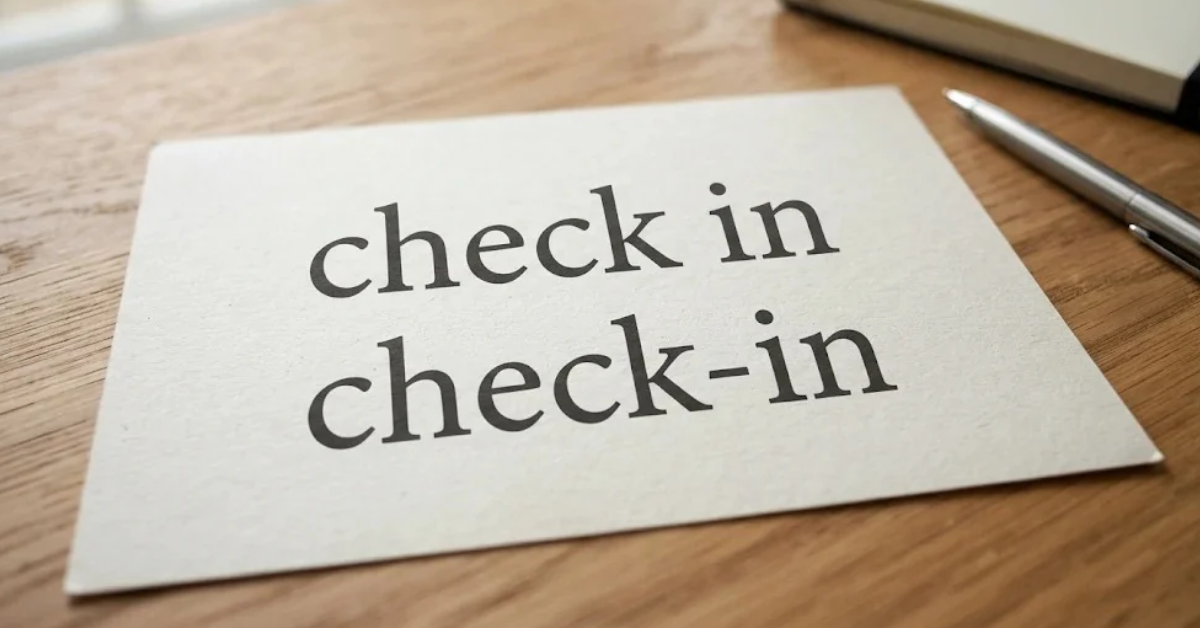
Have you ever paused while writing an email or travel message to wonder whether it should be check in or check-in? You’re not alone. Both forms are correct, but they serve different grammatical purposes.
The difference between check in vs check-in is simple once you understand how each one works. Check in is a verb phrase that describes an action, while check-in is a hyphenated noun or adjective. Choosing the right form makes your writing clearer and helps you avoid a common English grammar mistake.
Let’s look at their meanings, differences, examples, and everyday uses.
Check In vs Check-In: What Is the Difference?
The main difference between check in and check-in is their grammatical function.
- Check in: A verb phrase that describes the action of registering your arrival, confirming your presence, or contacting someone to share an update.
- Check-in: A hyphenated noun or adjective that refers to the registration process, an appointment, or something related to checking in.
In other words, you check in when you perform an action, but you complete a check-in when referring to the process or event itself.
Consider these examples:
- Verb: We need to check in at the hotel before 3 p.m.
- Noun: Hotel check-in begins at 3 p.m.
- Adjective: Please visit the hotel check-in desk.
Notice how the meaning stays closely related, but the spelling changes depending on how the expression is used.
What Does Check In Mean?
Check in is a phrasal verb made up of the verb check and the particle in. It generally means to register your arrival, report your presence, or make contact with someone.
It is commonly used when discussing hotels, airports, workplaces, appointments, and everyday communication.
1. Check In Means to Register Your Arrival
One of the most familiar uses of check in is when arriving at a hotel, airport, or another location where registration is required.
Examples:
- We should check in at the hotel before going sightseeing.
- Passengers must check in at least two hours before departure.
- I checked in at the reception desk when I arrived.
- You can check in online before reaching the airport.
In these examples, check in describes something a person does.
2. Check In Means to Contact Someone
The phrase can also mean getting in touch with someone to ask how they are doing or provide an update.
For example:
- I’ll check in with my manager tomorrow.
- She called to check in on her parents.
- Let’s check in with the team before making a decision.
- I wanted to check in and see how you’re feeling.
This usage is especially common in workplaces, friendships, and family conversations.
3. Check In Means to Report or Confirm Your Presence
In professional or organized settings, check in can mean confirming that you have arrived or are participating in an activity.
Examples:
- All employees must check in when they arrive.
- Please check in with the event coordinator.
- Students need to check in before entering the examination room.
- The delivery driver checked in with the office.
4. Check In Can Be Used as a Transitive Phrasal Verb
Sometimes, check in takes a direct object. This happens when someone registers another person or item.
Examples:
- The receptionist checked us in.
- Please check the guests in when they arrive.
- The airline employee checked in our luggage.
When a pronoun is used as the object, it normally goes between check and in.
- Correct: The receptionist checked us in.
- Incorrect: The receptionist checked in us.
What Does Check-In Mean?
Check-in is the hyphenated form of the expression. It works mainly as a noun or an adjective, rather than as a verb.
Its meaning depends on the sentence, but it usually refers to the registration process, an opportunity to communicate, or something connected with checking in.
1. Check-In as a Noun
When used as a noun, check-in refers to the act or process of registering arrival or confirming presence.
Examples:
- Hotel check-in starts at 3 p.m.
- Online check-in saves passengers time at the airport.
- The check-in took less than five minutes.
- We have a weekly check-in with our supervisor.
- The airline offers mobile check-in for eligible passengers.
Here, check-in names an activity or event rather than describing an action.
2. Check-In as an Adjective
The hyphenated expression can also describe a noun. In this case, it tells readers that something is related to the check-in process.
Examples:
- Where is the check-in counter?
- The hotel has a separate check-in area.
- Please read the check-in instructions carefully.
- We received a check-in confirmation email.
- The check-in procedure was straightforward.
In each sentence, check-in describes another word, such as counter, area, instructions, email, or procedure.
3. Check-In in Workplace Communication
In modern workplaces, a check-in often refers to a short meeting or conversation where people discuss progress, concerns, or upcoming tasks.
For example:
- We have a daily check-in at 9 a.m.
- My manager scheduled a performance check-in.
- The weekly team check-in helped everyone stay organized.
- Let’s arrange a quick check-in next week.
This meaning is particularly common in remote work, project management, and team communication.
Check In vs Check-In: Comparison Table
The following table makes the difference easier to remember.
| Feature | Check in | Check-in |
| Grammar | Phrasal verb | Noun or adjective |
| Spelling | Two separate words | Hyphenated |
| Main purpose | Describes an action | Names or describes a process |
| Example | Check in at reception. | The check-in desk is upstairs. |
| Travel usage | Check in for your flight. | Online check-in is available. |
| Workplace usage | Check in with your manager. | We have a weekly check-in. |
The easiest way to choose between them is to identify the role the expression plays in your sentence.
If you’re describing what someone does, use check in. If you’re naming the process or describing something related to it, use check-in.
When Should You Use Check In?
Use the two-word form when the expression functions as a verb.
Here are some common situations where check in is the correct choice.
When Talking About Hotels
Use check in when describing the action of arriving and registering at a hotel.
Examples:
- We will check in after lunch.
- Did you check in at the hotel?
- Guests can check in from 2 p.m.
- I need to check in before heading to my room.
When Talking About Airports
Use check in when discussing the action of registering for a flight or handing over luggage as part of the airline process.
Examples:
- Passengers should check in before boarding.
- I checked in using the airline’s mobile app.
- We need to check in our bags.
- You can check in online the day before your flight.
When Talking About Work
Use check in when describing an action involving communication or progress updates.
Examples:
- I’ll check in with the project manager.
- We should check in with the client this afternoon.
- My supervisor checks in with every team member.
- Let me check in and confirm the latest details.
When Talking About Friends and Family
The phrase is also useful in casual conversations.
Examples:
- I just wanted to check in and see how you’re doing.
- Please check in when you get home.
- She checks in with her family every weekend.
- I’ll check in on you tomorrow.
When Should You Use Check-In?
Use the hyphenated form when it acts as a noun or adjective.
When Referring to a Registration Process
Examples:
- Check-in opens two hours before departure.
- Hotel check-in is available throughout the afternoon.
- The check-in process was quick and simple.
- Online check-in is recommended.
When Describing a Place or Service
Examples:
- The check-in counter is near the entrance.
- Please visit the check-in desk.
- The airport has a dedicated check-in area.
- We found the hotel check-in facility easily.
When Referring to a Meeting or Conversation
Examples:
- Our weekly check-in is scheduled for Monday.
- I have a quick check-in with my manager.
- The team check-in lasted 15 minutes.
- Let’s schedule a project check-in.
Check In vs Check-In in Travel and Hotels
Travel is one of the most common contexts where people encounter these two spellings.
Although both forms appear frequently in hotel and airline communication, their grammatical roles remain different.
| Sentence | Correct form | Why? |
| We need to ___ at the hotel. | Check in | Verb |
| The hotel ___ process is simple. | Check-in | Adjective |
| When does ___ begin? | Check-in | Noun |
| Passengers must ___ online. | Check in | Verb |
| Where is the ___ counter? | Check-in | Adjective |
A useful way to remember the distinction is to compare these sentences:
- We check in at the airport.
- Airport check-in starts early.
- The check-in counter is open.
- Passengers can check in using their phones.
The first and last examples describe actions. The middle two use check-in to name or describe something.
Check In vs Check-In in Business Emails
The difference also matters in professional writing. Both forms are common in emails, but using the wrong one can make a sentence look less polished.
Examples Using Check In
- I wanted to check in regarding the project.
- I’ll check in with you later this week.
- Could you check in with the client?
- Let’s check in after the meeting.
Examples Using Check-In
- I’d like to schedule a quick check-in.
- Our weekly check-in is set for Thursday.
- Thank you for attending the project check-in.
- The check-in meeting will cover our latest progress.
How to Write a Professional Check-In Email
If you’re sending a short follow-up message, you might write:
Subject: Quick Check-In
Hi Alex,
I wanted to check in and see whether there are any updates on the project. Please let me know if you need anything from my side.
Best,
Sam
Notice the difference within the same email:
- Check-in appears in the subject line as a noun.
- Check in appears in the message as a verb.
This is a practical example of how both forms can be correct in closely related contexts.
Common Mistakes When Using Check In and Check-In
Even though the distinction is straightforward, writers sometimes mix up the two forms.
Here are a few mistakes worth avoiding.
Mistake 1: Using Check-In as a Verb
Incorrect: We need to check-in at the hotel.
Correct: We need to check in at the hotel.
Why? The phrase describes an action, so it should be written as two separate words.
Mistake 2: Using Check In as a Noun
Incorrect: Our weekly check in is scheduled for Friday.
Correct: Our weekly check-in is scheduled for Friday.
Why? The expression names a meeting, making check-in the appropriate form.
Mistake 3: Forgetting the Hyphen in an Adjective
Incorrect: Please go to the check in counter.
Correct: Please go to the check-in counter.
Why? The hyphenated form functions as an adjective describing the counter.
Mistake 4: Writing Checkin as One Word
Incorrect: Online checkin is available.
Correct: Online check-in is available.
Why? In standard English, the noun and adjective forms are normally written with a hyphen.
Mistake 5: Using the Wrong Form in a Workplace Message
Incorrect: I have a quick check in with my manager.
Correct: I have a quick check-in with my manager.
However, if you’re describing the action, write:
Correct: I need to check in with my manager.
The sentence structure determines the spelling.
Is Check-In One Word or Two Words?
The answer depends on how you’re using it.
- Two words: Check in is the verb phrase.
- Hyphenated: Check-in is the noun or adjective.
- One word: Checkin is generally not standard spelling in ordinary English writing.
For example:
- I will check in tomorrow. (Verb)
- Tomorrow’s check-in is scheduled for 10 a.m. (Noun)
- Please visit the check-in desk. (Adjective)
If you remember these three patterns, you’ll be able to use the expression correctly in most situations.
Easy Ways to Remember the Difference
If you regularly confuse check in and check-in, try these simple tricks.
1. Look for an Action
Ask yourself whether someone is doing something.
If the answer is yes, use check in.
Example: I need to check in before the meeting.
2. Look for a Thing or Event
If you’re naming a process, meeting, or service, use check-in.
Example: The check-in is scheduled for tomorrow.
3. Look for a Describing Word
If the expression describes another noun, use check-in.
Example: The check-in desk is near the entrance.
4. Replace It With Another Verb or Noun
Try replacing the expression with a similar word.
- If register or contact fits, you probably need check in.
- If registration or meeting fits, you probably need check-in.
For example:
- I need to register at the hotel. → I need to check in at the hotel.
- Hotel registration begins at 3 p.m. → Hotel check-in begins at 3 p.m.
This quick substitution test can help you make the right choice.
Check In vs Check-In: Practice Quiz
Test your understanding with these sentences. Choose the correct form for each blank.
- We need to ______ at the hotel before 4 p.m.
- The airline offers online ______.
- I will ______ with my manager tomorrow.
- Where is the airport ______ counter?
- Our weekly team ______ is scheduled for Monday.
- Please ______ when you arrive at the office.
- The hotel ______ process was surprisingly quick.
- She called to ______ on her friend.
Answers
- Check in
- Check-in
- Check in
- Check-in
- Check-in
- Check in
- Check-in
- Check in
If you got most of these right, you’ve understood the main difference. Remember that the grammatical role, not the general meaning, determines which spelling to use.
Frequently Asked Questions (FAQs)
1. Is it check in or check-in?
Both are correct, but they have different grammatical functions. Check in is a verb phrase, while check-in is a noun or adjective.
Example: You check in at a hotel, but you use the check-in desk.
2. Is check-in one word or two?
It is written as two words when used as a verb and with a hyphen when used as a noun or adjective. The one-word spelling checkin is generally nonstandard.
3. Should I write check in or check-in at a hotel?
Use check in when describing the action of registering your arrival.
Example: We will check in at the hotel at 3 p.m.
Use check-in when referring to the process or a related place.
Example: Hotel check-in starts at 3 p.m.
4. Is online check-in hyphenated?
Yes. Online check-in is the standard form when referring to the registration process as a noun.
Example: Online check-in is available through the airline’s website.
However, when describing the action, write: You can check in online.
5. Is check-in a noun or an adjective?
It can be both.
As a noun: The check-in took only five minutes.
As an adjective: The check-in desk is on the left.
Its grammatical role depends on how it is used in a sentence.
6. Is check in a phrasal verb?
Yes. Check in is a phrasal verb that commonly means to register an arrival, report your presence, or contact someone.
Example: Please check in with the receptionist.
7. Is check-in hyphenated in American and British English?
Yes. The standard noun and adjective forms are generally hyphenated in both American and British English. The verb form remains two separate words.
8. Is it check in with someone or check-in with someone?
Use check in with someone because the expression functions as a verb.
Example: I need to check in with my supervisor.
If you’re referring to a meeting, use the noun form: I have a check-in with my supervisor.
9. What is the plural of check-in?
The plural noun is check-ins.
Example: The company introduced weekly check-ins for all employees.
10. Is check-in the same as registration?
Not always, but the terms are closely related. Check-in usually refers to registering your arrival or confirming your presence, while registration can describe a broader process of officially recording information or enrolling someone.
Conclusion
Understanding check in vs check-in comes down to one simple grammar rule: use check in as a verb and check-in as a noun or adjective.
For example, you check in at a hotel, complete the hotel check-in process, and visit the check-in counter.
The same distinction applies to airport travel, workplace meetings, professional emails, and everyday conversations. Once you identify whether the expression describes an action or names something, choosing the correct spelling becomes much easier.
Keep this rule in mind when writing your next email, travel message, or workplace update, and explore more grammar guides to strengthen your everyday English.