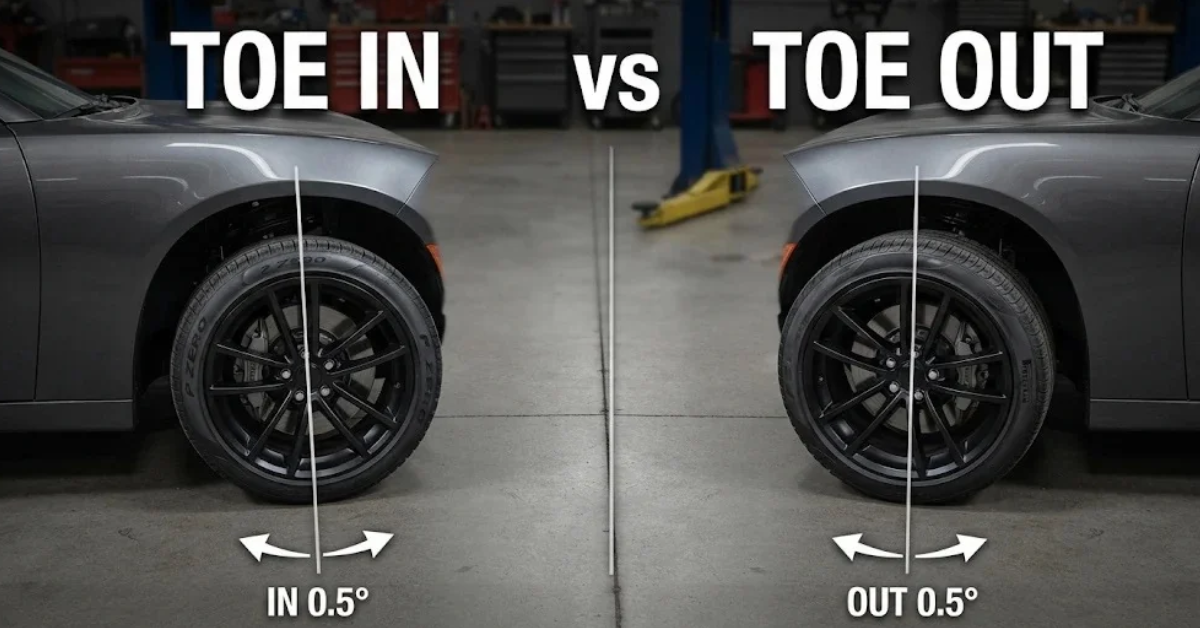
The direction your vehicle’s wheels point can have a surprising effect on how it drives. Even a small difference in wheel alignment can influence steering response, tire wear, and straight-line stability. That’s why understanding toe in vs toe out matters when discussing vehicle alignment, handling, and tire maintenance.
In simple terms, toe-in means the fronts of the tires point slightly toward each other, while toe-out means they point slightly away from each other. Neither setting is automatically better. The right alignment depends on the vehicle’s design, suspension setup, and manufacturer’s specifications.
This guide explains how toe angles work, how they affect driving, and what to know before changing your vehicle’s alignment.
What Is Toe in Wheel Alignment?
Toe is one of the main measurements checked during a wheel alignment. It describes the direction the wheels point relative to each other when viewed from above the vehicle.
Imagine looking down at your car from the ceiling. If the front edges of the two front tires are closer together than their rear edges, the wheels have toe-in. If the front edges are farther apart, the wheels have toe-out.
Toe alignment is usually measured in degrees, millimeters, or inches, depending on the alignment equipment and vehicle specifications.
There are three basic toe conditions:
- Toe-in: The front edges of the tires point toward each other.
- Toe-out: The front edges point away from each other.
- Zero toe: The wheels are parallel to each other when viewed from above.
These measurements may look small, but incorrect settings can make tires scrub against the road instead of rolling in their intended direction.
Toe In vs Toe Out: What’s the Difference?
The main difference is the direction in which the front edges of the wheels point.
What Is Toe-In?
Toe-in, also called positive toe, occurs when the front edges of the wheels are closer together than the rear edges.
Think about standing with your feet slightly turned inward. That’s a simple way to visualize toe-in on a vehicle.
For example, imagine two front tires that are angled slightly toward the vehicle’s centerline. Their front edges are closer together, creating a small inward angle.
Toe-in is used in some vehicle alignment specifications to help account for suspension movement and forces that occur while driving. The correct amount depends on the vehicle’s engineering.
Common characteristics of toe-in include:
- Wheels point slightly toward each other at the front.
- It is commonly represented as positive toe.
- Some vehicle designs use a small amount to achieve the intended driving alignment.
- Excessive toe-in can cause uneven tire wear and increased rolling resistance.
What Is Toe-Out?
Toe-out, also called negative toe, is the opposite alignment condition. The front edges of the wheels point away from each other, making them farther apart than the rear edges.
Imagine standing with your feet slightly turned outward. This gives you a basic picture of toe-out.
On a vehicle, the front wheels are angled outward relative to each other. Depending on the suspension design and alignment settings, this arrangement can influence steering response and cornering behavior.
Common characteristics of toe-out include:
- Wheels point away from each other at the front.
- It is commonly represented as negative toe.
- Some performance setups use a small amount to influence steering response.
- Excessive toe-out can cause rapid tire wear and poor straight-line behavior.
Toe-In vs Toe-Out at a Glance
| Feature | Toe-In | Toe-Out |
|---|---|---|
| Direction | Front edges point inward | Front edges point outward |
| Common designation | Positive toe | Negative toe |
| Wheel position | Front edges closer together | Front edges farther apart |
| Tire wear when excessive | Often associated with outside-edge wear | Often associated with inside-edge wear |
| Possible handling effect | Can contribute to straight-line tracking, depending on setup | Can make steering response more immediate in some setups |
| Main concern | Excessive inward alignment | Excessive outward alignment |
The important point is that neither setting is universally superior. A vehicle needs the toe measurement specified by its manufacturer, not simply the setting that sounds best for handling.
What Is Zero Toe?
Zero toe means the wheels are parallel when viewed from above. The distance between the front edges of the tires is equal to the distance between their rear edges.
This does not mean the wheels are perfectly aligned in every respect. It only describes their toe angle.
Some vehicles are designed to run close to zero toe because it can reduce unnecessary tire scrubbing and rolling resistance. Others require a small amount of toe-in or toe-out to achieve the intended alignment under normal driving conditions.
The correct setting depends on factors such as:
- Suspension geometry
- Steering system design
- Front-wheel or rear-wheel drive configuration
- Vehicle weight and load
- Suspension movement while driving
- Manufacturer alignment specifications
Zero toe is therefore not automatically the best choice for every car.
How Toe-In Affects Vehicle Handling
Toe-in can influence how a vehicle tracks along a straight road and responds to steering inputs. However, the actual effect depends on the complete suspension setup.
1. Straight-Line Stability
Some vehicles use a small amount of toe-in to help achieve stable tracking under normal driving conditions.
Suspension components and rubber bushings can move slightly when the vehicle accelerates, brakes, or travels over uneven surfaces. Engineers account for these movements when deciding the static alignment specification.
This is one reason an alignment reading should not be changed simply because zero toe appears more logical.
2. Steering Response
Toe-in can influence how quickly the vehicle responds to steering inputs.
Depending on the vehicle, excessive toe-in may make the steering feel less responsive or contribute to tire scrub. However, steering feel is also influenced by caster, tire characteristics, suspension geometry, and other factors.
3. Tire Wear
Too much toe-in can cause tires to wear unevenly. The outside portions of the tread may show increased wear, although the exact pattern depends on the vehicle and other alignment conditions.
A common sign of incorrect toe is feathering, where the tread blocks develop uneven, sawtooth-like edges.
4. Rolling Resistance
When wheels point in different directions instead of rolling along their intended paths, the tires can scrub across the road.
Excessive toe-in can increase this resistance, which may contribute to faster tire wear and reduced efficiency.
How Toe-Out Affects Vehicle Handling
Toe-out can produce different handling characteristics, particularly in vehicles designed for performance driving.
A small amount of toe-out may be used to influence how quickly the front wheels respond when the driver turns the steering wheel. However, the effect is not identical across all vehicles.
1. Quicker Steering Response
Some performance-oriented setups use front toe-out to make the vehicle feel more responsive during initial turn-in.
This can be useful in certain motorsport applications, where drivers want the vehicle to react quickly to steering inputs.
However, more toe-out does not automatically mean better handling. Excessive adjustment can make the vehicle nervous or unstable.
2. Cornering Characteristics
Toe-out can influence how a vehicle behaves when entering a corner.
Depending on the suspension geometry, tire characteristics, and overall alignment, it may contribute to a more responsive steering feel. It can also affect how the vehicle behaves during braking and acceleration.
The final result depends on the complete setup, not toe alone.
3. Tire Wear
Excessive toe-out is commonly associated with increased wear toward the inside portions of the tire tread.
It can also create feathering, where the tread blocks develop uneven edges because the tire is being dragged slightly sideways as it rolls.
4. Straight-Line Driving
Too much toe-out can make a vehicle feel less settled when traveling straight.
The steering may feel nervous, and the tires may scrub against the road. This can increase tire wear and make the vehicle less comfortable to drive.
Toe-In vs Toe-Out: Which Is Better for Tire Wear?
Neither toe-in nor toe-out is automatically better for tire life. What matters most is having the correct alignment for the vehicle.
An excessive toe angle in either direction can cause unnecessary tire wear.
Here’s a general comparison:
| Alignment condition | Possible tire wear pattern |
| Excessive toe-in | Increased wear toward the outside tread areas |
| Excessive toe-out | Increased wear toward the inside tread areas |
| Incorrect toe in either direction | Feathering or sawtooth tread wear |
| Correct manufacturer specification | Helps minimize unnecessary toe-related tire wear |
Keep in mind that tire wear is not caused by toe alone. Camber, tire pressure, suspension condition, driving habits, and road conditions can also affect how tires wear.
If you notice uneven tread wear, a professional alignment inspection is more useful than assuming the problem is toe-in or toe-out.
Toe-In vs Toe-Out in Front-Wheel and Rear-Wheel Drive Cars
Vehicle drivetrain can influence alignment requirements, but it does not provide a universal rule for choosing toe-in or toe-out.
Front-Wheel Drive Vehicles
In a front-wheel drive car, the front wheels both steer and deliver engine power to the road.
The suspension moves under acceleration and braking, which can influence the effective toe angle. Manufacturers account for these forces when setting alignment specifications.
Some front-wheel drive vehicles use slight toe-in, some use toe-out, and others are designed around near-zero toe.
The correct setting depends on the individual model.
Rear-Wheel Drive Vehicles
In a rear-wheel drive vehicle, the rear wheels provide the driving force while the front wheels handle steering.
Suspension movement and bushing compliance can influence the alignment of both axles. For this reason, rear-wheel drive vehicles may also have specific toe requirements.
It is incorrect to assume that every rear-wheel drive car needs toe-in or that every front-wheel drive car needs toe-out.
Always follow the manufacturer’s specifications.
What Is Front Toe vs Rear Toe?
Toe measurements apply to both the front and rear wheels, although their adjustment options vary by vehicle.
Front Toe
Front toe describes the direction of the front wheels relative to each other and the vehicle’s centerline.
It can influence:
- Steering response
- Straight-line tracking
- Steering-wheel position
- Front tire wear
Technicians commonly adjust front toe using the steering linkage or tie rods, depending on the vehicle’s design.
Rear Toe
Rear toe describes the direction of the rear wheels relative to each other and the vehicle’s centerline.
It is important because the rear wheels help determine the direction in which the vehicle travels.
Incorrect rear toe can contribute to:
- Uneven rear tire wear
- Poor tracking
- A steering wheel that appears off-center
- A vehicle that seems to travel slightly sideways
Some vehicles have adjustable rear toe, while others require different repair procedures if the measurement is outside specifications.
A four-wheel alignment checks the relationship between all four wheels rather than focusing only on the front axle.
Individual Toe vs Total Toe: What’s the Difference?
When looking at an alignment report, you may encounter the terms individual toe and total toe.
They are related, but they describe different measurements.
Individual toe measures the direction of one wheel relative to the vehicle’s reference line or thrust line.
Total toe is the combined toe measurement of both wheels on the same axle.
For example, a technician may measure the left and right front wheels separately and then calculate their combined toe value.
Both measurements matter because a vehicle can have an acceptable total toe reading while the individual wheel positions are not properly centered.
This is one reason professional alignment equipment checks more than a single number.
Signs Your Vehicle May Have Incorrect Toe Alignment
You don’t need to understand every alignment measurement to recognize when something may be wrong.
Several symptoms can suggest that your vehicle needs an alignment inspection.
1. Uneven Tire Wear
One of the most noticeable signs is uneven tire tread wear.
Look for:
- More wear on the inside or outside tread areas
- Feathered or sawtooth-like tread blocks
- Uneven wear between the left and right tires
- Tires wearing faster than expected
These signs can indicate incorrect toe, but other alignment or suspension problems may produce similar patterns.
2. Steering Wheel Is Off-Center
If the steering wheel sits slightly to one side while the vehicle travels straight, the alignment may need attention.
Incorrect front or rear toe can contribute to this condition.
3. Vehicle Feels Unstable
A vehicle that feels nervous, wanders, or requires frequent steering corrections may have an alignment issue.
However, tire pressure, worn suspension parts, and other mechanical problems can cause similar symptoms.
4. Tires Make Unusual Noise
Uneven tread wear can sometimes produce humming or other road noise.
If the sound changes with road speed, have the tires and suspension inspected rather than assuming toe alignment is the only cause.
5. Handling Changes After an Impact
Hitting a pothole, striking a curb, or experiencing an accident can affect wheel alignment or damage suspension components.
If the vehicle starts pulling, feels unstable, or develops unusual tire wear afterward, arrange an inspection.
How Is Toe Alignment Measured and Adjusted?
Modern wheel alignment is generally performed using specialized equipment that measures the position of each wheel.
A technician compares the readings with the manufacturer’s recommended specifications.
A typical alignment process includes:
- Inspecting the tires: The technician checks tire condition, pressure, and visible wear.
- Checking suspension components: Worn or damaged parts may need attention before alignment adjustments.
- Mounting alignment sensors: Equipment is attached to the wheels to measure their positions.
- Reading alignment angles: The machine measures toe, camber, caster, and other relevant values.
- Adjusting toe: The technician uses the appropriate adjustment points, such as tie rods or rear suspension adjusters.
- Checking the final readings: The technician confirms that the measurements meet the vehicle’s specifications.
An alignment machine can show whether the wheels have excessive toe-in or toe-out and help the technician correct the settings accurately.
Should You Choose Toe-In or Toe-Out for Better Performance?
If you’re modifying a vehicle for better handling, it may be tempting to experiment with toe settings.
However, there is no universal performance setting that works for every car.
A performance vehicle may use a carefully selected amount of front toe-out to influence turn-in response. Another vehicle may benefit from a different setting because of its suspension geometry, tires, weight distribution, and intended use.
Before changing toe settings, consider the following:
- Daily driving: Prioritize the manufacturer’s recommended alignment for predictable handling and tire life.
- Track driving: Use a setup developed for the vehicle, tires, and track conditions.
- Modified suspension: Have the alignment checked after changing suspension components or ride height.
- Tire protection: Avoid excessive toe in either direction because it can cause rapid tread wear.
- Vehicle safety: Have adjustments made by a qualified alignment technician.
A setup that works on a racing car may be unsuitable for a family sedan or everyday road vehicle.
How to Maintain Proper Toe Alignment
Maintaining correct alignment can help protect your tires and keep your vehicle driving as intended.
Here are some practical habits worth following:
- Check tire pressure regularly. Incorrect pressure can cause uneven wear and affect handling.
- Inspect tire tread. Look for feathering, uneven shoulder wear, and unusual patterns.
- Check alignment after major impacts. Potholes and curbs can affect alignment or suspension components.
- Inspect suspension parts. Worn bushings, tie rods, and ball joints can contribute to alignment problems.
- Follow the vehicle manufacturer’s maintenance guidance. Check the owner’s manual for recommended inspections.
- Get an alignment when symptoms appear. Don’t wait for severe tire damage before investigating unusual handling.
Correct toe alignment is especially important because small errors can create continuous tire scrub over thousands of kilometers.
Frequently Asked Questions (FAQs)
1. What is the main difference between toe-in and toe-out?
Toe-in means the front edges of the tires point toward each other, while toe-out means they point away from each other. Both are wheel alignment settings that affect tire wear and vehicle handling.
2. Is toe-in or toe-out better?
Neither is automatically better. The correct setting depends on the vehicle’s suspension design, drivetrain, and manufacturer’s specifications. Using the recommended alignment helps maintain predictable handling and reduce unnecessary tire wear.
3. Does toe-in cause tire wear?
Yes. Excessive toe-in can cause uneven tire wear because the tires scrub against the road instead of rolling straight. It may also create feathering across the tread.
4. Does toe-out improve handling?
A small amount of toe-out can make steering response feel quicker in some performance setups. However, too much toe-out can make a vehicle feel nervous at higher speeds and increase tire wear.
5. What does zero toe mean?
Zero toe means the wheels are parallel when viewed from above. The distance between the front edges of the tires is equal to the distance between their rear edges.
6. What is positive toe?
Positive toe generally refers to toe-in, where the front edges of the wheels point toward each other. It is commonly used in alignment specifications to describe an inward toe angle.
7. What is negative toe?
Negative toe generally refers to toe-out, where the front edges of the wheels point away from each other. It describes an outward toe angle relative to the vehicle’s reference line.
8. Can incorrect toe alignment damage tires?
Yes. Incorrect toe alignment can cause tires to wear unevenly and sometimes much faster than expected. Excessive toe in either direction can create feathering and unnecessary tread wear.
9. How do I know if my car has incorrect toe alignment?
Common warning signs include uneven tire wear, feathered tread, an off-center steering wheel, unusual handling, and a vehicle that wanders or requires frequent steering corrections. A professional wheel alignment inspection can confirm the problem.
10. How often should I check my vehicle’s toe alignment?
Follow your vehicle manufacturer’s maintenance recommendations. It’s also sensible to have alignment checked when replacing suspension or steering components, after a significant pothole or curb impact, or when you notice uneven tire wear or handling changes.
11. Is toe-in better for front-wheel drive cars?
Not necessarily. Front-wheel drive vehicles do not all require toe-in. The correct setting depends on the vehicle’s suspension geometry and engineering specifications, so check the manufacturer’s alignment data.
12. Can I adjust toe alignment myself?
Although some basic adjustments may be possible with mechanical tools, accurate toe alignment requires suitable measuring equipment and knowledge of suspension geometry. A professional alignment service is generally the safer and more reliable option.
Conclusion
Understanding toe in vs toe out makes it easier to see why wheel alignment matters for your vehicle’s handling, stability, and tire life. Toe-in means the front edges of the wheels point toward each other, while toe-out means they point away from each other. Zero toe means the wheels are parallel.
Neither toe-in nor toe-out is universally better. The right setting depends on your vehicle’s design and the manufacturer’s recommended specifications. An incorrect adjustment can lead to uneven tire wear, increased rolling resistance, and less predictable handling.
If your steering feels unusual or your tires are wearing unevenly, consider having your wheel alignment inspected by a qualified technician. Keeping the correct toe setting can help your tires last longer and your vehicle perform as intended.
For more practical automotive guides, explore related articles about camber, caster, tire wear, and wheel alignment.