Have you ever written a sentence and paused to wonder whether grately or greatly is the correct spelling? You’re not alone. These two forms look similar, and because English spelling can be tricky, it’s easy to add an extra letter without realizing it.
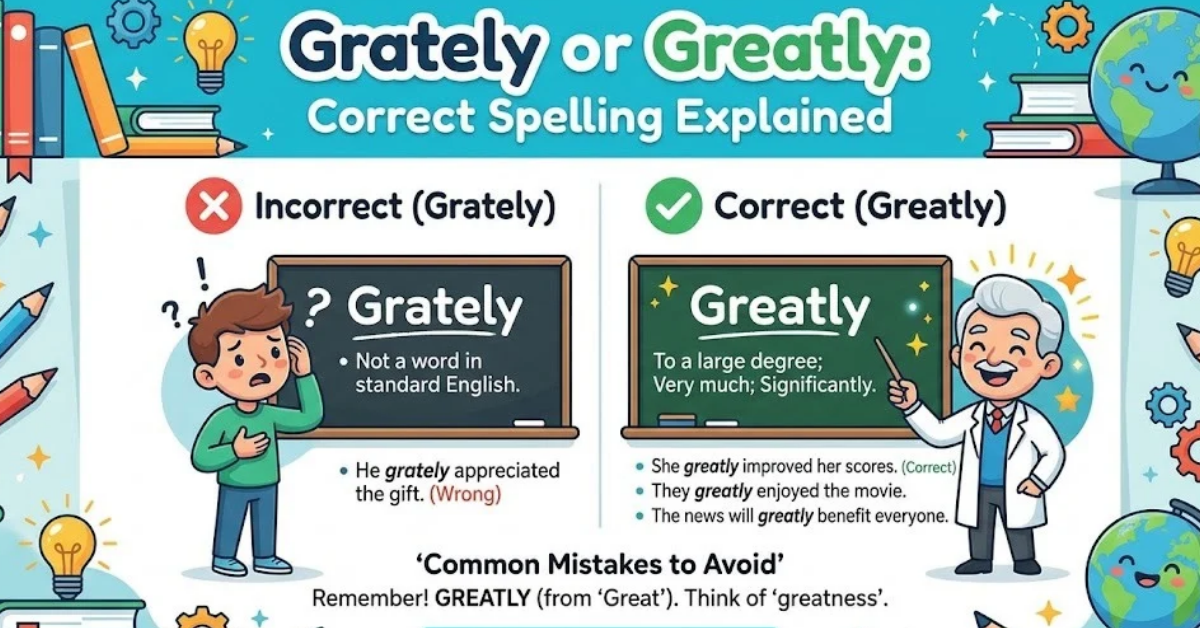
The correct spelling is greatly. The word grately is a common misspelling and is not accepted as the standard spelling of the adverb used to mean “to a large extent” or “very much.”
Whether you’re writing a professional email, completing a school assignment, or creating content online, knowing the difference will help you communicate more clearly. Let’s explore the meaning of greatly, how to use it correctly, and why this spelling mistake happens so often.
Grately vs Greatly: Which One Is Correct?
When comparing grately vs greatly, the answer is straightforward:
- Greatly: The correct English spelling.
- Grately: An incorrect spelling when the intended word is greatly.
The word greatly is an adverb used to describe the degree or extent of an action, feeling, change, or effect.
For example:
Your advice greatly improved my understanding of the subject.
In this sentence, greatly explains how much the advice improved the person’s understanding.
On the other hand, writing “Your advice grately improved my understanding” would be incorrect in standard English.
Remember: If you mean “very much,” “significantly,” or “to a large extent,” use greatly.
What Does Greatly Mean?
Greatly means to a considerable degree, to a large extent, or very much. It is commonly used to emphasize the strength, importance, or magnitude of something.
Here are a few examples:
- Her confidence has greatly improved.
- We greatly appreciate your support.
- The new system greatly reduced waiting times.
- His decision greatly influenced the outcome.
- I was greatly impressed by their performance.
In each example, greatly emphasizes the extent of an action, change, or feeling.
The word appears frequently in everyday conversation, business communication, academic writing, and formal correspondence.
Why Is Grately Incorrect?
The confusion usually comes from the relationship between the adjective great and the adverb greatly.
The correct formation is:
Great + ly = greatly
The final letter of great is t, so adding the suffix -ly produces greatly. There is no additional letter r between the g and the e.
The incorrect spelling grately may look plausible at first glance, but it does not follow the spelling of the word great.
A useful way to remember the difference is to focus on the base word:
- Great
- Greater
- Greatest
- Greatly
All four words retain the same basic spelling of great.
Greatly in a Sentence: Correct Examples
One of the easiest ways to learn the correct spelling is to see it used in different contexts.
1. Greatly in Everyday Conversation
- I greatly appreciate everything you’ve done for me.
- Your kindness has greatly improved my day.
- The weather greatly affected our plans.
- I was greatly relieved to hear the good news.
2. Greatly in Professional Writing
- The new policy greatly improved workplace efficiency.
- We greatly value our customers’ feedback.
- The updated software has greatly reduced processing time.
- Your contribution has greatly benefited the entire team.
3. Greatly in Academic Writing
- The discovery greatly expanded our understanding of the subject.
- Environmental conditions can greatly influence plant growth.
- The results greatly differed from the original predictions.
- Improved access to education can greatly benefit communities.
4. Greatly in Personal Messages
- I greatly appreciate your friendship.
- You have greatly inspired me to keep going.
- Your support has meant a great deal to me.
- I am greatly thankful for everything you’ve done.
The final example is understandable, but “I am very thankful” or “I am deeply grateful” sounds more natural in everyday English.
Greatly vs Great: What’s the Difference?
Although great and greatly share the same root, they serve different grammatical purposes.
Great is usually an adjective. It describes a person, thing, experience, or quality.
Example:
We had a great time at the concert.
Here, great describes the noun time.
Greatly is an adverb. It describes the extent or degree of an action, feeling, or effect.
Example:
We greatly enjoyed the concert.
Here, greatly modifies the verb enjoyed.
The easiest way to remember the distinction is this:
- Great: Describes something.
- Greatly: Explains how much or to what extent something happens.
Greatly vs Gratefully: Are They the Same?
Another spelling confusion involves greatly and gratefully. Although these words look similar, they have different meanings.
Greatly means to a large extent or very much.
Example:
I greatly appreciate your help.
Gratefully means in a thankful or appreciative manner.
Example:
I gratefully accepted her offer.
The distinction becomes clearer when you consider what each word emphasizes. Greatly describes the degree of an action or feeling, while gratefully describes the manner in which something is done.
Compare these sentences:
- I greatly value your friendship.
- I gratefully acknowledge your support.
Both sentences express appreciation, but they use different adverbs for different purposes.
Greatly vs Grateful: Understanding the Difference
The words greatly and grateful are also easy to confuse, particularly when writing about appreciation.
Greatly is an adverb, while grateful is an adjective that describes a feeling of thankfulness.
Examples:
- I greatly appreciate your kindness.
- I am grateful for your kindness.
Both sentences communicate appreciation, but their grammatical structures differ.
You can also combine the words naturally:
I am greatly grateful for everything you have done.
Although grammatically possible, this phrasing sounds awkward and unnecessarily repetitive. A more natural option would be:
I am deeply grateful for everything you have done.
Common Synonyms for Greatly
Depending on the sentence, several words can replace greatly. However, the best choice depends on the intended meaning and context.
| Synonym | Meaning or use | Example |
| Significantly | To an important or noticeable degree | Costs decreased significantly. |
| Considerably | By a substantial amount | The process became considerably easier. |
| Substantially | To a large or meaningful extent | Profits increased substantially. |
| Deeply | Strongly, especially for emotions | I am deeply moved by your kindness. |
| Extensively | Over a wide range or large scope | The topic has been extensively researched. |
| Immensely | To a very great degree | We immensely enjoyed the experience. |
| Profoundly | In a deep or powerful way | The experience profoundly changed her outlook. |
These synonyms are not interchangeable in every sentence. For example, deeply concerned sounds natural, while extensively concerned generally does not.
Choose a synonym that fits both the meaning and tone of your sentence.
How to Remember the Correct Spelling of Greatly
If you frequently confuse grately and greatly, a few simple techniques can help.
1. Remember the Base Word
Start with great and add -ly.
Great + ly = greatly.
This is the most reliable way to remember the spelling.
2. Think of Related Words
Remember the word family:
- Great
- Greater
- Greatest
- Greatly
The shared spelling makes it easier to recognize the correct form.
3. Use a Memory Sentence
Try remembering this sentence:
I greatly appreciate the great things you do.
Both great and greatly appear together, reinforcing the correct spelling.
4. Check the Meaning
If you intend to say “very much,” “significantly,” or “to a large extent,” the word you probably need is greatly.
If a spelling checker flags grately, replace it with greatly unless you are intentionally referring to a proper name or quoting text exactly.
Is Grately Ever a Word?
In ordinary English writing, grately is not the standard spelling of greatly. Most dictionaries and spelling references recognize greatly as the correct adverb.
You might occasionally encounter Grately as a brand name, username, surname, or other proper name. In such cases, its spelling depends on the name itself.
However, if you’re writing a sentence such as “I grately appreciate your help,” the correct wording is:
I greatly appreciate your help.
Frequently Asked Questions
1. Is it grately or greatly?
Greatly is correct. Grately is a misspelling when used as an alternative to greatly.
2. What does greatly mean?
Greatly means to a large extent, considerably, or very much. For example, “The changes greatly improved the service” means the changes improved the service significantly.
3. Why do people spell greatly as grately?
People may confuse the spelling because the words look similar or because they type quickly. Remembering that greatly comes from great can help prevent this mistake.
4. How do you spell greatly?
The correct spelling is G-R-E-A-T-L-Y. A simple way to remember it is to write great first and then add -ly.
5. Is greatly a real word?
Yes. Greatly is a standard English adverb used to describe the degree or extent of an action, feeling, or effect.
6. What is another word for greatly?
Depending on the context, alternatives include significantly, considerably, substantially, immensely, and deeply. For example, “The results improved greatly” could become “The results improved significantly.”
7. Is greatly the same as gratefully?
No. Greatly means to a large extent, while gratefully means in a thankful manner. For example, “I greatly appreciate your help” and “I gratefully accepted your help” express related but different ideas.
8. Can I write “I greatly appreciate it”?
Yes. “I greatly appreciate it” is grammatically correct and commonly used in professional and personal communication. It expresses a strong sense of appreciation.
9. Is “greatly appreciated” correct?
Yes. “Your help is greatly appreciated” is a standard expression that means your help is valued very much.
10. What is the difference between great and greatly?
Great is generally an adjective that describes a noun, as in “a great opportunity.” Greatly is an adverb that describes the degree of an action or effect, as in “The opportunity greatly benefited her career.”
Conclusion: Grately or Greatly?
When choosing between grately or greatly, always use greatly when you mean “very much,” “significantly,” or “to a large extent.” The spelling grately is incorrect for this meaning.
The simplest way to remember the correct form is to start with the word great and add the suffix -ly: great + ly = greatly.
Getting this small spelling detail right can make your writing clearer and more professional. If you’re unsure about another commonly confused English word, explore more spelling and grammar guides to build your confidence and improve your everyday communication.