Some words sound similar or appear in similar contexts, yet they describe very different ideas. That’s exactly what happens with analogy vs allegory. Both are used to communicate meaning beyond a straightforward statement, but they work in different ways.
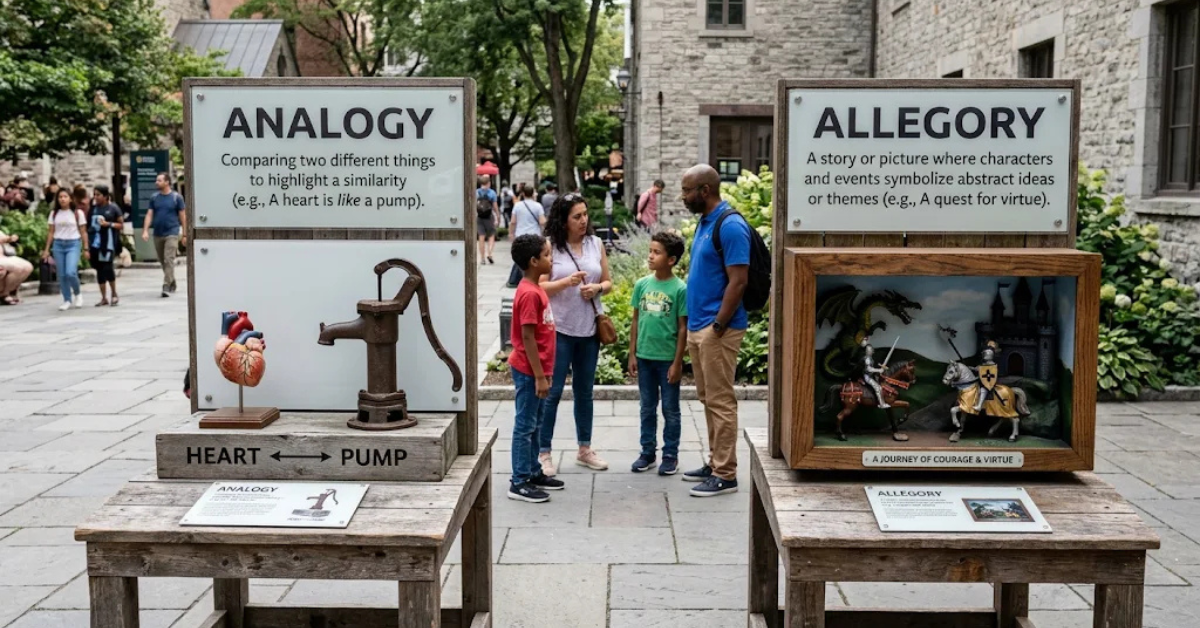
An analogy explains an unfamiliar idea by comparing it with something more familiar. An allegory, on the other hand, is a story, image, or narrative in which characters, events, and details represent deeper meanings, often involving moral, political, or philosophical ideas.
Understanding the difference makes reading, writing, and interpreting literature much easier. Whether you’re studying English, preparing an essay, or simply trying to use these terms correctly, this guide explains both concepts with straightforward definitions and practical examples.
What Is an Analogy?
An analogy is a comparison between two things that are different but share a relevant similarity. Its purpose is to make an idea easier to understand by connecting it to something the audience already knows.
For example:
“Learning a new language is like building a house. You need a strong foundation before adding more complicated structures.”
This sentence compares language learning with house construction. The two activities are not identical, but both involve building knowledge or structure step by step.
Analogies are especially useful when explaining complicated subjects, teaching new concepts, or making an argument easier to follow.
Examples of Analogy
Here are several everyday examples:
- The brain is like a computer: Both process information, store data, and perform different operations, although their actual mechanisms are very different.
- A teacher is like a guide: A teacher helps students navigate unfamiliar knowledge, much like a guide helps travelers find their way.
- The heart works like a pump: This comparison helps explain how the heart moves blood through the body.
- A business is like a team sport: Different people have different responsibilities, but their combined efforts contribute to a shared goal.
- A good argument is like a building: It needs a solid foundation of evidence to support its conclusions.
Notice that each example compares two different things to explain a particular feature or relationship.
Why Do Writers Use Analogies?
Writers, teachers, speakers, and researchers use analogies for several reasons.
1. To explain difficult concepts
A comparison can make an unfamiliar subject easier to understand. For instance, describing electricity as water flowing through pipes gives beginners a simple way to picture electrical current, although the comparison has limitations.
2. To make explanations memorable
People often remember an idea more easily when it is connected to a familiar experience.
3. To strengthen an argument
An analogy can help readers see why two situations may share an important feature.
4. To simplify technical information
Science, education, business, and technology often use analogies to introduce complicated processes to general audiences.
One important point: an analogy is not proof that two things are identical. It highlights a useful similarity while leaving other differences aside.
What Is an Allegory?
An allegory is a story, poem, picture, or other creative work in which characters, events, objects, and settings represent ideas beyond their literal meaning.
Unlike a simple comparison, an allegory usually develops its deeper meaning throughout an entire narrative or composition.
For example, imagine a story about a traveler walking through a dark forest. Along the way, the traveler encounters obstacles, makes difficult choices, and eventually reaches a bright open field.
On the surface, this is a journey through a forest. At a symbolic level, it could represent a person’s struggle with fear, uncertainty, and personal growth.
The story communicates its deeper message through the events and characters rather than explaining everything directly.
Examples of Allegory in Literature
Several well-known literary works help demonstrate how allegory works.
1. Animal Farm by George Orwell
<text color=”secondary” size=”xs”>Literary example</text>
<Entity value=”Animal Farm” category=”book” disambig=”1945 political allegorical novella by George Orwell”/> uses farm animals to represent political figures, social groups, and systems of power.
Although the story follows animals living on a farm, its deeper meaning concerns revolution, political control, propaganda, and the corruption of authority.
The animals and their changing relationships help communicate ideas about real political systems.
2. The Pilgrim’s Progress by John Bunyan
<text color=”secondary” size=”xs”>Literary example</text>
<Entity value=”The Pilgrim’s Progress” category=”book” disambig=”1678 Christian allegory by John Bunyan”/> follows a character named Christian as he travels toward the Celestial City.
His journey represents the Christian spiritual experience, including temptation, faith, struggle, and perseverance.
Many characters and locations have symbolic meanings connected to religious beliefs and moral choices.
3. The Tortoise and the Hare
<text color=”secondary” size=”xs”>Fable example</text>
<text weight=”medium”>The Tortoise and the Hare</text> is a familiar fable traditionally associated with Aesop.
The story describes a race between a slow tortoise and an overconfident hare. The tortoise wins because it continues steadily while the hare becomes careless.
The narrative communicates a moral lesson: consistency and persistence can be more valuable than natural ability combined with overconfidence.
It is a simple example of how a story can communicate a broader lesson through its characters and events.
Why Do Writers Use Allegories?
Allegories allow writers to explore complicated ideas through creative storytelling.
Common purposes include:
- Teaching moral lessons: Characters and events can demonstrate the consequences of good or bad decisions.
- Criticizing society: Writers can discuss political systems, inequality, or corruption indirectly.
- Exploring philosophical ideas: An allegorical story can examine freedom, justice, truth, and human nature.
- Expressing religious beliefs: Characters and journeys can represent spiritual struggles and moral development.
- Encouraging interpretation: Readers can discover deeper meanings beyond the literal plot.
Allegory is particularly effective when a writer wants a story to work on more than one level.
Analogy vs Allegory: Key Differences
The easiest way to understand analogy vs allegory is to remember that an analogy is primarily a comparison, while an allegory is a sustained representation of deeper ideas.
Although both can communicate abstract concepts, their structure and purpose are different.
| Feature | Analogy | Allegory |
|---|---|---|
| Meaning | A comparison between two things | A narrative or composition with a deeper symbolic meaning |
| Main purpose | Explain an idea through similarity | Communicate a broader message through representation |
| Structure | Usually a sentence, example, or extended comparison | Often an entire story, poem, or artwork |
| Main elements | Two related ideas or situations | Characters, events, objects, and settings |
| Interpretation | Focuses on a shared relationship | Requires understanding symbolic meanings |
| Common uses | Teaching, explanations, arguments | Literature, religion, politics, moral storytelling |
| Example | The brain is like a computer | Animal Farm represents political power and corruption |
The Simplest Difference
Consider these two examples:
Analogy: “Life is like a journey because both involve choices, challenges, and unexpected changes.”
This compares life with traveling to explain certain similarities.
Allegory: A story follows a traveler who crosses mountains, faces dangerous obstacles, meets helpful strangers, and eventually reaches a destination representing personal fulfillment.
The second example uses an entire journey to communicate a deeper message about life.
That’s the central distinction: an analogy explains through comparison, while an allegory develops meaning through symbolic representation.
Analogy vs Allegory vs Metaphor
The confusion becomes even greater when metaphor enters the discussion.
Analogy, allegory, and metaphor are related literary and rhetorical concepts, but they are not interchangeable.
What Is a Metaphor?
A metaphor is a figure of speech that describes one thing in terms of another, suggesting that they share a particular quality.
For example:
“Time is a thief.”
Time does not literally steal objects. The metaphor suggests that time takes away moments and opportunities, often without people noticing.
How Are They Different?
| Literary device | Main function | Example |
|---|---|---|
| Analogy | Explains through comparison | Learning is like building a house. |
| Allegory | Uses a narrative or composition to represent deeper ideas | A journey represents spiritual development. |
| Metaphor | Describes one thing as another | Time is a thief. |
An analogy may contain a metaphor, and an allegory may use metaphors throughout its story. However, each term describes a different way of communicating meaning.
Can an Analogy Be an Allegory?
An analogy and an allegory can share a similar subject, but they are not automatically the same thing.
For example, comparing education to a journey is an analogy:
“Education is like a journey because every new lesson takes you somewhere you have not been before.”
Now imagine a complete story about a young traveler who crosses different landscapes. Each location represents a stage of learning, and the traveler gradually develops wisdom through experience.
That longer narrative could function as an allegory.
The difference is not simply the topic. It is how the writer develops the comparison or symbolic meaning.
An analogy can be short and direct, while an allegory usually builds its message through multiple connected elements.
How to Identify an Analogy in a Sentence
Finding an analogy is easier when you look for a comparison that explains a relationship.
Ask yourself these questions:
- Are two different things being compared?
- Do they share a relevant feature or relationship?
- Does the comparison help explain something unfamiliar?
- Is the writer using the similarity to make an idea clearer?
If the answer is yes, the sentence may contain an analogy.
Analogy Examples in Everyday Language
- “Managing a budget is like planning a road trip because both require knowing how much you have and where you want to go.”
- “A strong friendship is like a garden because it needs regular attention and care.”
- “The internet is like a network of roads connecting people and information.”
Each example uses a familiar situation to explain another idea.
How to Identify an Allegory in a Story
Identifying an allegory requires looking beyond the literal events.
A story may appear to be about animals, a journey, a kingdom, or an imaginary world. However, its characters and events might represent real social, political, religious, or philosophical ideas.
Use these steps:
- Look beyond the plot: Ask whether the story has a meaning beyond what happens on the surface.
- Examine the characters: Do they represent particular qualities, groups, or ideas?
- Consider the setting: Could a place represent a larger condition or experience?
- Follow the events: Do the events communicate a consistent message?
- Identify the theme: Is the writer exploring morality, power, freedom, faith, or another abstract idea?
Not every symbolic object or fictional story is an allegory. A sustained pattern of symbolic meaning is usually what makes an allegorical interpretation convincing.
Common Mistakes When Using Analogy and Allegory
Even experienced writers sometimes confuse these terms. Here are a few mistakes worth avoiding.
1. Treating Every Comparison as an Allegory
A sentence comparing two things is not automatically an allegory.
“The classroom is like a garden” is an analogy if the comparison explains how students grow through learning. It becomes part of an allegorical narrative only if a larger work develops the garden as a symbolic representation of education or human development.
2. Assuming Every Symbol Is an Allegory
A symbol is an object, image, character, or action that represents something beyond itself.
A red rose might symbolize love, but including a rose in a story does not automatically make the entire story an allegory.
3. Confusing Metaphors With Analogies
A metaphor makes a direct figurative comparison, while an analogy usually explains a similarity in greater detail.
For example:
- Metaphor: “Knowledge is a light.”
- Analogy: “Knowledge is like a light because it helps people see possibilities they could not recognize before.”
4. Looking for Only One Meaning in an Allegory
Some allegorical works communicate several connected ideas. A story may explore morality, power, social behavior, and human nature at the same time.
Readers should consider the complete narrative rather than forcing every detail into one rigid interpretation.
Analogy vs Allegory: Practice Examples
Want to check whether you understand the difference? Try identifying the literary device in each example.
Example 1: “A good leader is like a captain because both guide a group toward a shared destination.”
Answer: Analogy. The sentence compares leadership with navigation to explain a shared responsibility.
Example 2: A story follows a kingdom where truth is outlawed, dishonest officials control the population, and a young citizen struggles to restore justice.
Answer: Allegory, if the kingdom and its characters consistently represent broader ideas about political power and truth.
Example 3: “Her words were a warm blanket on a difficult day.”
Answer: Metaphor. The sentence describes comforting words through the image of a warm blanket.
Example 4: A fable tells the story of a greedy king who loses everything because he refuses to share his wealth.
Answer: It can function as an allegory or moral fable, depending on how its characters and events represent a broader lesson about greed and responsibility.
The important thing is to look at how meaning is communicated, not just whether the language sounds figurative.
Frequently Asked Questions About Analogy vs Allegory
1. What is the main difference between analogy and allegory?
An analogy compares two different things to explain a similarity. An allegory is a story, poem, or composition in which characters and events represent deeper ideas or messages.
2. Is an analogy a literary device?
Yes. An analogy is a rhetorical and explanatory device used in writing and speech. It helps readers understand an unfamiliar idea through a familiar comparison.
3. Is an allegory a figure of speech?
Not exactly. Allegory is generally considered a literary device or extended symbolic narrative rather than a single figure of speech. It develops deeper meaning through characters, events, and other elements.
4. What is an example of an analogy?
“Learning is like exercising because both improve with consistent practice.”
This is an analogy because it compares learning with physical exercise to explain the importance of repetition and effort.
5. What is an example of an allegory?
George Orwell’s Animal Farm is a well-known example. The story uses farm animals and their political relationships to explore revolution, power, propaganda, and corruption.
6. Can an allegory contain an analogy?
Yes. An allegorical story can include comparisons and analogies within its dialogue or narration. The presence of an analogy does not change the larger work’s allegorical structure.
7. What is the difference between analogy and metaphor?
A metaphor describes one thing as another to suggest a shared quality, such as “Time is a thief.” An analogy explains a similarity more explicitly, often by showing how two relationships or situations work in comparable ways.
8. Is a fable an allegory?
A fable can be allegorical, particularly when its characters and events represent broader human qualities or social ideas. Many fables also communicate a direct moral lesson.
9. Why do writers use allegory?
Writers use allegory to explore complex ideas through storytelling. It can communicate moral lessons, criticize political systems, discuss religious beliefs, or encourage readers to think about society and human behavior.
10. How can I remember analogy vs allegory?
Remember it this way: an analogy explains by comparing, while an allegory communicates through a symbolic story. If you are looking at a comparison between two things, think analogy. If you are interpreting a narrative with deeper symbolic meaning, think allegory.
Conclusion: Understanding Analogy vs Allegory
The difference between analogy vs allegory becomes much easier once you understand how each device communicates meaning.
An analogy makes an idea clearer by comparing it with something familiar. An allegory uses characters, events, settings, and narratives to represent deeper messages about life, society, morality, politics, or religion.
Both are valuable tools for writers and speakers, but they serve different purposes. Use analogies when you want to explain a complicated idea through a relatable comparison. Use allegory when you want to develop a deeper message through storytelling.
The next time you read a poem, novel, speech, or everyday comparison, look beyond the words themselves. Ask whether the writer is explaining a similarity or building a symbolic message. That simple habit will help you recognize these literary devices and use them more confidently in your own writing.