English spelling can be confusing, especially when a simple change in tense requires doubling a letter. One common example is the confusion between stoped or stopped. Both versions may look reasonable at first glance, but only one is accepted as the correct standard spelling in modern English.
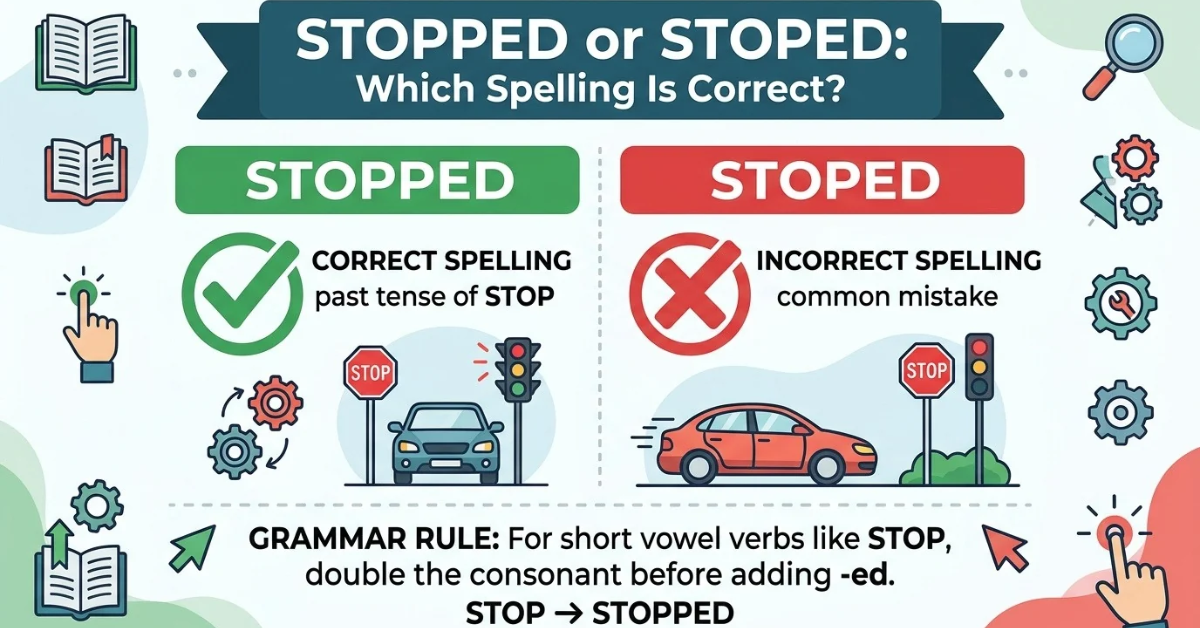
The correct spelling is stopped, with two P’s. It is the past tense and past participle of the verb stop. The alternative spelling, stoped, is a common spelling mistake because people sometimes assume that adding “-ed” to a verb is all that is needed to form its past tense.
In this guide, we will explain why the spelling changes, how the doubling rule works, and how to use the word correctly in everyday writing.
Is It Stoped or Stopped?
The correct spelling is stopped. The word stoped is not the standard past-tense form of the verb stop.
Here is a quick comparison:
| Spelling | Correct? | Explanation |
|---|---|---|
| Stopped | Yes | Correct past tense of stop |
| Stoped | No | Common spelling error |
| Stopping | Yes | Present participle of stop |
| Stops | Yes | Third-person singular form |
| Stop | Yes | Base form of the verb |
For example:
- Correct: She stopped working when the manager arrived.
- Incorrect: She stoped working when the manager arrived.
The important thing to remember is that the final consonant must be doubled before adding the “-ed” ending.
Why Is Stopped Spelled With Two P’s?
The reason comes from an important English spelling rule involving short vowel sounds and final consonants.
When a verb ends in a consonant-vowel-consonant (CVC) pattern, the final consonant is generally doubled before adding a suffix that begins with a vowel, such as “-ed” or “-ing”.
The word stop follows this pattern:
- S = First consonant
- O = Short vowel
- P = Final consonant
When “-ed” is added, the final P is doubled:
Stop + ed = Stopped
This rule helps preserve the short vowel sound in the original word.
Understanding the Consonant Doubling Rule
The same spelling pattern appears in several other common English verbs.
| Base Verb | Past Tense | Present Participle |
|---|---|---|
| Stop | Stopped | Stopping |
| Plan | Planned | Planning |
| Drop | Dropped | Dropping |
| Shop | Shopped | Shopping |
| Clap | Clapped | Clapping |
| Rob | Robbed | Robbing |
| Slip | Slipped | Slipping |
Notice that each verb doubles its final consonant before adding the suffix.
However, this rule does not apply to every verb. For example, verbs ending in two consonants or a vowel combination generally follow different spelling patterns.
What Does Stopped Mean?
Stopped is the past tense and past participle of the verb stop. It describes an action that has ended, an activity that has been interrupted, or movement that has come to an end.
Depending on the context, the word can have several meanings.
1. To End an Activity
When someone stops doing something, they discontinue an action.
Examples:
- He stopped playing video games to finish his homework.
- I stopped drinking coffee because it affected my sleep.
- They stopped working after completing the project.
2. To Bring Movement to an End
The word can also describe a person, vehicle, or object that is no longer moving.
Examples:
- The bus stopped outside the school.
- She stopped her car at the traffic light.
- The train stopped suddenly because of an emergency.
3. To Prevent Something From Continuing
Stopped can also describe an action that prevents an event or process from happening.
Examples:
- The security team stopped the intruder.
- Better planning stopped the project from falling behind.
- The heavy rain stopped the outdoor event.
How to Use Stopped in a Sentence
Understanding the meaning is helpful, but knowing how to use the word in different grammatical situations makes your English more accurate.
Here are some common sentence structures.
Stopped in the Simple Past Tense
Use stopped when describing an action that happened and finished in the past.
Examples:
- She stopped at the grocery store yesterday.
- The children stopped talking when the teacher entered.
- Our company stopped using the old software last year.
Stopped With Has, Have, or Had
The past participle is used with helping verbs to form perfect tenses.
Examples:
- He has stopped smoking.
- They have stopped discussing the issue.
- The machine had stopped working before the technician arrived.
Stopped Followed by an -ing Verb
When describing an activity that someone discontinued, use this structure:
Stopped + verb-ing
Examples:
- She stopped eating junk food.
- I stopped watching television before bedtime.
- They stopped arguing about the decision.
Stopped Followed by To + Verb
This structure has a different meaning. It describes stopping one activity in order to do something else.
Examples:
- He stopped to answer the phone.
- We stopped to take pictures during the journey.
- She stopped to buy some groceries.
There is an important difference between these two constructions:
- He stopped smoking. (He quit smoking.)
- He stopped to smoke. (He paused another activity so he could smoke.)
Understanding this distinction can make your English much clearer.
Stopped vs. Stop: What Is the Difference?
Both words come from the same verb, but they are used in different grammatical situations.
| Word | Grammatical Form | Example |
|---|---|---|
| Stop | Base form | Please stop talking. |
| Stops | Present tense | He stops here every morning. |
| Stopped | Past tense | She stopped yesterday. |
| Stopping | Present participle | They are stopping the vehicle. |
Use stop when talking about the present, future, or an instruction. Use stopped when describing an action completed in the past or when forming perfect tenses.
Common Spelling Mistakes Similar to Stoped
The confusion surrounding this word is part of a larger spelling pattern in English. Many people forget to double the final consonant when adding “-ed” or “-ing”.
Here are some examples worth remembering:
- Planed vs. planned: Planned is the past tense of plan, while planed is a different word related to smoothing a surface with a plane.
- Droped vs. dropped: Dropped is correct.
- Shoped vs. shopped: Shopped is correct.
- Claped vs. clapped: Clapped is correct.
- Sliped vs. slipped: Slipped is correct.
Learning these patterns can help you avoid similar mistakes in emails, school assignments, professional documents, and everyday communication.
Easy Tricks to Remember the Correct Spelling
If you frequently forget how to spell this word, try these simple techniques:
- Remember the double P: The past tense always uses two P’s.
- Think of the base word: Start with stop, identify its short vowel sound, and double the final consonant.
- Practice similar words: Remember examples such as dropped, planned, and slipped.
- Read your writing aloud: Reading can help you identify grammatical errors, although it may not reveal every spelling mistake.
- Use a spelling checker: Tools such as Microsoft Word and Grammarly can help identify incorrect spellings.
A simple memory trick is to remember that when stop meets “-ed”, the P gets a partner.
Frequently Asked Questions (FAQs)
1. Is it stoped or stopped?
Stopped is the correct spelling. It is the past tense and past participle of the verb stop. The spelling stoped is incorrect in standard modern English.
2. Why does stopped have two P’s?
The word follows the consonant-vowel-consonant doubling rule. Because stop ends in a short vowel followed by a single consonant, the final P is doubled before adding “-ed”.
3. Is stoped ever a correct English word?
Stoped is not the standard past-tense spelling of stop. Although it may occasionally appear in old texts, technical contexts, or as a typographical error, you should use stopped in ordinary English writing.
4. Is stopping spelled with one P or two?
The correct spelling is stopping, with two P’s. The final consonant is doubled before adding “-ing”, following the same spelling rule.
5. What is the difference between stop and stopped?
Stop is the base form of the verb, while stopped is its past tense and past participle. For example, “I stop working at six” describes a routine, while “I stopped working at six” describes a completed action in the past.
6. What is the past participle of stop?
The past participle is stopped. It is used with auxiliary verbs such as has, have, and had. For example, “The car has stopped.”
7. Is it stoping or stopping?
Stopping is correct. The final P is doubled before adding “-ing”. The spelling stoping is incorrect when referring to the continuous form of the verb stop.
8. What is the spelling rule for doubling the final consonant?
For many short verbs ending in a consonant-vowel-consonant pattern, the final consonant is doubled before adding a vowel-starting suffix. Examples include stopping, running, planned, and dropped. There are exceptions, particularly with longer words and certain stress patterns.
Conclusion
When deciding between the two spellings, remember that stopped is always the correct standard past-tense form of stop. The alternative spelling is a common mistake that usually happens when writers forget the consonant-doubling rule.
The key lesson is simple: when a short verb ends in a consonant-vowel-consonant pattern, you generally double the final consonant before adding “-ed” or “-ing”.
Whether you are writing an email, completing an assignment, or creating website content, using the correct spelling makes your communication more professional and easier to understand.
If you want to improve your English spelling further, explore more grammar guides covering commonly confused words, verb forms, and everyday writing mistakes.