Have you ever wondered whether to write analog or analogue? Both spellings appear in English, and you may have noticed them in technology articles, product descriptions, books, and everyday conversations. So, which one is actually correct?
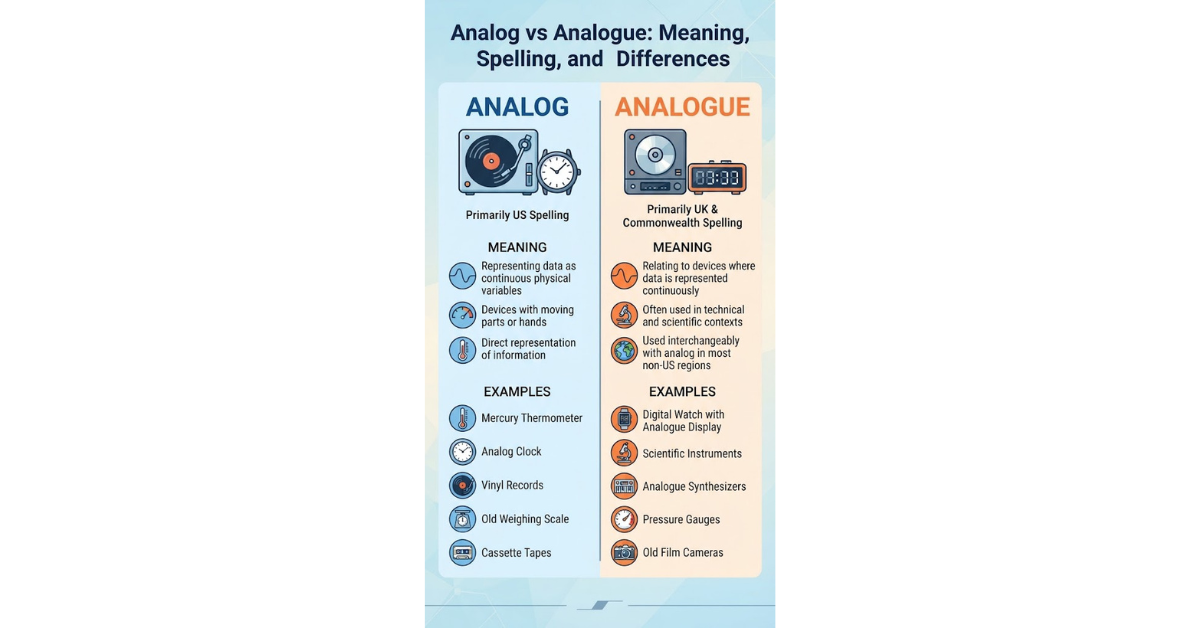
When comparing analog vs analogue, the good news is that both spellings are correct. The main difference comes down to regional English conventions. Analog is the preferred spelling in American English, while analogue is commonly used in British English and other varieties that follow British spelling conventions.
Although the two forms generally have the same meaning, knowing when to use each one can make your writing more consistent and professional. Let’s look at their definitions, pronunciation, examples, and differences in everyday and technical contexts.
Analog vs Analogue: Which Spelling Is Correct?
Both analog and analogue are accepted English spellings. Neither is inherently incorrect, but the appropriate choice depends on your audience and the type of English you’re using.
Here’s a simple comparison:
| Analog | Analogue |
| Preferred in American English | Preferred in British English |
| Common in US technical writing | Common in UK technical writing |
| Used for analog clocks and signals | Used for analogue clocks and signals |
| Standard American spelling | Standard British spelling |
For example:
- American English: “My grandfather still wears an analog watch.”
- British English: “My grandfather still wears an analogue watch.”
Both sentences are grammatically correct and communicate exactly the same idea.
The easiest rule to remember: Use analog when writing for an American audience and analogue when following British English conventions.
What Does Analog or Analogue Mean?
The word analog or analogue has several related meanings, depending on the context.
In technology, it generally describes a system or device that represents information through continuously varying physical quantities, such as electrical voltage, sound waves, or changes in position.
For example, a traditional clock with moving hands is an analog or analogue device because its hands move continuously around the clock face.
The word can also describe something that is comparable to or serves a similar purpose as something else.
Consider these common uses:
- Analog technology: Equipment that processes continuously varying signals.
- Analog clock: A clock that displays time using moving hands.
- Analog signal: A signal that varies continuously over time.
- Analogue comparison: Something that is similar to another thing in function or purpose.
The exact meaning depends on how the word is used in a sentence.
Why Are There Two Spellings: Analog and Analogue?
The difference between analog and analogue comes from the development of American and British English spelling conventions.
British English generally retains the ending “-ogue” in words such as catalogue, dialogue, and analogue. American English often simplifies these endings by removing the final “ue,” producing catalog, dialog, and analog.
Over time, these regional preferences became established in dictionaries, publishing standards, and professional writing.
Here are some other examples of similar spelling differences:
| American English | British English |
| Analog | Analogue |
| Catalog | Catalogue |
| Dialog | Dialogue |
| Monolog | Monologue |
| Epilog | Epilogue |
There is one important detail: not every word ending in “-ogue” follows this pattern in every context. Some American writers still use forms such as dialogue, particularly in literary or specialized writing.
Analog vs Analogue in American and British English
Understanding regional spelling conventions is especially useful when writing for international audiences.
Analog in American English
In the United States, analog is the standard spelling. It appears frequently in technical documentation, educational materials, product descriptions, and everyday communication.
Examples include:
- Analog television
- Analog audio equipment
- Analog watches
- Analog signals
- Analog photography
If you’re writing a blog post, academic paper, or business document for American readers, analog is generally the safest choice.
Analogue in British English
In the United Kingdom, analogue is the traditional and widely preferred spelling. The same convention is common in several other English-speaking regions that follow British spelling standards.
Examples include:
- Analogue television
- Analogue audio equipment
- Analogue watches
- Analogue signals
- Analogue photography
If your audience is primarily in the UK, Australia, or another region that follows British English conventions, analogue is usually the better option.
Which Spelling Should International Writers Use?
If you’re creating content for readers around the world, either spelling can work. However, consistency is more important than switching between regional variations.
Choose one spelling style and follow it throughout your article, website, or publication.
For example, if you use analogue, you may also want to use other British English forms, such as colour, centre, and catalogue, where applicable.
Analog vs Analogue in Technology
One of the most common places you’ll encounter these words is in technology. Both spellings describe the same technological concepts.
What Is Analog or Analogue Technology?
Analog technology uses continuously varying physical signals to represent information. These signals can change smoothly over time rather than being restricted to separate numerical values.
Traditional audio equipment, vinyl records, analog radios, and older television systems are familiar examples.
For instance, an analog audio recording represents sound through continuously changing physical or electrical variations. A digital recording, on the other hand, converts sound into numerical data that can be stored and processed electronically.
Analog vs Digital: What’s the Difference?
Although analog and analogue are spelling variations, analog and digital describe two different ways of representing information.
| Feature | Analog | Digital |
| Signal | Continuously varying | Represented using discrete values |
| Information | Physical signal variations | Numerical data |
| Examples | Vinyl records, analog radios | CDs, MP3 files, digital radios |
| Noise | Can accumulate as signal degradation | Often allows more effective error correction |
| Processing | Uses analog electronic circuits | Uses digital electronic systems |
Neither approach is automatically better in every situation. Analog systems can provide continuous signal representation, while digital systems offer advantages in storage, copying, processing, and error correction.
Examples of Analog and Analogue Devices
Here are some everyday devices that demonstrate the concept:
- Analog clock: Displays time using moving hands.
- Vinyl record player: Uses physical grooves and a stylus to reproduce recorded sound.
- Traditional radio: Can receive and process continuously varying radio signals.
- Mercury thermometer: Displays temperature through changes in the mercury column.
- Film camera: Captures images using light-sensitive photographic film.
These devices are commonly described using either spelling, depending on the regional English standard.
Is Analog or Analogue Pronounced Differently?
No. In ordinary usage, analog and analogue are pronounced the same way.
The commonly used pronunciation is:
AN-uh-log
The final “ue” in analogue does not create an additional syllable or change the pronunciation.
This is why people sometimes find the spelling difference confusing. When speaking, there is no audible distinction between the two forms.
Analog vs Analogue as a Noun and Adjective
Another interesting aspect of these words is that they can be used as both nouns and adjectives, although their grammatical usage depends on the sentence.
Analog or Analogue as an Adjective
As an adjective, the word describes something that operates through continuously varying signals or is comparable to something else.
Examples:
- “I prefer analog photography.”
- “The company uses analogue equipment.”
- “This watch has an analog display.”
- “The researcher identified an analogue system.”
Analogue as a Noun
The spelling analogue is also commonly used as a noun, particularly when referring to something that is comparable to or serves as a counterpart to another thing.
For example:
- “The new treatment is an analogue of an existing medication.”
- “Scientists developed an analogue of the natural environment.”
In this sense, analogue means something comparable or corresponding to another thing.
American English commonly uses analog as an adjective in technological contexts, while analogue remains common as a noun in certain scientific and technical contexts. Usage can vary by discipline and publication style.
Common Mistakes to Avoid When Using Analog and Analogue
Although both spellings are correct, writers sometimes make mistakes when choosing between them.
Here are a few things to keep in mind:
- Mixing regional spellings: Avoid switching between analog and analogue without a reason.
- Assuming one spelling is universally incorrect: Both forms are legitimate English words.
- Confusing analog with digital: These terms describe different methods of representing information, not alternative spellings.
- Ignoring your audience: Choose American or British spelling according to the readers you’re targeting.
- Overlooking technical context: In specialized writing, follow the terminology used by the relevant industry, scientific field, or publication.
A consistent spelling style makes your content easier to read and gives it a more professional appearance.
Frequently Asked Questions (FAQs)
1. Is it analog or analogue?
Both spellings are correct. Analog is preferred in American English, whereas analogue is the standard preference in British English.
2. What is the difference between analog and analogue?
There is generally no difference in meaning or pronunciation. The distinction is primarily regional spelling, with American English favoring analog and British English favoring analogue.
3. Is analogue British or American?
Analogue is primarily associated with British English. It is also used in other English-speaking countries that follow British spelling conventions, including Australia.
4. Is analog American English?
Yes. Analog is the standard American English spelling. It is widely used in American technology, science, education, and everyday writing.
5. How do you pronounce analog and analogue?
Both words are pronounced approximately AN-uh-log. The additional “ue” in analogue does not change how the word is spoken.
6. Is an analog clock or analogue clock correct?
Both expressions are correct. Americans generally write analog clock, while British writers typically use analogue clock. Both refer to a clock that displays time using moving hands.
7. Is analog technology the same as digital technology?
No. Analog technology represents information through continuously varying signals, whereas digital technology represents information using discrete numerical values. Both approaches have different applications and advantages.
8. Why does American English remove the ue from analogue?
American English has developed spelling conventions that simplify certain British word endings. This is why analogue often becomes analog, just as catalogue becomes catalog and dialogue sometimes becomes dialog.
Conclusion
When comparing analog vs analogue, remember that both spellings are correct and have essentially the same meaning. The difference is mainly regional: analog is preferred in American English, while analogue is commonly used in British English.
Both versions appear in discussions about technology, audio equipment, photography, clocks, and scientific concepts. The important thing is to understand your audience and maintain consistent spelling throughout your writing.
If you’re unsure which version to choose, follow the English style guide used by your publication or organization. For more help with commonly confused English words, explore related spelling and grammar guides to keep improving your vocabulary and writing skills.