Have you ever wondered whether to write extensible or extendible? Both words look almost identical, and they share a similar meaning, making it difficult to know which one belongs in your sentence. The good news is that both extensible and extendible are correct English words.
Although they are often used interchangeably, there are some differences in their frequency, context, and preferred usage. Extensible is particularly common in technology and software development, while extendible is frequently used when describing something that can be physically or practically extended.
Understanding extensible vs extendible will help you choose the most appropriate word for academic writing, professional communication, technical documentation, and everyday conversations. Let’s look at their meanings, differences, examples, and usage rules.
Extensible vs Extendible: Which One Is Correct?
Both extensible and extendible are grammatically correct adjectives. Neither spelling is inherently wrong, and both describe something that can be extended, expanded, or made longer.
However, they are not equally common in every context.
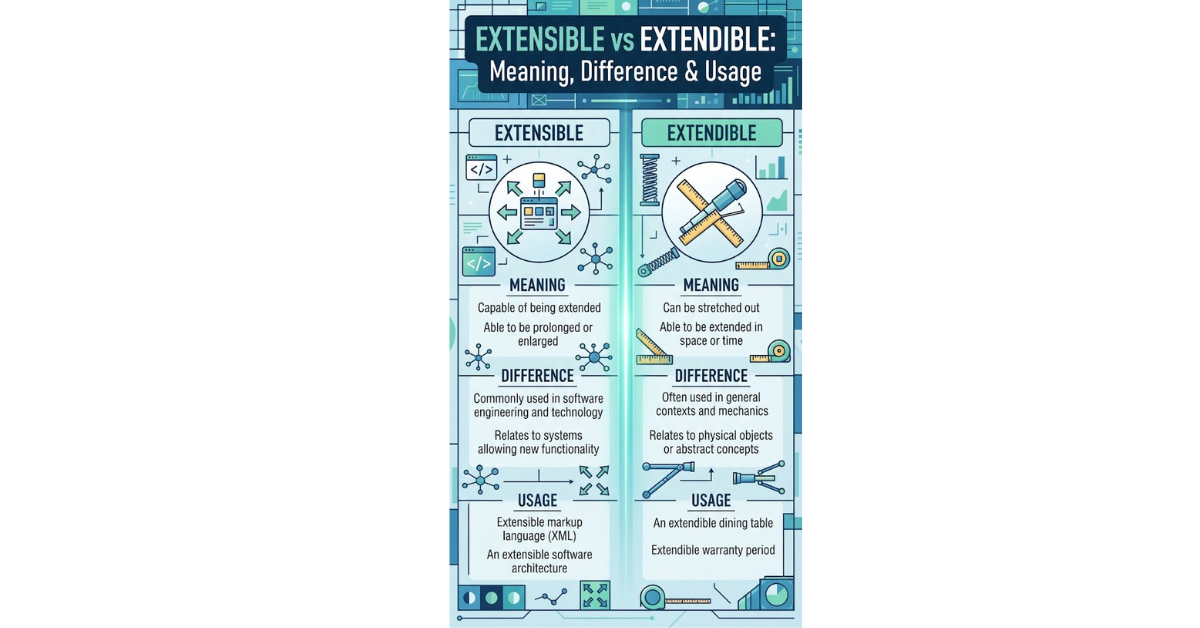
- Extensible: Generally preferred in computing, software engineering, and technical writing. It often describes systems that can accommodate additional features or functionality.
- Extendible: Commonly describes something that can be lengthened, stretched, or expanded. It is also used in technical and general English.
For example:
- “The software uses an extensible architecture that supports additional features.”
- “The dining table has an extendible section that provides extra seating.”
Both sentences use the words correctly, but each word fits a slightly different context.
What Does Extensible Mean?
Extensible is an adjective that describes something designed or capable of being extended, expanded, or modified without requiring a complete replacement.
The word is especially popular in technology because software developers often create systems that allow additional functions, components, or capabilities to be added later.
For example, an extensible software platform may allow developers to install plugins, add integrations, or introduce new features without changing its entire underlying structure.
Examples of Extensible in Sentences
Here are some examples that demonstrate how to use extensible correctly:
- “The company developed an extensible platform that supports third-party applications.”
- “An extensible software architecture makes future upgrades easier.”
- “The programming language offers an extensible framework for developers.”
- “We need an extensible system that can handle future business requirements.”
- “The application uses an extensible design to accommodate additional functionality.”
Common Uses of Extensible
The word extensible frequently appears in the following areas:
- Software development: Systems that support additional features and modules.
- Programming languages: Languages that allow developers to introduce new functionality.
- Technology platforms: Applications that support plugins and integrations.
- Business systems: Solutions that can grow as organizational requirements change.
- Product design: Products that can accommodate additional components or capabilities.
In general, extensible emphasizes the ability to grow or adapt while retaining the existing structure.
What Does Extendible Mean?
Extendible is also an adjective. It describes something that can be extended, lengthened, enlarged, or increased in size, duration, or scope.
The word is often associated with physical objects, structures, and arrangements that can be made longer or larger.
For instance, an extendible dining table can be expanded by adding an extra section. Similarly, an extendible ladder can be lengthened to reach a higher position.
Examples of Extendible in Sentences
Consider these examples:
- “We purchased an extendible dining table for our new home.”
- “The extendible ladder can reach several different heights.”
- “The contract includes an extendible period of six months.”
- “The company designed an extendible support structure.”
- “This extendible hose makes it easier to reach distant areas.”
Common Uses of Extendible
You may encounter extendible in several situations:
- Furniture: Tables that can be expanded to accommodate more people.
- Equipment: Ladders, poles, and other adjustable tools.
- Contracts: Agreements that allow their duration to be extended.
- Structures: Components that can be lengthened or expanded.
- Everyday objects: Items designed to provide additional length or capacity.
The central idea is the ability to extend something beyond its original size, length, or duration.
Extensible vs Extendible: Key Differences
The main difference between these words is their typical usage rather than their basic meaning. Both communicate the idea of being capable of extension, but extensible has a stronger association with adaptability and technical expansion.
Here’s a comparison:
| Feature | Extensible | Extendible |
| Part of speech | Adjective | Adjective |
| Basic meaning | Capable of being extended | Capable of being extended |
| Common context | Technology and software | Physical objects and general usage |
| Common examples | Extensible software, extensible architecture | Extendible table, extendible ladder |
| Grammatical correctness | Correct | Correct |
| General usage | More common in technical contexts | Less common overall in many contexts |
The distinction is not absolute. You may find extendible in technical writing and extensible in descriptions of physical objects. Context and established terminology should guide your choice.
Why Is Extensible More Common in Technology?
If you read software documentation or programming articles, you will probably encounter extensible much more frequently than extendible.
This is because software systems are often designed to support future changes. Developers want applications that can accommodate new features without requiring major modifications to their existing architecture.
For example, consider a content management system that allows users to install additional plugins. Rather than rebuilding the entire platform, developers can add new functionality through these extensions.
This is commonly described as an extensible system.
Examples of Extensible Technology
Some common examples include:
- Extensible architecture: A software structure designed to support additional components.
- Extensible programming language: A language that allows developers to add capabilities or customize its behavior.
- Extensible application: Software that supports plugins, extensions, or integrations.
- Extensible framework: A development framework that allows additional functionality.
- Extensible markup language: A reference to XML, which stands for Extensible Markup Language.
In these examples, extensibility is about adaptability, customization, and future development rather than simply making something physically longer.
Can Extensible and Extendible Be Used Interchangeably?
Yes, in many situations, the two words can be used interchangeably because they share the same basic definition.
However, replacing one with the other may make a sentence sound less natural, especially when a particular industry has an established preference.
For example:
- “The software has an extensible architecture” sounds natural in technical writing.
- “The software has an extendible architecture” is understandable but less conventional.
- “We bought an extendible dining table” sounds natural when describing expandable furniture.
- “We bought an extensible dining table” is grammatically possible, but may sound less familiar to many readers.
The best approach is to consider the subject, audience, and terminology commonly used in your field.
Extensibility vs Extendibility: Understanding the Nouns
The difference also appears in the noun forms of these adjectives.
- Extensibility: The quality or ability of something to be extended, expanded, or modified.
- Extendibility: The quality or ability of something to be extended or lengthened.
Both nouns are valid, although extensibility is particularly established in software engineering and technical discussions.
Examples of Extensibility
- “The extensibility of the platform makes it suitable for growing businesses.”
- “Developers evaluated the system’s extensibility before choosing the framework.”
- “Good extensibility allows applications to support new requirements.”
Examples of Extendibility
- “The extendibility of the table makes it useful for family gatherings.”
- “The product’s extendibility allows users to adjust its length.”
- “The extendibility of the agreement depends on both parties.”
How to Choose Between Extensible and Extendible
If you’re unsure which word to use, follow these simple guidelines:
- Consider the subject: If you’re describing software, applications, programming languages, or digital systems, extensible is generally the better choice.
- Think about physical expansion: If you’re describing something that becomes longer or larger, extendible may sound more natural.
- Check industry terminology: Technical fields sometimes have established terms that should be followed.
- Consider your audience: Choose the word that communicates your meaning clearly without sounding unnecessarily complicated.
- Remain consistent: If you’re writing a technical document, use terminology consistently throughout the content.
Remember, these are practical preferences rather than strict grammatical rules.
Frequently Asked Questions (FAQs)
1. Is extensible or extendible correct?
Both words are correct English adjectives. They describe something that can be extended or expanded, although extensible is more common in technology and software development.
2. What is the difference between extensible and extendible?
The words have essentially the same core meaning, but their typical applications differ. Extensible is frequently used for adaptable software and systems, while extendible often describes physical objects or arrangements that can be lengthened.
3. Is extensible a real word?
Yes, extensible is a recognized English word. It means capable of being extended, expanded, or modified to accommodate additional features or requirements.
4. Is extendible a real word?
Yes, extendible is also a valid English word. It describes something that can be made longer, larger, or more extensive.
5. Is extensible more common than extendible?
Generally, yes. Extensible is especially common in computing, software engineering, and technical documentation. However, both words remain valid, and their frequency depends on the subject and context.
6. What is the noun form of extensible?
The noun form is extensibility. It refers to the ability or quality of something to be extended or expanded, particularly in software and technology.
7. Can I use extensible when describing furniture?
Yes, it is grammatically possible, but extendible or extendable may sound more natural when describing furniture that can be physically lengthened or expanded.
8. What is the difference between extendible and extendable?
Both words describe something that can be extended. Extendable is another common alternative, often used in everyday English, while extendible is a valid but less frequently encountered form.
Conclusion
When comparing extensible vs extendible, the important thing to remember is that both spellings are correct. They share the same fundamental meaning but have different usage preferences depending on the context.
Extensible is generally the preferred choice when discussing software, technology, programming, and systems designed to accommodate future features. Extendible is often a natural choice for physical objects, adjustable equipment, and arrangements that can be made longer or larger.
Neither word is universally better. Choose the one that fits your subject, follows established terminology, and makes your meaning clear. For more helpful explanations of commonly confused English words, explore additional spelling and grammar guides to keep improving your writing.