Have you ever written a sentence and wondered whether the correct spelling is present or presant? You’re not alone. English spelling can be confusing, especially when a word’s pronunciation makes one spelling seem just as reasonable as another.
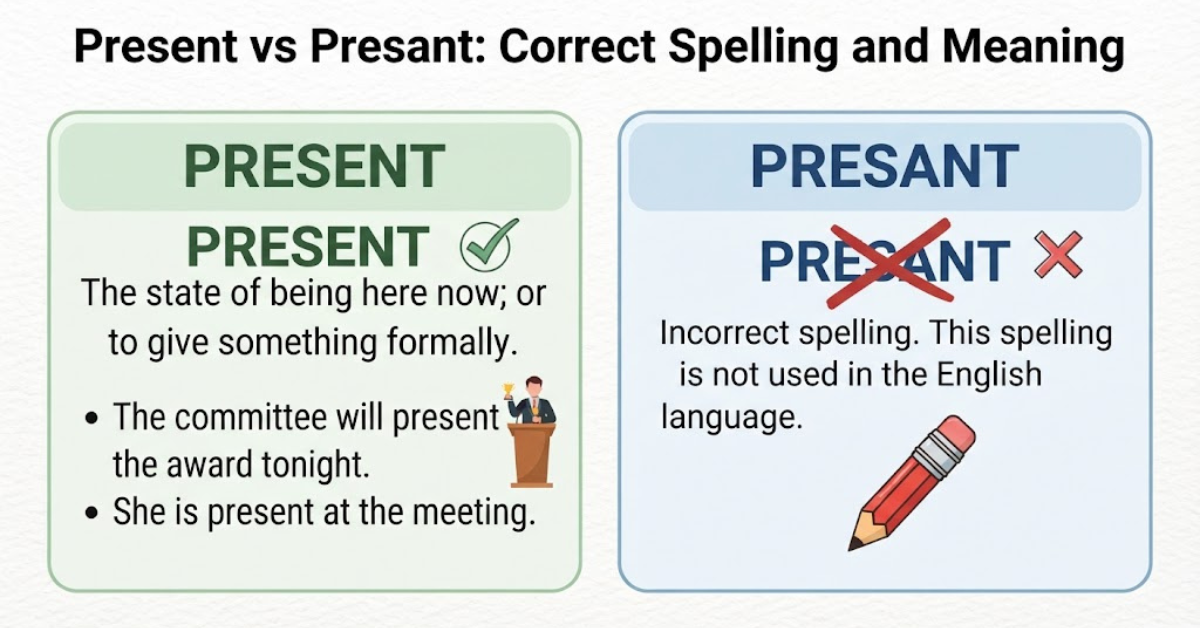
When comparing Present vs Presant, the correct spelling is present. The word presant is a common spelling mistake and is not recognized as a standard English word.
Whether you’re writing a birthday message, preparing a school assignment, or composing a professional email, knowing the difference will help you avoid unnecessary errors. Let’s explore the correct spelling, its meanings, pronunciation, and practical examples.
Present or Presant: Which One Is Correct?
The correct spelling is present, with the letter e in the second syllable.
The incorrect spelling presant replaces that e with an a. Although the two versions may sound similar in some accents, only present is the standard spelling.
Here’s a quick comparison:
| Word | Correct or Incorrect? | Explanation |
| Present | Correct | Standard English spelling |
| Presant | Incorrect | Misspelling of present |
| Presented | Correct | Past tense of present |
| Presenting | Correct | Present participle of present |
| Presentation | Correct | Noun form of present |
Remember: If you’re writing about a gift, the current moment, or introducing something to an audience, use present.
What Does Present Mean?
The word present has several meanings in English. Its meaning depends on how it is used in a sentence.
It can refer to a gift, the current time, someone’s physical presence, or the act of showing or introducing something.
1. Present as a Gift
When used as a noun, present means something given to another person, usually as a gesture of kindness, celebration, or appreciation.
Examples:
- “I bought my sister a birthday present.”
- “He received a beautiful present on his graduation day.”
- “The children were excited to open their Christmas presents.”
In this context, present is a synonym for gift.
2. Present as the Current Time
The word present can also refer to the time happening right now.
Examples:
- “We should focus on the present rather than worry about the past.”
- “The present situation requires careful consideration.”
- “At present, the company is hiring new employees.”
This meaning is commonly used in everyday conversations, academic writing, and professional communication.
3. Present as Being in a Place
When used as an adjective, present can mean being physically in a particular place or attending an event.
Examples:
- “All the students were present during the examination.”
- “The manager was present at the meeting.”
- “Only three members were present at the gathering.”
The opposite of present in this context is absent.
4. Present as an Action
As a verb, present means to show, introduce, offer, or formally give something to someone.
Examples:
- “She will present her research tomorrow.”
- “The teacher presented the students with their certificates.”
- “The company plans to present its new product next month.”
In this usage, present describes an action rather than a person, object, or time.
Why Is Present Often Misspelled as Presant?
The spelling mistake presant usually happens because English pronunciation does not always make vowel differences obvious.
Several factors can contribute to this error.
1. Similar Vowel Sounds
In some accents, the unstressed vowel in present may sound similar to a short “uh” sound. This can make it difficult for learners to determine whether the word contains an e or an a.
However, the correct spelling remains present, regardless of pronunciation.
2. Confusion With Other English Words
English contains many words that use similar vowel sounds but have different spellings.
For example:
- Present
- Pleasant
- Pleasantly
- President
Seeing these words together can sometimes make spelling patterns confusing, particularly for English learners.
3. Typing Too Quickly
People often make spelling mistakes when typing quickly on phones, computers, or other devices.
Because presant looks similar to present, it may go unnoticed during proofreading. Spell-checking tools can help identify such mistakes, but learning the correct spelling is still important.
How to Remember the Correct Spelling of Present
If you frequently confuse present with presant, a simple memory trick can help.
Use the E-for-Everyday Trick
Remember this sentence:
“The present is here, and the present has an E.”
The word present contains the letter e in its second syllable. Whenever you write the word, think about the correct spelling rather than relying entirely on how it sounds.
You can also practice by writing the word in different sentences:
- I bought a present for my friend.
- Everyone was present at the meeting.
- We should enjoy the present.
- She will present her ideas tomorrow.
Practicing the word in different contexts helps reinforce its spelling and meaning.
Present vs Presant: Examples in Sentences
Here are some examples showing how to use present correctly.
| Correct Sentence | Incorrect Sentence |
| I received a birthday present. | I received a birthday presant. |
| She is present in the classroom. | She is presant in the classroom. |
| We should live in the present. | We should live in the presant. |
| He will present his project. | He will presant his project. |
The correct spelling is the same in every example, even though the meaning changes.
Present vs Presentation: What’s the Difference?
Although present and presentation are related words, they serve different grammatical purposes.
| Word | Part of Speech | Meaning | Example |
| Present | Noun | A gift | “I bought a present.” |
| Present | Verb | To show or introduce | “She will present the report.” |
| Present | Adjective | Existing or attending | “He was present.” |
| Presentation | Noun | An organized explanation or display | “The presentation was excellent.” |
The word presentation is formed from present and the suffix -ation. It refers to the act of presenting something or the material being presented.
For example, a student might prepare a presentation about climate change and present it to the class.
Is Present a Noun, Verb, or Adjective?
Yes, present can function as a noun, verb, or adjective.
Its grammatical role depends on the sentence.
- Noun: “The present was wrapped in blue paper.”
- Verb: “She will present the award.”
- Adjective: “All participants were present.”
- Adjective referring to time: “The present moment is important.”
This flexibility makes present a useful and frequently encountered word in English.
Present vs Presant: Pronunciation Guide
The word present has different pronunciations depending on its grammatical use.
When used as a noun or adjective, it is generally pronounced:
PREZ-uhnt
When used as a verb, the stress shifts to the second syllable:
pri-ZENT
For example:
- “I bought a PREZ-uhnt.” (Noun)
- “I will pri-ZENT my findings.” (Verb)
The pronunciation changes, but the spelling remains the same.
The incorrect form presant does not become correct simply because someone pronounces the word differently.
Common Mistakes to Avoid When Using Present
Understanding the spelling is only one part of using the word correctly. You should also pay attention to its meaning and grammatical role.
Here are some common mistakes to avoid:
- Writing presant: Always use present with an e.
- Confusing present and presentation: Use presentation when referring to a formal display or explanation.
- Using present instead of currently: Both can refer to the current time, but they may not fit every sentence.
- Confusing present and absent: These words have opposite meanings when describing attendance.
- Misplacing verb stress: Remember that the verb form is pronounced pri-ZENT.
Learning these distinctions will make your English writing more accurate and natural.
Frequently Asked Questions
1. Is it present or presant?
The correct spelling is present. The word presant is a spelling error and is not accepted as standard English.
2. Why is present spelled with an e?
The standard English spelling is present, with an e in the second syllable. Although pronunciation can vary across accents, the spelling does not change.
3. What does present mean?
Present can mean a gift, the current time, being physically in a place, or the act of showing or introducing something.
4. Is present a noun or a verb?
Present can be a noun, verb, or adjective. Its grammatical function depends on how it is used in a sentence.
5. What is the plural of present?
When referring to gifts, the plural is presents.
Example: “She received three presents on her birthday.”
6. What is the past tense of present?
The past tense is presented.
Example: “He presented his research at the conference.”
7. How do you spell present correctly?
The word is spelled P-R-E-S-E-N-T. A simple way to remember it is to focus on the e in the second syllable.
Conclusion
When comparing Present vs Presant, the correct spelling is always present. The word presant is a common spelling mistake that occurs because pronunciation can make the vowel sound unclear.
Remember that present has several meanings, including a gift, the current moment, being in a particular place, and introducing or showing something. Its spelling remains the same whether it is used as a noun, verb, or adjective.
To improve your spelling, practice using present in different sentences and remember the correct vowel pattern. If you’re interested in improving your English vocabulary, explore more spelling guides to learn the difference between commonly confused words and communicate with greater confidence.