Have you ever wondered whether the correct spelling is convertor or converter? These two words look almost identical, and both appear in English writing, especially when discussing technology, electrical devices, and software.
The spelling difference may seem minor, but choosing the right word can make your writing clearer and more professional. When comparing convertor vs converter, the important thing to know is that both spellings are recognized in English, although converter is much more common and is generally the preferred choice.
Let’s explore their meanings, usage, spelling differences, and examples to help you understand which form to use in different situations.
Convertor vs Converter: Which One Is Correct?
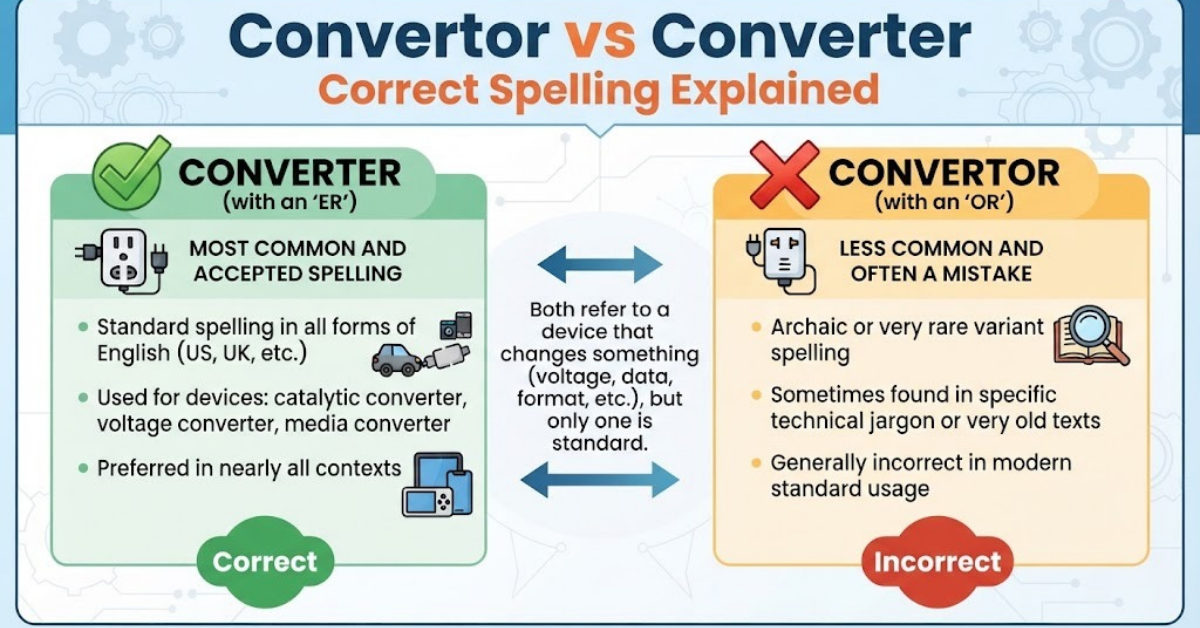
Both convertor and converter are correct English spellings. However, converter is the more widely used and preferred spelling in modern English.
The two words generally have the same meaning: a person or device that converts something from one form, type, or state into another.
For example:
- A currency converter changes one currency into another.
- A video converter changes a video file from one format to another.
- An electrical converter changes electrical energy from one form to another.
Although convertor is not technically incorrect, it is less common in everyday writing, technical documentation, and general communication.
| Word | Correct? | Usage |
| Converter | Yes | Standard and widely preferred |
| Convertor | Yes | Less common alternative |
| Conversion | Yes | The process of changing something |
| Convert | Yes | The verb meaning to change something |
Quick answer: Use converter unless a particular product, organization, or technical document specifically uses convertor.
What Does Converter Mean?
A converter is a person, device, tool, or program that changes something into a different form.
The word comes from the verb convert, which means to transform, change, or adapt something.
The meaning depends on the context in which the word is used.
Converter in Technology
In technology, a converter is often a software application or hardware device that changes data from one format to another.
Examples include:
- PDF converter: Changes documents into PDF files or converts PDFs into other formats.
- Video converter: Changes video files between formats such as MP4, AVI, and MOV.
- Image converter: Changes images between JPEG, PNG, WebP, and other formats.
- Audio converter: Changes audio files between MP3, WAV, FLAC, and other formats.
For example:
“I used an online video converter to change my MOV file into MP4.”
Converter in Electrical Engineering
In electrical engineering, a converter is a device that changes electrical energy from one form into another.
Common examples include:
- AC-to-DC converters
- DC-to-AC converters
- DC-to-DC converters
- AC-to-AC converters
A power converter may be used in electronic equipment, renewable energy systems, electric vehicles, and industrial machinery.
For example:
“The power converter transforms the incoming electrical supply into the voltage required by the device.”
Converter in Everyday Life
The word also appears in ordinary situations where one measurement, value, or system is changed into another.
Examples include:
- Currency converter
- Temperature converter
- Weight converter
- Length converter
- Unit converter
A currency converter, for instance, helps someone determine how much one currency is worth in another currency.
What Does Convertor Mean?
Convertor has essentially the same meaning as converter. It refers to something or someone that performs a conversion.
The spelling with an “o” instead of an “e” is an accepted variant, but it is considerably less common.
You may encounter convertor in:
- Certain technical publications
- Older texts
- Specialized product descriptions
- Some regional English usage
- Specific product names or company terminology
For example:
“The convertor changes the electrical input into the required output.”
The sentence is understandable and grammatically acceptable, but most modern writers would choose converter instead.
If you’re writing an article, report, email, or academic assignment, converter is generally the safer choice.
Why Is Converter More Common Than Convertor?
The preference for converter is largely a matter of established usage.
English contains many words that form nouns by adding the suffix “-er” to a verb. For example:
| Verb | Noun |
| Convert | Converter |
| Write | Writer |
| Teach | Teacher |
| Drive | Driver |
| Calculate | Calculator |
The “-er” ending commonly identifies a person or thing that performs an action.
The word converter follows this familiar pattern, which helps explain why it is widely accepted and easily recognized.
The alternative spelling convertor is also established, but it is less frequently used in contemporary English.
Convertor vs Converter in American and British English
One common question is whether convertor is the British English spelling and converter is the American English spelling.
The distinction is not that simple.
Both spellings can appear in British and American English. Unlike familiar spelling differences such as color and colour, the difference between convertor and converter is not a straightforward American-versus-British distinction.
In both varieties of English, converter is the more common form.
For example:
- American English: “The converter changes the file format.”
- British English: “The converter changes the file format.”
Both sentences use the standard, widely preferred spelling.
If you’re writing for an international audience, choosing converter will generally make your writing more familiar to readers.
Convertor vs Converter: Example Sentences
The following examples show how both words can be used in context.
Examples Using Converter
- “I downloaded a free PDF converter to edit my documents.”
- “The voltage converter allows the appliance to operate safely.”
- “You can use a currency converter to check exchange rates.”
- “The software includes a built-in image converter.”
- “The converter changed the file from WAV to MP3.”
Examples Using Convertor
- “The convertor is designed to transform the electrical input.”
- “This convertor supports multiple file formats.”
- “The engineer replaced the faulty convertor.”
- “The device functions as a voltage convertor.”
These examples illustrate that both forms communicate the same basic idea. However, the converter spelling is more conventional and is usually recommended for general writing.
Converter vs Conversion: What Is the Difference?
Although converter and conversion are related, they have different grammatical roles.
A converter is the person, device, or program that performs a change.
A conversion is the process or result of changing something.
For example:
- “The converter changed the file into a different format.”
- “The conversion took less than a minute.”
Here is a simple comparison:
| Word | Part of Speech | Meaning |
| Convert | Verb | To change something |
| Converter | Noun | Something that performs a change |
| Convertor | Noun | An alternative spelling of converter |
| Conversion | Noun | The process or result of changing something |
| Convertible | Adjective | Capable of being converted |
Understanding these related words helps you select the right term for your sentence.
How to Remember the Correct Spelling of Converter
If you frequently confuse convertor and converter, a simple spelling trick can help.
Think of the word convert and add “-er”:
Convert + er = Converter
The “-er” ending is common in English nouns that describe people or things performing an action.
You can also remember these familiar examples:
- Teach → Teacher
- Write → Writer
- Convert → Converter
This pattern makes the spelling easier to recognize.
Another useful strategy is to use the word in a sentence several times:
“The converter changes the file.”
“The currency converter calculates the exchange rate.”
“The electrical converter changes the voltage.”
Repeated exposure to the preferred spelling helps make it more familiar.
Common Mistakes to Avoid When Using Converter
Even though the spelling difference is small, a few mistakes can make your writing less consistent.
Here are some things to remember:
- Do not assume convertor is always incorrect. It is an accepted variant.
- Avoid switching between convertor and converter within the same article unless there is a specific reason.
- Use converter when writing for a general audience.
- Do not confuse converter with conversion. One performs the action, while the other describes the process or result.
- Follow the spelling used in official product documentation when referring to a specific device or brand.
Consistency is especially important in technical writing, where a single term may appear dozens of times.
Frequently Asked Questions
1. Is convertor or converter the correct spelling?
Both spellings are accepted in English. However, converter is more common and is generally the preferred spelling in modern writing.
2. Is convertor a real word?
Yes. Convertor is a recognized English spelling variant of converter. It has the same basic meaning but is used less frequently.
3. Why do people write convertor instead of converter?
Some writers encounter the alternative spelling in technical documents, product descriptions, or older texts. Others may simply use it because it resembles the word convert.
4. Is converter American or British English?
Converter is used in both American and British English. It is not an exclusively American spelling.
5. What is the plural of converter?
The plural is converters.
For example: “The laboratory uses several different converters.”
The plural of convertor is convertors.
6. What is the difference between converter and conversion?
A converter is a person, device, or program that changes something. Conversion refers to the process or result of that change.
For example, a currency converter performs a currency conversion.
7. Should I use convertor or converter in SEO articles?
Use converter as the primary spelling in most SEO articles because it is the more common form. You can mention convertor naturally when discussing spelling variations or answering a related search query.
Conclusion
When comparing convertor vs converter, both spellings are technically correct, but converter is the more widely accepted and commonly used form in modern English.
A converter is a person, tool, or device that changes something from one form into another. The alternative spelling, convertor, carries the same meaning but appears less frequently in general writing.
For everyday communication, professional documents, technical articles, and SEO content, converter is the recommended choice. Remember the simple pattern “convert + er,” and you’ll be less likely to make this spelling mistake.
If you’re interested in improving your English spelling and vocabulary, explore more guides covering commonly confused words and their correct usage.